
TL;DR
The female wedding ring market in 2026 looks nothing like it did even two years ago. Gold prices have surged past $4,700 per ounce, lab-grown stones now account for over half of all rings sold, and moissanite has gone from “budget alternative” to a genuine first choice for many buyers. This guide covers 13 distinct women’s wedding ring styles, with real pricing, honest trade-offs, and practical advice for choosing the right one.
Why the Wedding Ring Market Feels Different in 2026
The average woman’s wedding ring costs about $1,400 in 2026, with most bands falling between $600 and $1,800. But those numbers hide a major shift happening underneath.
Gold is trading at record highs around $4,700 per ounce, nearly double what it was in early 2025. That 70%+ jump in raw gold costs has pushed setting prices up 40% to 50% across the industry. A standard 14K gold setting that uses about 5 grams of gold simply costs a lot more to produce now.
At the same time, lab-grown stones accounted for roughly 47% to 52% of engagement rings sold in 2025, the first time they crossed the halfway mark. About two-thirds of Gen Z buyers chose them. Moissanite, which costs 90% less than diamond while actually producing more colorful fire, has become a mainstream option rather than a compromise.
Women’s bands have held somewhat steady in price because lab-grown diamond options and 10K gold have helped contain costs. If you’re shopping for a female wedding ring right now, you have more choices at more price points than any previous generation.
Exploring moissanite wedding rings? Browse a pavé moissanite ring available in 925 silver through 18K gold.
At-a-Glance Comparison: 13 Wedding Ring Styles for Women
| Style | Best For | Price Range | Pairs Well With | Trending in 2026? |
|---|---|---|---|---|
| Moissanite & Lab-Grown Diamond Rings (Avittam Diamond Jewels) | Budget-conscious buyers, ethical shoppers, custom requests | $150–$3,000 | Any style in this guide | Very |
| Classic Plain Band | Minimalists, active lifestyles | $200–$800 | Any engagement ring | Always |
| Pavé Band | Sparkle lovers, standalone wear | $300–$1,500 | Solitaire e-rings | Yes |
| Full Eternity Band | Maximum brilliance all around | $500–$2,500 | Plain e-ring settings | Yes |
| Half Eternity Band | Practicality + sparkle | $350–$1,800 | Most engagement rings | Yes |
| Vintage-Inspired Band | Nostalgia seekers, detail lovers | $400–$2,000 | Vintage or antique e-rings | Very |
| Halo Wedding Ring | Size-conscious buyers | $400–$2,500 | Standalone or stacked | Yes |
| Three-Stone Ring | Symbolism seekers | $500–$3,000 | Standalone wear | Yes |
| Curved / Contour Band | Flush-fitting pairs | $250–$1,200 | Protruding center stones | Yes |
| Solitaire Wedding Ring | One-ring-only wearers | $300–$2,000 | Standalone | Always |
| Wide / Statement Band | Bold, architectural taste | $400–$1,500 | Standalone | Very |
| Stackable Bands | Collectors, milestone markers | $150–$800 each | Other stackable bands | Very |
| Mixed-Metal Ring | Rule-breakers, versatile dressers | $350–$1,800 | Mixed jewelry collections | Very |
Now, each style in detail.
1. Moissanite & Lab-Grown Diamond Wedding Rings (Avittam Diamond Jewels)
Best for: Budget-conscious buyers who want diamond-level brilliance, broad metal options, and the flexibility of custom designs.
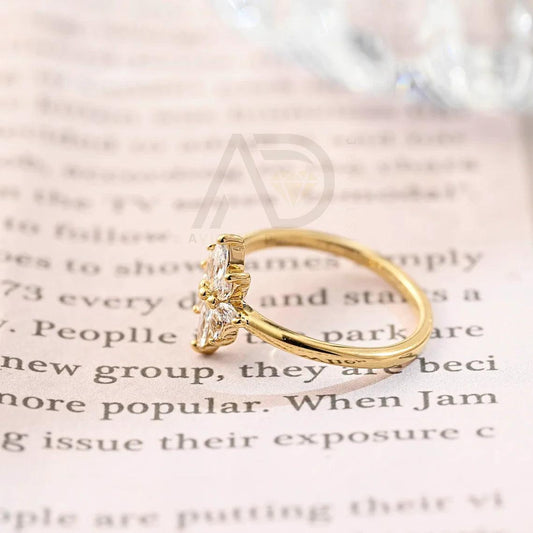
Avittam Diamond Jewels specializes in moissanite and lab-grown diamond wedding rings that span every style category in this guide, from pavé bands and hidden halos to three-stone settings and vintage-inspired designs. Every ring is offered in 925 sterling silver, 10K, 14K, or 18K gold in yellow, rose, and white tones, so buyers can match their aesthetic and budget without settling.
- Price: $150–$3,000 depending on stone type and metal. Moissanite rings start around $150 in sterling silver, while lab-grown diamond options range from $600 to $3,000. The metal step-up pricing is transparent on each product page, making it easy to see exactly what moving from silver to 14K gold adds.
- Customization: Send a photo of any design and the team will recreate it, with engraving available. Custom orders start at a $150 minimum, coordinated through WhatsApp or email, with no need for in-store visits.
- Shipping & warranty: Free worldwide shipping on all orders, with a limited lifetime warranty and a 30-day return window.
The collection covers the full spectrum of styles below (solitaire, pavé, halo, hidden halo, three-stone, eternity, contour, vintage) in moissanite and lab-grown diamond options. For women who’ve already decided on moissanite or lab-grown stones and want to compare settings side by side, browsing the full ring collection is the most efficient starting point.
2. Classic Plain Band
Best for: Women who want their ring to disappear into daily life.
The plain band is the foundation everything else builds on. Court profile (slightly domed), D-shape, or flat band, pick your cross-section and you’re done.
- Width: 2–3mm is the sweet spot for most women’s wedding rings. Slim enough to let an engagement ring take center stage, sturdy enough for decades of daily wear.
- Price: $200–$800 depending on metal. A 925 sterling silver band sits at the low end, while 14K and 18K gold push toward the higher range.
- Durability: Nothing to snag, nothing to lose. This is the lowest-maintenance option.
Honest take: A plain band can look underwhelming next to a sparkling engagement ring. But paired with a statement engagement ring, it provides breathing room that actually makes the whole set look more intentional.
For women with active jobs (nurses, mechanics, fitness instructors), this is often the only practical choice. No prongs to catch on gloves, no stones to worry about during deadlifts.
3. Pavé Band
Best for: Women who want continuous shimmer without a large center stone.
Small stones set closely into the band create an unbroken line of sparkle. The effect is subtle from a distance and striking up close.
- Stone options: Moissanite pavé is visually identical to diamond pavé at roughly 1/10th the cost. Unless someone examines the ring with a loupe, they cannot tell the difference.
- Price: $300–$1,500 for moissanite versions. Diamond pavé bands start around $1,000 and climb quickly.
- Versatility: Works beautifully as a standalone wedding ring or stacked with a solitaire engagement ring.
Trade-offs: Tiny pavé stones can occasionally come loose over years of wear. A good setting (micro-pavé vs. bead-set) matters enormously here. Also, pavé bands with stones all around are effectively eternity bands, which means they can’t be resized. Check whether the pavé extends partway or fully around before purchasing.
For a step-cut twist on the pavé look, baguette-accented designs offer a geometric alternative that’s trending heavily in 2026.
4. Full Eternity Band
Best for: Maximum brilliance from every angle.
Stones wrap entirely around the ring, so it sparkles no matter which direction your hand turns. The symbolism is obvious and genuinely beautiful: love without beginning or end.
- Price: $500–$2,500 depending on stone type and metal.
- Visual impact: The highest-sparkle option for a band-style ring.
The catch most articles won’t tell you: Full eternity bands cannot be resized. The stones run all the way around, so a jeweler can’t cut and re-solder the band without removing stones. Your fingers will change size over the years (weight fluctuation, pregnancy, aging, even weather). If you go this route, get your sizing extremely precise, and understand that you may need to replace the ring entirely if your finger size changes significantly.
Practitioners on jewelry forums frequently mention this as the number one regret for eternity band buyers. Beautiful ring, frustrating limitation.
5. Half Eternity Band
Best for: The practical majority of women.
Stones cover the top half (or three-quarters) of the band, with a smooth metal underside. You still get the sparkle where people actually see it, plus two significant advantages.
- Resizable: Because the lower portion is plain metal, a jeweler can resize it as your finger changes over the years.
- Comfortable: The smooth underside feels better against adjacent fingers, especially for women who work with their hands.
- Price: $350–$1,800. Generally 15-25% less than a comparable full eternity band because fewer stones are needed.
This is the style I’d recommend to most women who haven’t handled both versions in person. You sacrifice sparkle on the palm side of the ring (which nobody sees anyway) and gain practical comfort for decades of wear.
If you’re weighing this against a full eternity band, the wedding band and bridal set guide breaks down pairing options in more detail.
6. Vintage-Inspired Band
Best for: Women drawn to the craftsmanship of earlier eras.
Filigree, milgrain edging, hand-engraved patterns, Art Deco geometry. These rings draw from Edwardian, Victorian, and Art Deco periods, translating antique design language into modern construction.
- 2026 trend factor: Very strong. The Pinterest nostalgia wave has pushed vintage aesthetics into mainstream bridal jewelry.
- Price: $400–$2,000 depending on detail complexity and metalwork.
- Pairing: Pairs naturally with vintage or antique engagement rings, but also creates an interesting contrast with modern solitaires.
Worth noting: Intricate filigree can trap soap, lotion, and dirt more readily than smooth designs. Regular cleaning matters more with these rings. An ultrasonic cleaner works well for moissanite and gold, though you should avoid it for certain gemstone types.
For the Art Deco aesthetic specifically, a vintage cushion split-shank design captures that era’s geometry.
7. Halo Wedding Ring
Best for: Getting maximum visual size without maximum carat weight.
A center stone surrounded by a ring of smaller accent stones creates the illusion of a much larger diamond or moissanite. The halo catches light independently, making the overall ring appear significantly bigger than its center stone would suggest.
- Hidden halo variation: Accent stones sit underneath the center stone rather than around it. From the top, you see a clean solitaire. From the side, a ring of hidden sparkle. This is the modern evolution, and it’s been one of the fastest-growing styles.
- Price: $400–$2,500. The hidden halo version often costs slightly less because it uses smaller accent stones in a less visible position.
Trade-off: Halo settings collect dust and oil between the center stone and the surrounding ring. They need more frequent cleaning than simpler designs. Some women find the traditional halo too “busy” for a wedding band, which is exactly why the hidden halo exists.
Browse the hidden halo setting option to see the profile difference.
8. Three-Stone Ring
Best for: Women who want built-in symbolism.
Past, present, future. Three stones in a row, traditionally with a larger center stone flanked by smaller side stones. The combination of shapes (round center with pear side stones, cushion center with baguette accents) lets you create something unique without going fully custom.
- Price: $500–$3,000. The total carat weight is higher than a solitaire, which affects cost.
- Versatility: Works beautifully as a standalone ring, which matters if you prefer one ring instead of a traditional engagement-plus-band stack.
Downside: Three-stone rings sit higher on the finger than most bands. That raised profile means more snagging potential on pockets, gloves, and sweater knits. For an active lifestyle, this is worth considering.
A cushion three-stone with pear accents shows how mixed shapes add visual interest while keeping the classic three-stone structure.
9. Curved / Contour Band
Best for: Flush pairing with protruding engagement rings.
If your engagement ring has a large center stone, an oval or marquise shape, or a low-profile cathedral setting, a straight band leaves an awkward gap. Curved contour bands are designed with a gentle dip or sharp chevron point that hugs the engagement ring’s contours. The result looks intentional and bespoke.
- V-shape / chevron bands: The sharper, more angular version of the contour concept. Very popular in 2026, particularly in mixed-metal combinations.
- Price: $250–$1,200. Often simpler in stone count than eternity or pavé styles, which keeps the price lower.
- Important: These are designed for specific engagement ring profiles. Buying a contour band without checking it against your engagement ring is a gamble. Many jewelers (including custom shops) can match a contour to your specific ring.
Understanding how different wedding band shapes work with engagement rings matters here. The ring shape and silhouette guide explains the geometry behind each profile.
10. Solitaire Wedding Ring
Best for: Women who prefer one ring that does everything.
A single stone on a band. No side stones, no halo, no pavé. Just one beautiful center stone, and that’s the entire statement.
- The “one ring or two” question: Some women prefer wearing both an engagement ring and a wedding band. Others find two rings uncomfortable, distracting, or unnecessary. A solitaire ring can serve as both, which simplifies the decision and saves budget.
- Price: $300–$2,000 depending on stone size and metal.
- Sizing consideration: Solitaire settings with high prongs (like cathedral or basket settings) sit above the finger. For everyday comfort, lower-profile settings or bezel mounts work better.
A knife-edge solitaire design offers a sleek profile that wears comfortably as a solo ring.
11. Wide / Statement Band
Best for: Women with bold, architectural taste who want the ring to speak for itself.
The 2026 trend toward chunky, confident silhouettes has pushed wider bands (6mm and above) into the spotlight for women’s wedding rings. These bands make a statement without needing additional embellishment. Clean geometry, strong lines, substantial presence.
- Price: $400–$1,500. More metal means higher material cost, especially with gold prices where they are.
- Sizing is critical: A wider ring covers more skin, making it feel tighter than a slimmer band of the exact same size. Go up a quarter or half size for bands over 6mm. This is one of the most common mistakes in online ring orders.
Not for everyone. Wide bands can overwhelm smaller hands. If your finger is size 4 or 5, a 6mm band may visually dominate the hand in a way that feels disproportionate. Try before you commit, or at minimum, wrap a piece of tape that width around your finger to get a sense of scale.
12. Stackable Bands
Best for: Collectors who want their ring set to grow over time.
Instead of choosing one band, many brides are building collections that evolve with anniversary bands, milestone pieces, or simply new layers added for fun. Each ring tells a chapter.
- Price: $150–$800 per band. The appeal is that individual pieces can be modest, and the collection builds gradually over years.
- Mix-and-match potential: Different metals, different stone shapes, different widths. The intentional “not perfectly matched” look is part of the aesthetic.
- Practical note: Stacking three or more rings adds significant width to your finger. Each additional band also means more surfaces rubbing against each other, which can cause wear on softer metals like sterling silver.
Stackable bands are also the most forgiving option if your taste changes. You can rotate rings in and out, swap seasonal looks, or simply wear one ring on busy days and three on special occasions.
13. Mixed-Metal Ring
Best for: Women who refuse to follow matching rules.
Two-tone and tri-tone designs mix yellow gold with white gold, rose gold with platinum, or any combination that breaks the old “everything must match” convention. In 2026, women are constructing ring collections that express personal fashion rather than adhering to rules.
- Price: $350–$1,800. Mixed-metal construction is slightly more complex, which can add cost.
- Advantage: A mixed-metal wedding ring blends seamlessly with whatever other jewelry you already own. No more worrying about whether your watch is gold while your ring is silver.
- The yellow gold factor: Yellow gold’s comeback is not a fleeting trend. It signals a broader cultural shift toward warmer, more traditional aesthetics.
A two-tone hidden halo ring shows how mixing metals creates a fresh look while keeping the design cohesive.
How to Choose the Right Female Wedding Ring
With 13 styles laid out, the question becomes: which one is actually right for you? Here’s how to narrow it down.
Metal Choice: The 2026 Reality
Gold prices have rewritten the math on metal selection. Here’s what each tier actually means for your budget:
- 925 Sterling Silver: $150–$400 for most designs. Excellent starting point. Can tarnish over time, and some alloys contain nickel (more on that below). Needs occasional polishing.
- 10K Gold: The most underrated option. 41.7% pure gold, extremely durable, and significantly cheaper than 14K. Rising gold prices have made 10K a smart choice, not a compromise.
- 14K Gold: The industry standard. 58.3% pure gold, excellent balance of durability and gold content. Still the most popular, but costs have risen 40-50% since early 2025.
- 18K Gold: 75% pure gold. Richer color, softer metal, higher price. Best for women who prioritize appearance and don’t subject their rings to rough treatment.
White gold maintenance: White gold requires rhodium replating every 1-2 years to maintain its bright white appearance. Without replating, it gradually shows its natural yellowish tint. Yellow gold and rose gold avoid this ongoing cost entirely.
Nickel sensitivity: A concern that surfaces regularly in Reddit discussions about women’s wedding rings. Some women discover nickel allergies only after wearing a ring daily for weeks. Sterling silver and 10K gold can contain nickel in their alloy mix. If you have sensitive skin or known metal allergies, higher-karat gold (14K+) or platinum eliminates this risk.
Stone Choice: Moissanite vs. Lab-Grown Diamond vs. Natural Diamond
This is the biggest decision after style, and in 2026, there’s no wrong answer. Here’s a direct comparison:
| Factor | Moissanite | Lab-Grown Diamond | Natural Diamond |
|---|---|---|---|
| Hardness (Mohs) | 9.25 | 10 | 10 |
| Brilliance / Fire | More colorful fire | Identical to natural | Classic white sparkle |
| Price (1ct equivalent) | ~$300 | ~$1,000–$1,500 | ~$4,000+ |
| Resale value | Minimal | Low | Moderate |
| Durability edge | No cleavage planes | Cleavage planes exist | Cleavage planes exist |
Moissanite’s durability advantage goes deeper than the Mohs scale. Diamond has cleavage planes, which are internal weak spots where the stone can split if struck at the right angle. Moissanite is uniformly strong throughout, with no weak spots. For a ring worn every day, that matters.
For a thorough comparison, the moissanite vs. diamond guide covers the nuances in more depth.
Sizing: Width Matters More Than You Think
Most women’s wedding bands range from 1.5mm to 4mm in width, with 2–3mm being the most popular. At these widths, your standard ring size works fine.
Once you go above 5mm (which the wide band trend encourages), you need to size up. A 6mm band should be ordered a quarter to half size larger than your measured finger size. This catches many online buyers off guard.
Comfort-fit interiors (slightly domed on the inside) also affect how a ring feels. They slide on more easily and feel less constrictive, but they effectively make the ring slightly larger. If your jeweler offers a comfort-fit option, ask whether the stated size accounts for it.
Lifestyle Fit
Be honest about how you use your hands.
- Active lifestyle, manual work: Bezel settings, half eternity bands, or plain bands. Avoid high-set prongs.
- Desk work, low-impact days: Anything goes. Halo, three-stone, wide bands are all fine.
- Healthcare, food service, frequent glove use: Low-profile designs only. Pavé with a smooth surface works. Protruding settings do not.
What About Moissanite for a Wedding Ring?
Some buyers still hesitate here, so let’s address this directly.
Moissanite is a lab-created silicon carbide gemstone. It scores 9.25 on the Mohs hardness scale, making it the second-hardest gemstone used in jewelry (only diamond is harder). Its refractive index of 2.65–2.69 is actually higher than diamond’s 2.42, which means it produces more rainbow fire.
That rainbow fire is worth discussing honestly. In larger stones (over 2 carats), moissanite shows more colored light dispersion than diamond. Some buyers love this, describing it as more lively and interesting. Others find it “too sparkly” or noticeably different from diamond. In smaller stones (under 1 carat) and in pavé settings, the difference is essentially invisible.
Moissanite vs. cubic zirconia: This confusion persists, but the two are not comparable. CZ scratches, clouds, and yellows within 2-5 years of daily wear. Moissanite maintains its brilliance permanently. If someone tells you moissanite will “go cloudy,” they’re thinking of CZ. For a deep dive on this, the CZ vs. moissanite comparison lays out the differences clearly.
A moissanite wedding band typically runs 70–90% less than a comparable diamond design. That’s not a subtle savings. It’s the difference between a $300 ring and a $3,000 ring for stones that most people genuinely cannot tell apart in normal viewing conditions.
Practitioners on YouTube who’ve purchased and worn moissanite rings daily for extended periods consistently report that the stones hold up. No tarnishing, no dulling, no visible wear. One reviewer tested five 14K gold moissanite rings against her expectations and found them virtually indistinguishable from her diamond pieces in everyday lighting.
Making the Final Decision
There’s no universal “best” female wedding ring. There’s only the best ring for a specific woman’s hand, life, and budget.
If you’re torn between styles, consider starting with something versatile (a half eternity band or a pavé band) that pairs well with a future upgrade or addition. The stackable approach means your first ring doesn’t have to be your only ring.
If budget matters (and it should, given the current gold market), moissanite in 10K or 14K gold delivers extraordinary value. The quality gap between moissanite and diamond has functionally disappeared for everyday wear, and the cost gap remains enormous.
Ready to see the options? Explore the full collection of moissanite rings available in 925 silver, 10K, 14K, and 18K gold with free worldwide shipping.
Frequently Asked Questions
How much should a woman’s wedding ring cost in 2026?
The average sits around $1,400, with most bands ranging from $600 to $1,800. However, moissanite rings in 925 silver or 10K gold can bring that starting point well below $400 without sacrificing appearance or durability. With gold prices at record highs, choosing a lower karat or a silver base is a financially sound decision, not a downgrade.
Is moissanite durable enough for everyday wear as a wedding ring?
Yes. Moissanite ranks 9.25 on the Mohs hardness scale and has no cleavage planes (unlike diamond, which has internal weak spots). It resists scratches, chips, and breakage extremely well. It also maintains its brilliance permanently, unlike cubic zirconia, which clouds and yellows within a few years.
Can a full eternity band be resized?
No. Because stones run all the way around the band, the metal cannot be cut and re-soldered without removing stones. If your finger size changes (and over decades, it probably will), you’ll need a new ring. A half eternity band offers similar sparkle on the visible portion while remaining fully resizable.
What width should a woman’s wedding band be?
Most women choose 2–3mm. This width complements engagement rings without overwhelming the finger. If you’re drawn to the wider band trend (6mm+), order a quarter to half size larger than your measured size, because wider bands feel tighter due to increased skin contact.
Should I get one ring or a separate engagement ring and wedding band?
This is a personal decision that affects budget, comfort, and style. A single ring (solitaire or three-stone) simplifies daily wear and costs less overall. A two-ring set offers more variety and the ceremony tradition of adding the band. Neither approach is wrong, but few articles frame this as the deliberate choice it actually is.
What metal is best for a wedding ring if I have sensitive skin?
Avoid 925 sterling silver and 10K gold if you have known nickel sensitivity, as both alloys can contain nickel. 14K gold, 18K gold, and platinum are safer choices for reactive skin. If you’re unsure, wear a ring in the intended metal for several days before committing to a wedding band.
Why is yellow gold so popular again in 2026?
Yellow gold’s comeback reflects a broader cultural shift toward warmer, more traditional aesthetics. After years of white gold and platinum dominance, buyers are gravitating toward classic warmth. It also has a practical benefit: yellow gold doesn’t need rhodium replating like white gold does, reducing long-term maintenance costs.
How do lab-grown diamonds compare to moissanite for wedding rings?
Lab-grown diamonds are chemically identical to natural diamonds and score 10 on the Mohs scale. Moissanite scores 9.25 but has no cleavage planes, making it arguably tougher for daily wear. The biggest difference is price: lab-grown diamonds cost roughly 3-5 times more than moissanite for a similar visual result. Both are excellent choices for a women’s wedding ring.