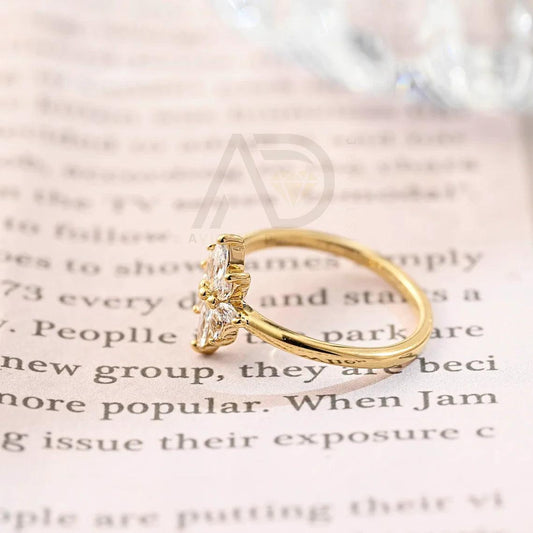

TL;DR
A marquise cut wedding ring features an elongated, boat-shaped stone with pointed ends and 58 facets. It looks about 15% larger than a round diamond of the same carat weight and costs up to 30% less. The shape flatters the finger, works beautifully in both traditional and east-west orientations, and pairs especially well with moissanite. The main things to watch for: the bow-tie shadow effect, chipping at the tips, and finding a wedding band that sits flush.
The marquise cut is one of those shapes that people either fall for instantly or overlook entirely. There’s rarely a middle ground. But if you’re reading this, something about that elongated, pointed silhouette caught your eye, and you want to know whether it’s the right choice for a wedding ring you’ll wear every day.
Good instinct. The marquise is having a genuine moment right now, and for reasons that go beyond trend cycles.
Considering a marquise-shaped ring with moissanite accents? Explore this marquise pavé moissanite ring for a sense of what the shape looks like in a real setting.
What Is a Marquise Cut?
The marquise cut (pronounced “mahr-keez”) is a fancy-shape diamond or gemstone with an elongated oval outline and two sharply pointed ends. The shape is sometimes called a navette, from the French word meaning “little boat,” because viewed from above, it resembles a slender hull.
Like a round brilliant, a marquise features 58 facets arranged across the table, crown, girdle, and pavilion. The brilliant facet pattern gives it strong fire and sparkle, though the way light performs in that elongated body is quite different from what you’d see in a round stone.
The anatomy has specific terminology worth knowing. The belly is where the stone curves widest, and that’s where the width measurement is taken. The points are the tapered tips at each end. The wing is the curved section running from the belly to each point. Understanding these parts matters when you’re evaluating symmetry or choosing a protective setting.
The origin story is surprisingly romantic. In the 1740s, King Louis XV of France reportedly asked a jeweler to craft a diamond that would capture the shape of his mistress’s lips. That mistress was Jeanne Antoinette Poisson, better known as the Marquise de Pompadour. Whether the legend is perfectly true or embellished over centuries, the name stuck.
What Makes the Marquise Shape Distinctive
A few things separate the marquise from every other diamond shape, and they matter practically, not just aesthetically.
The Size Illusion
A marquise cut diamond faces up roughly 15% larger than a round brilliant of the same carat weight. A 1.5-carat marquise can easily pass for a 2-carat round to the naked eye. This isn’t a trick or a marketing claim. It’s geometry: the elongated body distributes weight across a larger surface area rather than hiding it in depth.
For anyone shopping on a budget (and who isn’t?), this size advantage is one of the most compelling reasons to consider the shape.
Ideal Proportions
The sweet spot for length-to-width ratio falls between 1.75:1 and 2.25:1. Stones within this range look balanced, neither too stubby nor too narrow. Outside it, things start to feel off.
Depth should land around 58% to 62%, and table percentage between 53% and 63%. These numbers matter more than most shoppers realize, because they directly affect how light enters and exits the stone.
The Finger-Flattering Effect
The elongated silhouette visually lengthens the finger and makes it appear more slender. This is one of those things that sounds like marketing copy until you actually try one on. The effect is real, and it’s especially noticeable on shorter fingers where a round stone might sit more compactly.
Versatile Orientation
Most people picture a marquise set north-south, with the points aligned along the finger. That’s the classic look. But turn it 90 degrees into an east-west orientation, and the ring takes on a completely different personality: sleek, modern, unexpected. Celebrities like Catherine Zeta-Jones, Portia de Rossi, and more recently Selena Gomez have worn marquise rings that put this versatility on full display.
Advantages of a Marquise Cut for a Wedding Ring
Cost-Per-Carat Value
A marquise cut can cost up to 30% less than a round brilliant of equivalent carat weight. Combined with the face-up size advantage, this means you’re getting a stone that looks bigger and costs less. That’s a rare combination in the jewelry world.
If you’re comparing moissanite versus diamond, the savings compound even further. A moissanite marquise delivers intense brilliance at a fraction of diamond pricing, and the elongated facet pattern actually showcases moissanite’s higher refractive index beautifully. The fire in a well-cut moissanite marquise is genuinely striking.
Vintage Character with Modern Comeback Appeal
The marquise cut experienced peaks of popularity during the Art Deco period, when geometric shapes dominated jewelry design, and again in the 1970s when disco culture embraced the unconventional. It faded for a while as round and princess cuts dominated the 1990s and 2000s.
Now it’s surging again. Market data from early 2026 shows a 22% increase in searches for elongated diamond shapes compared to the prior year. Selena Gomez’s marquise engagement ring played a significant role in this, introducing the shape to millions of people who might never have considered it.
A vintage-inspired split shank design can capture some of that Art Deco spirit if you’re drawn to the era’s aesthetic.
It Stands Out
Walk into any jewelry store and you’ll see rows of round brilliants, a few ovals, maybe some cushion cuts. The marquise is rarer in retail displays, which means wearing one immediately sets your ring apart. That distinctiveness matters to a lot of buyers who don’t want the same ring everyone else has.
What to Watch Out For
The marquise is a beautiful shape, but it’s not without quirks. Ignoring these will lead to disappointment.
The Bow-Tie Effect
This is the first thing any jeweler should mention. The bow-tie is a dark shadow that appears across the center of the stone, roughly in the shape of (you guessed it) a bow tie. It happens when light doesn’t reflect evenly through the pavilion facets.
Here’s the nuance most guides miss: every marquise has some degree of bow-tie. A faint one adds depth and character. A pronounced one kills the stone’s brilliance and makes it look dark in the center. The problem is that no certificate or grading report will tell you how severe the bow-tie is. This varies stone by stone, even at identical proportions.
Practitioners on Reddit and jewelry forums consistently advise the same thing: always request a face-up photo or video before buying. You cannot judge a marquise by certification alone. A jeweler who willingly shares real photos and videos, rather than just spec sheets, is a jeweler worth buying from.
Chipping at the Points
Those elegant pointed ends are structurally vulnerable. A bump against a countertop or a car door can chip an unprotected tip. This is not a theoretical risk; it happens. The solution is choosing a setting that shields the points. V-prongs are the most popular protective option. Bezel settings provide even more coverage.
Symmetry Sensitivity
In a round diamond, minor symmetry flaws are hard to spot. In a marquise, even slight misalignment between the two points is immediately visible. The eye naturally draws a line from tip to tip, and if those points don’t align perfectly, the stone looks crooked.
Always check symmetry before purchasing. The points should mirror each other exactly when you look at the stone face-up.
No Standardized Cut Grade
Fancy shapes (anything that isn’t round) don’t receive standardized cut grades from major grading labs like GIA. This means you can’t rely on a “triple excellent” rating to ensure brilliance. You have to evaluate the stone visually, which is another reason why photos and videos are non-negotiable when shopping for a marquise cut wedding ring.
Color Shows More
The marquise’s large surface area and shallow cut mean body color is more visible than in a round brilliant. The tips, in particular, tend to concentrate color. This isn’t necessarily a problem, but it makes your metal choice more consequential. More on that in the metal section below.
Best Settings for a Marquise Wedding Ring
The setting does more than hold the stone. With a marquise, it affects protection, proportions, and daily wearability.
Solitaire with V-Tip Prongs
The classic choice. A six-prong setting with V-shaped prongs covering each pointed end gives maximum stone visibility while protecting the vulnerable tips. This is the most popular marquise setting for good reason: it lets the shape speak for itself.
Halo
A frame of smaller stones around the marquise amplifies sparkle, adds visual size, and creates a buffer that helps protect the tips. A halo can also soften a faint bow-tie by surrounding it with light. For anyone who loves maximum brilliance, this is hard to beat.
Bezel
A bezel setting wraps metal around the entire perimeter of the stone. It provides the most protection of any setting style and creates a sleek, modern look. If you’re active, work with your hands, or just don’t want to worry about catching a prong on something, a bezel-set marquise is the practical choice. You can see how a bezel-set ring works in practice, even in a different cut.
East-West Setting
Rotating the marquise 90 degrees so it sits horizontally across the finger is a growing trend. It looks contemporary and a little rebellious, completely changing the personality of the shape. This orientation also sits lower on the finger and is less likely to catch on things.
Hidden Halo
A row of tiny stones set beneath the center stone, visible only from the side. The hidden halo adds sparkle from unexpected angles without changing the ring’s top-down silhouette. A hidden halo with pavé band shows how this concept works, and it translates beautifully to marquise center stones.
Pairing a Marquise Ring with a Wedding Band
This is the section most guides skim over, and it’s the one marquise wedding ring buyers need most.
The pointed ends of a marquise stone create a practical problem: a straight wedding band often won’t sit flush against the engagement ring. The tip of the stone juts out and forces a gap between the two rings. Some people don’t mind this. Others find it maddening.
Contoured or Curved Bands
The most popular solution. A curved wedding band arcs gently around the point of the marquise, allowing both rings to sit snugly together with no gap. This creates a cohesive, finished look, especially when the curve mirrors the marquise’s angles.
If you’re planning a moissanite bridal set, consider buying the engagement ring and wedding band together so the curve is matched precisely.
Straight Band with Intentional Negative Space
Some couples actually prefer the gap. A classic straight band worn below a marquise engagement ring creates a small V-shaped space between the rings. This negative space can look deliberate and artistic rather than accidental, especially when the band is a simple, thin profile.
Marquise Accent Stones in the Band
Here’s something clever: using small marquise-shaped stones as accent elements in the wedding band itself. The shape echoes the center stone and creates visual continuity in the stack. This elongated cushion ring with marquise and round pavé stones shows how marquise accents work alongside other stone shapes.
Choosing Metal for a Marquise Ring
Metal choice matters more with a marquise than with most other shapes, and not enough people talk about this.
Because the marquise cut has a large face-up area and relatively shallow depth, it tends to show body color more readily. If your stone has any warmth to it (say, a G to I color grade in diamond terms, or a near-colorless moissanite), the metal surrounding it will either mask or emphasize that warmth.
Yellow gold and rose gold work beautifully with slightly warmer stones. The warm metal tone blends with the stone’s color rather than creating a stark contrast. This is actually one of the reasons vintage marquise rings in yellow gold look so harmonious.
White gold and platinum pair best with colorless or near-colorless stones. If you’re choosing a D to F color diamond or a colorless moissanite, white metal lets that icy brightness shine through.
Sterling silver offers an entry-level option for budget-conscious buyers who want the white metal look. It won’t have the heft of gold or platinum, but for a marquise moissanite ring, it can be a smart starting point.
Understanding the difference between wedding rings and wedding bands also helps when you’re coordinating metals across multiple pieces in a stack.
Marquise vs. Other Popular Shapes
Quick comparisons, because most shoppers are weighing the marquise against at least one alternative:
Marquise vs. Round: The marquise looks larger per carat and costs significantly less. The round offers more consistent brilliance and has a standardized cut grade, making it easier to evaluate on paper. If maximizing sparkle-per-dollar matters most, the round wins on sparkle consistency. If maximizing visual impact on a budget matters, the marquise wins.
Marquise vs. Oval: The oval is the marquise’s closest cousin. Both elongate the finger and face up large. The oval is softer, more balanced, and currently the single most popular fancy shape. The marquise is sharper, more dramatic, and less common. If you want to stand out, go marquise. If you want a crowd-pleaser, go oval.
Marquise vs. Pear: Both have at least one pointed end, but the pear is asymmetrical (one point, one rounded end) while the marquise is symmetrical at both ends. The marquise reads as more structured and formal. The pear has a playful, teardrop quality.
Marquise vs. Emerald: These are almost opposites. The emerald cut is about clean lines and mirror-like reflections (step-cut). The marquise is about fire and sparkle (brilliant-cut). The emerald won’t sparkle as much but offers a quiet, sophisticated elegance. Pick based on which personality speaks to you.
For shoppers comparing multiple cuts, a princess cut halo ring offers yet another perspective: geometric brilliance with sharp corners instead of pointed tips.
Why Moissanite Works Especially Well in a Marquise Cut
Most competing guides are diamond-centric, but this point deserves attention. Moissanite’s higher refractive index (2.65 vs. diamond’s 2.42) means it produces more fire, those colorful flashes of light that catch the eye. In an elongated marquise shape, this fire is distributed across a large surface area, creating an intense sparkle that’s genuinely impressive.
The price difference amplifies the marquise’s natural advantage. If a marquise already looks 15% bigger than a round of the same carat weight, and moissanite already costs a fraction of what diamond does, you’re stacking two value advantages on top of each other. A moissanite marquise wedding ring can deliver a look that would cost thousands more in diamond.
Practitioners on the r/Moissanite subreddit frequently recommend the marquise cut for moissanite specifically, noting that the elongated brilliant facet pattern showcases moissanite’s optical properties beautifully. The one thing to watch: moissanite has double refraction, which can create a subtle “doubling” effect when viewed from certain angles. In a marquise, this is rarely noticeable face-up, but it’s worth knowing about.
For a deeper dive into moissanite versus diamond across all the factors that matter, that comparison guide covers the full picture.
Practical Buying Tips for a Marquise Cut Wedding Ring
A few things that come from experience rather than textbooks:
-
Always view face-up photos or video. This bears repeating. The bow-tie effect, symmetry, and overall brilliance of a marquise can only be judged visually. A stone that looks perfect on a grading report can look lifeless in person, and vice versa.
-
Check point alignment carefully. Hold the stone (or image) at arm’s length. The two points should form a perfectly straight line. If one point drifts even slightly to one side, the stone will always look off-center in its setting.
-
Think about your lifestyle before choosing a setting. If you’re rough on your hands, skip the six-prong solitaire and go bezel or halo. Protecting those tips is not optional.
-
Buy the wedding band at the same time, or at least plan for it. The flush-fit challenge is real. Knowing whether you’ll want a curved band, a straight band with gap, or a custom contour will save you frustration later.
-
Don’t over-prioritize carat weight. Because the marquise already faces up so large, you can often go lower in carat weight than you’d think and still get the visual presence you want. A well-cut 1-carat marquise can look as impressive as a mediocre 1.5-carat stone.
Community members in Reddit’s r/jewelry thread noted that one of the biggest challenges with marquise rings is simply finding them. Many mainstream retailers don’t stock the shape widely, and the selection can be thin. This is where custom work or specialized jewelers become valuable. Avittam Diamond Jewels offers custom orders starting at $150 with coordination via WhatsApp or email, and rings are available in 925 silver, 10K, 14K, or 18K gold with free worldwide shipping.
Frequently Asked Questions
Is a marquise cut wedding ring old-fashioned?
Not at all. The marquise has cycled in and out of fashion since the 1740s. It peaked during the Art Deco era and again in the 1970s, and it’s experiencing a strong resurgence right now. Searches for elongated diamond shapes rose 22% in 2026. Selena Gomez’s marquise engagement ring accelerated the trend further. Calling it old-fashioned misses the point, it’s cyclical, and the cycle currently favors it.
Can moissanite be cut in a marquise shape?
Yes, and it’s a popular combination. Moissanite’s higher refractive index creates exceptional fire and sparkle in the elongated marquise facet pattern. Many buyers on the r/Moissanite subreddit specifically recommend marquise as one of the best shapes for moissanite because of how dramatically the optical properties show through.
Does a marquise cut look good on short fingers?
It’s actually one of the best shapes for shorter fingers. The elongated silhouette creates a visual lengthening effect that makes fingers appear more slender and longer. An east-west orientation can have a slightly different effect, widening the visual line across the finger, so consider which direction works best for your hand shape.
What wedding band works best with a marquise engagement ring?
A contoured or curved band is the most popular pairing because it arcs around the marquise’s pointed end for a flush fit. A straight band works too, but you’ll have a small gap between the rings, which can look intentional and elegant or frustrating depending on your preference. Try both before committing.
Why does my marquise diamond show a dark shadow in the middle?
That’s the bow-tie effect. It’s caused by light not reflecting evenly through the pavilion facets. A faint bow-tie is normal and even adds a bit of depth and character. A heavy, dark bow-tie is a dealbreaker and means the stone is poorly cut. This is why viewing photos or video before buying is essential, no grading report captures this.
Is a marquise cut more fragile than other shapes?
The pointed ends are more vulnerable to chipping than the edges of a round or cushion cut. The stone itself isn’t weaker, but those narrow tips are structurally thinner. Choosing a setting with V-prongs or a bezel eliminates most of the risk. With proper protection, a marquise is perfectly durable for daily wear.
How does a marquise cut compare in price to a round diamond?
A marquise typically costs up to 30% less per carat than a round brilliant. Since it also faces up about 15% larger for the same weight, you’re effectively getting more visual impact for less money. The value gap becomes even more dramatic when you choose moissanite over diamond.
What’s the best length-to-width ratio for a marquise?
The generally accepted sweet spot is between 1.75:1 and 2.25:1. Stones in this range look balanced and proportional. Below 1.75, the stone starts to look squat, almost like a fat oval. Above 2.25, it can appear too narrow and fragile. Personal preference matters here, but staying within that range is a safe bet.
Ready to explore the shape for yourself? Browse marquise-accented rings in Avittam’s collection, or reach out via WhatsApp or email for a custom marquise wedding ring designed to your exact specifications.