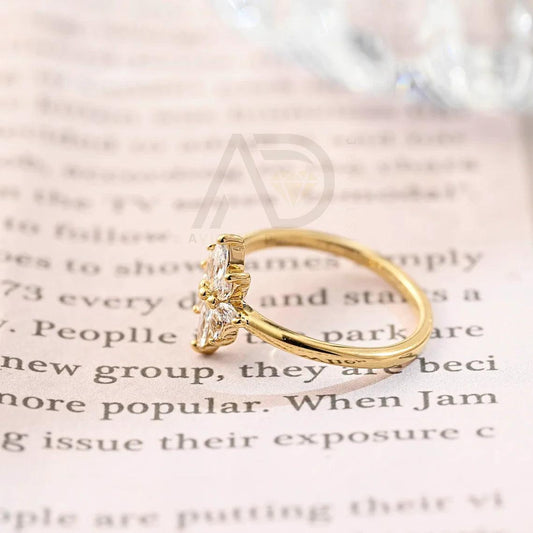

TL;DR
A marquise wedding band set pairs a marquise-cut engagement ring with a band designed to sit flush against its elongated, pointed shape. The marquise cut creates unique pairing challenges (gaps, spinning, tip vulnerability) that make buying a pre-matched set smarter than assembling pieces separately. This glossary covers every term you need, from bow-tie effect to V-prongs, so you can shop with confidence whether you’re choosing diamond, moissanite, or lab-grown stones.
The marquise cut has been turning heads since roughly 1745, when King Louis XV of France asked a jeweler to create a diamond shape that echoed the lips of his mistress, the Marquise de Pompadour. Nearly three centuries later, the shape still commands attention for the same reason: it’s dramatic, elongated, and makes the finger look longer and more slender than almost any other cut.
But that drama comes with complications. The pointed tips, the elongated profile, the way the stone sits high on the finger, all of it means a marquise engagement ring is harder to pair with a wedding band than a round or princess cut. Standard straight bands leave a gap. The wrong prong style leaves the tips exposed. And if the set isn’t designed as a unit, the rings can shift and spin independently throughout the day.
That’s why the terms below matter. They’re the vocabulary of getting this right. Whether you’re shopping for a marquise bridal set, building a custom stack, or just trying to understand what a jeweler is talking about, this glossary covers it.
If you’re exploring moissanite bridal sets, this guide will give you the foundation to make informed decisions about marquise shapes specifically.
The Shape
Marquise Cut
An elongated diamond or gemstone shape with 58 facets, two pointed ends, and curved sides that taper to those points. The outline resembles a football or, more poetically, a boat hull. The name comes from the French aristocratic title “marquise” (a rank above count, below duke), because courtiers at the French court wore this cut to signal their status. The shape maximizes carat weight across the surface area, so a 1-carat marquise looks noticeably larger than a 1-carat round.
Navette
The alternate name for the marquise shape, from the French word meaning “little ship.” You’ll encounter this term in vintage jewelry descriptions and European retailers more than American ones, but it refers to exactly the same cut. If you see a “navette wedding set” listed online, it’s a marquise wedding band set by another name.
Length-to-Width Ratio
The proportion that defines how elongated a marquise stone appears. Divide the length (tip to tip) by the width (across the center). The classic sweet spot falls between 1.85:1 and 2.10:1, though stones cut anywhere from 1.6:1 to 2.2:1 are common in GIA submissions. A ratio below 1.7 starts looking stubby. Above 2.2, the stone can appear thin and fragile. This ratio also affects how your wedding band fits: wider marquise stones need more contour in a curved band, while narrower ones sometimes pair fine with a gentle notch.
One thing most guides skip: the GIA does not assign a formal cut grade to marquise diamonds. Any retailer advertising a “GIA-certified excellent cut” on a marquise is giving you their own opinion, not an official grade. Keep that in mind when comparing stones.
Bow-Tie Effect
A shadow shaped like a bow tie that appears across the center of a marquise stone when light leaks through poorly angled facets. Every elongated cut (oval, pear, marquise) shows some degree of this. A faint bow tie actually adds character and depth. A severe one means the stone was cut poorly, and it will look dark across the middle in any lighting.
Precision-cut moissanite tends to show less bow-tie than natural diamond marquise stones, because the cutting process is more controlled. If you’re comparing stones in person or on video, tilt them under light and watch the center. That will tell you more than any certificate.
Symmetry
Both pointed tips of a marquise stone should align perfectly on a central axis, and the two curved sides should mirror each other. This sounds obvious, but even small misalignments are easy to spot in marquise cuts because the shape is so linear. One tip sitting slightly higher, or one curve bulging more than the other, creates a visibly lopsided look in the final setting. Excellent or very good symmetry isn’t optional for this shape. It’s necessary.
North-South vs. East-West Orientation
The traditional way to wear a marquise is north-south, with the points aimed toward the fingertip and knuckle. This maximizes the elongating effect on the finger. East-west orientation, where the stone sits horizontally across the finger, is a growing trend (some retailers are calling it one of the biggest moissanite engagement ring trends heading into 2026). Orientation matters for your wedding band set because it completely changes how the band needs to contour. A north-south marquise needs a band that curves around the lower point. An east-west marquise can often sit alongside a straight band without any gap at all.
The Set
Wedding Band Set (Bridal Set)
A combination of an engagement ring and a matching wedding band, designed and sold together as a pair. For marquise shapes specifically, buying a matched set solves problems that are genuinely difficult to fix after the fact. As Jared’s buying guide puts it, buying a wedding band separately could prove difficult if you have to work around certain diamond shapes like a marquise or a pear. A set ensures the rings are created to be worn together.
Practitioners on Reddit consistently identify the gap between rings as the number one pain point for marquise ring owners. A pre-matched marquise bridal set eliminates this problem entirely because the band is engineered around the specific stone profile.
Wedding Set
Sometimes used interchangeably with “bridal set,” but technically a wedding set can refer to three rings: the engagement ring, the bride’s wedding band, and the groom’s matching band. The distinction is minor and varies by retailer. In the US, “bridal set” is the more common retail term for the two-ring combination.
For a deeper look at how wedding rings and wedding bands differ in general, there’s a useful breakdown in this guide on wedding band vs. wedding ring.
Ring Stack
Multiple bands worn together on the same finger, either flanking an engagement ring or worn independently. Stacking has become a major trend because it lets you add rings over time (anniversary bands, push presents, milestone markers). A marquise ring stack might include a contoured band below the engagement ring and a chevron band above it, creating a symmetrical frame around the center stone.
Ring Enhancer (Ring Guard)
A single piece of jewelry that consists of two fused bands with a channel between them. Your engagement ring slides into the channel, and the enhancer wraps around both sides of the center stone. For marquise shapes, enhancers can be spectacular because they frame those dramatic pointed tips. The downside: they add bulk. If you already have a wide marquise stone, an enhancer can make the whole arrangement feel heavy on the finger.
The Fit
Flush Fit
The holy grail for most marquise wedding band set shoppers: zero visible gap between the engagement ring and wedding band when worn together. Achieving flush fit depends on two things. First, the setting height of the engagement ring. Higher-profile settings give the band room to slide underneath the stone. Second, the band shape. Lower-profile marquise settings almost always need a curved or notched band to sit flush.
Contoured Band (Curved Band)
A wedding band with a gentle curve cut into one edge, shaped to trace the outline of the engagement ring’s center stone. For a marquise set, a well-designed contoured band follows the lower tip of the marquise so closely that the two rings look like they were cast as one piece. This is the most popular band style for marquise pairings, and for good reason. It solves the gap problem without adding visual complexity.
Chevron Band (V-Shaped Band)
An angular band that comes to a point, mirroring the geometry of the marquise’s tips. Where a contoured band curves, a chevron band makes a sharp V. The look is more modern and geometric. Stacking a chevron band above and below a marquise engagement ring creates a symmetrical crown effect that’s become extremely popular on social media. In her YouTube walkthrough, jewelry designer Cassandra demonstrated how chevron pairings with marquise rings can create a visual line that extends the stone’s tapered silhouette, making the whole arrangement feel intentional and architectural.
Straight Band
A flat, uncontoured wedding band. With a high-set marquise engagement ring, a straight band can work perfectly well because the stone clears the band’s top edge. With a low-set marquise, though, you’ll get a noticeable gap between the rings. Some people embrace this gap as a deliberate design choice. Others find it annoying. If you go this route, know what you’re choosing.
Notched Band
A custom-cut band where small sections of metal are removed to accommodate specific prongs or setting elements on the engagement ring. Less common than contoured bands but useful when the engagement ring has unusual prong placement or a complex halo that prevents a standard curve from sitting right.
The Setting
V-Prong
A prong shaped like the letter V that cups the pointed tip of a marquise stone, covering and protecting it from chipping. This is not optional. The sharp points of a marquise cut are the most vulnerable part of the stone. Strike your hand against a counter, and an unprotected tip can chip or fracture. A master jeweler always secures marquise tips with V-prongs or sturdy double-claw prongs. If a ring leaves the tips exposed, it is not designed for a lifetime of wear.
Bezel Setting
A thin metal rim that wraps entirely around the stone’s perimeter, holding it in place without any prongs. Bezel-set marquise rings offer maximum protection and a sleek, contemporary look. The tradeoff is that the metal rim covers some of the stone’s edge, reducing the amount of light entering from the sides. For someone who works with their hands, a bezel-set marquise is worth serious consideration.
Explore a bezel-set ring design to see how this setting style frames a stone in practice.
Halo Setting
A ring of small accent stones (melee) surrounding the center marquise, amplifying its visual size and adding sparkle. Halos work particularly well with marquise cuts because they follow the stone’s elongated outline, creating a larger and more dramatic footprint on the finger. The downside: halos add width and can make band pairing trickier.
Hidden Halo
A row of tiny accent stones set beneath the center stone, visible only from the side profile. Hidden halos add sparkle without increasing the ring’s top-down footprint, which makes band pairing easier than a traditional halo. This is a smart choice if you want extra brilliance but also want your marquise wedding ring set to sit together without complicated contouring.
See how hidden halo designs add that side-profile sparkle while keeping the top profile clean.
The Stone
Moissanite
A lab-created gemstone (silicon carbide) scoring 9.25 to 9.5 on the Mohs hardness scale, making it the second hardest gemstone used in jewelry after diamond. Its refractive index of 2.65 to 2.69 actually exceeds diamond’s 2.42, which means moissanite throws more fire and rainbow flashes than a diamond of the same size. That higher fire is especially visible in the marquise cut, where the elongated facet pattern amplifies dispersive light.
Budget-conscious buyers on forums frequently point out that moissanite marquise stones appear larger than equivalent-carat rounds due to the elongated surface area, making the combination of moissanite and marquise shape arguably the strongest value play in engagement rings. In 2026, premium moissanite marquise engagement rings typically cost between $300 and $2,000, roughly 10 to 20 percent of a comparable natural diamond.
Unlike some gemstones, moissanite won’t cloud or lose its brilliance over time. Its refractive index is a permanent property of the crystal structure. For a thorough comparison, check out this guide on moissanite vs. diamond.
Lab-Grown Diamond
A diamond created in a laboratory using either High Pressure High Temperature (HPHT) or Chemical Vapor Deposition (CVD) methods. Same crystal structure, same hardness (10 Mohs), same optical properties as mined diamonds. They cost significantly less, typically 30 to 50 percent of equivalent natural stones. Lab-grown marquise diamonds are graded the same way as natural ones, with the same caveat that GIA doesn’t issue a cut grade for this shape.
For more detail on how lab-grown stones compare to moissanite, there’s a practical buyer’s guide that breaks down the differences.
Melee Diamonds
The tiny accent stones (typically under 0.20 carats each) set into bands, halos, and pavé channels. In a marquise wedding band set, melee stones usually appear in the band rather than the engagement ring’s main setting. SI1 to SI2 clarity is standard for melee and perfectly eye-clean at that size. Don’t overpay for high clarity grades in accent stones. Nobody is examining your band’s 1.5mm side stones with a loupe.
Practical Terms
Metal Matching
Wearing rings of different metal alloys together causes the harder metal to slowly abrade the softer one. Pairing a platinum band with an 18k gold engagement ring, for instance, will gradually wear away the gold over years of daily contact. The prevention is straightforward: match your metal alloys across all rings in the set. Pair 14k gold with 14k gold, platinum with platinum. This is especially important for marquise ring sets because the contoured band presses tightly against the engagement ring, maximizing friction between the two surfaces.
Rhodium Plating
White gold isn’t naturally white. It’s yellow gold alloyed with white metals (palladium, nickel, or silver) and then electroplated with rhodium, a platinum-group metal, to achieve that bright white finish. The plating wears off over time, revealing a slightly yellowish tone underneath. Expect to get your white gold rings replated every 12 to 18 months. This is normal maintenance, not a defect, but it’s a detail most shoppers don’t learn about until after the purchase.
Soldering
Permanently fusing two rings together by a jeweler, creating a single unit that moves as one piece on the finger. For marquise sets, soldering offers two benefits: it prevents the gap between rings from opening up during wear, and it stops both rings from spinning independently. The downside is obvious. You can no longer wear the rings separately. Most couples who solder their marquise sets have already worn them stacked for a while and decided they never want to separate them.
Ring Spinning
When a ring rotates on the finger so the center stone shifts off-center, facing sideways or even toward the palm. Marquise cuts are particularly prone to spinning because the elongated stone creates a top-heavy profile. The weight distribution is uneven, and on thinner bands, gravity pulls the heavier side downward. A matched marquise wedding band set helps stabilize the engagement ring because the contoured band acts as a physical stop, preventing rotation. This is one of the most practical (and rarely discussed) reasons to buy a set rather than mismatched pieces.
Pavé Band
A band set with continuous rows of tiny diamonds or moissanite stones held in place by small metal beads or prongs. The word comes from the French “pavé,” meaning paved, because the stones cover the band like cobblestones on a street. Pavé bands are one of the most popular companions for marquise engagement rings because the small, consistent sparkle complements the center stone’s dramatic shape without competing with it.
Avittam Diamond Jewels offers several designs featuring marquise pavé accents that show how pavé detailing works alongside different stone shapes.
Eternity Band
A ring set with stones all the way around its circumference, symbolizing unending commitment. Eternity bands are gorgeous but come with a sizing limitation: because stones cover the entire band, resizing is either impossible or extremely difficult. If your finger size might change (weight fluctuation, pregnancy, aging), consider a half-eternity band instead, where stones cover only the top half.
Band Width
For marquise pairings, bands between 1.5mm and 2.5mm tend to work best. Narrower bands keep the visual focus on the marquise stone and feel lighter on the finger. Wider bands (3mm and above) can look heavy and competitive with more modestly sized marquise centers. If your marquise stone is 1.5 carats or larger, you have more room to go wider, but even then, the elongated stone shape generally pairs better with thinner, more delicate bands.
Why Sets Matter More for Marquise Than Other Shapes
This point deserves its own section because it’s the central argument for buying a pre-matched marquise wedding band set rather than shopping for pieces independently.
Three problems are specific to (or amplified by) the marquise shape:
The gap problem. A standard straight band won’t sit flush against most marquise engagement rings. The lower pointed tip protrudes below the band line, creating a visible wedge of space between the two rings. Contoured and chevron bands solve this, but only if they’re designed for the exact proportions of your stone. A set guarantees the match.
The spinning problem. Marquise stones sit top-heavy on the finger. Without a stabilizing band pressed against the engagement ring, the stone rotates throughout the day. Practitioners on Reddit report this as one of the most common frustrations with marquise solitaires, and a well-fitted contoured band acts as a physical brace.
Replacement difficulty. If you need to replace a marquise center stone down the line, matching the exact shape, color, and length-to-width ratio is surprisingly difficult. Buying a complete set from a single jeweler means you have a consistent record of your stone’s specifications.
For those exploring custom options, Avittam Diamond Jewels accepts custom design orders (minimum $150) and can work with you to create a marquise ring set in 925 silver, 10K, 14K, or 18K gold across yellow, rose, and white tones, with free worldwide shipping.
Putting It All Together
Knowing these terms transforms the shopping experience. Instead of staring at product listings wondering what “contoured flush-fit pavé band with V-prong marquise solitaire” means, you can evaluate whether the contour matches your stone’s proportions, whether the V-prongs are substantial enough to protect the tips, and whether the pavé stones are appropriately sized for the band width.
The marquise shape rewards careful pairing more than any other cut. Get it right, and the set looks like a single, unified piece of jewelry. Get it wrong, and you’ll spend years annoyed by a gap, a spin, or a chipped tip.
If you’re ready to explore designs that complement marquise-shaped stones, browse vintage-inspired moissanite settings or reach out about a custom marquise wedding band set through Avittam’s WhatsApp or email support.
Frequently Asked Questions
What is the difference between a bridal set and a wedding set?
A bridal set is an engagement ring paired with a matching wedding band, sold as a two-ring combination. A wedding set sometimes refers to three rings: the bride’s engagement ring, the bride’s wedding band, and the groom’s matching band. In practice, many retailers use the terms interchangeably. For marquise shapes, what matters most is that the engagement ring and band were designed together, regardless of what the retailer calls the package.
Why does my marquise engagement ring spin on my finger?
Marquise stones are elongated and top-heavy, which creates an uneven weight distribution on the band. Gravity pulls the heavier stone side downward, causing the ring to rotate. A contoured wedding band pressed against the engagement ring acts as a stabilizer. Soldering the two rings together is the permanent fix.
Can I use a straight band with a marquise engagement ring?
Yes, if the engagement ring has a high-profile setting that lifts the marquise stone well above the band line. In that case, a straight band can slide underneath without hitting the stone or creating a large gap. Low-set marquise rings almost always need a curved or chevron band for a flush fit.
Is moissanite a good choice for a marquise wedding band set?
Moissanite is an excellent choice for marquise sets. It scores 9.25 to 9.5 on the Mohs hardness scale, making it extremely scratch-resistant for daily wear. Its higher refractive index (2.65 to 2.69 versus diamond’s 2.42) means it throws even more fire and brilliance. Precision-cut moissanite also tends to show less bow-tie effect than many natural marquise diamonds, and costs roughly 10 to 20 percent of a comparable natural diamond.
What band width works best with a marquise engagement ring?
Most marquise rings pair well with bands between 1.5mm and 2.5mm. Narrower bands keep the focus on the center stone. Go thicker only if the marquise is large enough (1.5 carats or more) to visually balance a wider band.
How do I prevent gaps between my marquise engagement ring and wedding band?
Buy a matched set where the band is specifically contoured to the engagement ring’s stone profile. If you already own a marquise engagement ring and need to find a band, bring it to a jeweler who can trace the stone’s outline and create a custom contoured or chevron band. Alternatively, a ring enhancer wraps both sides of the stone, eliminating the gap entirely.
Does the orientation of my marquise stone affect band pairing?
Significantly. A north-south marquise (points toward fingertip and knuckle) requires a contoured or chevron band to avoid gaps at the lower tip. An east-west marquise (horizontal across the finger) often pairs comfortably with a straight band because the stone’s profile doesn’t protrude below the band line. Always consider orientation before choosing your band style.
Should I solder my marquise wedding band set together?
If you always wear both rings and you’re frustrated by spinning or shifting, soldering is a practical solution. It prevents the gap from reappearing and keeps both rings aligned. The only real downside is that you lose the flexibility to wear them separately. Most couples try wearing the set stacked for several months before committing to soldering.