
TL;DR
You don’t need thousands of dollars to get a beautiful engagement ring. Moissanite rings in sterling silver or 10K gold start around $150 and offer more sparkle than diamond at a fraction of the cost. This guide covers eight engagement ring styles, all available under $500, with honest advice on which stones, metals, and settings give you the most ring for your money.
You Can Get a Stunning Engagement Ring for Under $500. Here’s How.
The average American spent about $4,600 on an engagement ring in 2025. That number is misleading. A growing number of couples are spending a fraction of that and ending up with rings that look just as good on the finger.
The secret? Moissanite and smart metal choices.
Moissanite costs 70-90% less than comparable diamonds and actually produces more fire (those colorful flashes of light that make people stare). It scores 9.25 on the Mohs hardness scale, harder than sapphire, tough enough for a lifetime of daily wear. Practitioners on Reddit’s r/Moissanite community consistently report that stones under 1.5 carats are nearly indistinguishable from diamond to anyone who isn’t a gemologist with a loupe.
Pair moissanite with 925 sterling silver or 10K gold, and you’re looking at engagement rings starting from $150 that genuinely rival rings costing ten times more. Gold prices have surged past $4,700 per ounce in 2026 (up over 70% from early 2025), which makes these lower-cost metal options even more relevant than they were a year ago.
Browse moissanite engagement rings starting from $150 in silver through 18K gold.
At-a-Glance: 8 Engagement Ring Styles Under $500
| Style | Best For | Starting Price (Moissanite/Silver) | Maintenance | 2026 Trend | Pairs Well With |
|---|---|---|---|---|---|
| Solitaire | Timeless minimalist | ~$150 | Low | Steady (40% of sales) | Any band style |
| Hidden Halo | Modern romantic | ~$200 | Medium | Rising fast | Thin pavé band |
| Classic Halo | Maximum perceived size | ~$250 | Higher | Declining (5.3%) | Plain metal band |
| Pavé Band | Sparkle lovers | ~$200 | Medium-High | Steady | Matching pavé band |
| Three-Stone | Sentimental buyer | ~$300 | Medium | Up 26% YoY | Simple curved band |
| East-West | Fashion-forward | ~$250 | Low-Medium | Surging | Stackable thin bands |
| Vintage / Art Deco | Old-soul romantic | ~$300 | Medium | Up 36% YoY | Milgrain band |
| Bezel Set | Active lifestyle | ~$200 | Very Low | Rising | Flush-fit band |
Every style listed above is available under $500 in 925 sterling silver or 10K gold with moissanite. Stepping up to 14K or 18K gold pushes some styles above $500, but silver and 10K options keep all of these firmly in budget territory.
1. The Classic Solitaire (From ~$150)
Best for: The buyer who wants the stone to do all the talking, without spending a paycheck.
The solitaire accounts for 40.3% of all engagement ring designs sold in 2025. One stone, clean lines, nothing competing for attention. It also happens to be the most affordable setting type because there are no accent stones adding to the cost.
At around $150 in sterling silver with a moissanite center stone, this is the lowest entry point for a ring that looks genuinely elegant. Move to 10K gold and you’re still well under $500.
Why it works on a budget:
- Fewer stones means a lower price, period
- Maximum light exposure to the center stone, so a well-cut moissanite absolutely blazes
- Easiest setting to resize if you guess wrong on the finger size
- Stacks naturally with almost any wedding band
- Simple to upgrade the metal later if you start with silver
Honest downsides:
- The stone sits exposed. A princess-cut solitaire without corner-protecting prongs is asking for trouble, chips happen.
- Some buyers find it too plain after a few years, though that’s personal taste rather than a design flaw
Budget pick: A knife-edge solitaire adds subtle visual interest to the band while keeping the minimalist profile. The tapered edge catches light differently than a flat band and creates the illusion of a thinner, more delicate ring. Starting around $150 in silver, this is one of the best value picks in the entire collection.
Metal tip: 10K gold gives you real gold at the lowest gold price point. At 41.7% pure gold, it’s actually harder and more scratch-resistant than 14K or 18K. Most people genuinely cannot tell the difference on a finger.
2. The Hidden Halo (From ~$200)
Best for: Buyers who want understated elegance with a secret detail, without paying halo prices.
This is the design that keeps showing up in ring-shopping threads on Reddit, and the praise is remarkably consistent. Practitioners on r/EngagementRings call the hidden halo the “best of both worlds” pick: solitaire elegance from the top view, surprise sparkle when viewed from the side or below.
Small accent stones sit beneath the center stone, invisible when looking straight down at the ring. The effect is a clean, modern face-up appearance with a flicker of extra brilliance when the hand moves. Starting around $200 in silver, it’s only slightly more expensive than a solitaire but feels significantly more custom.
Why it works on a budget:
- Adds perceived size to the center stone without the “busy” look of a full halo
- Photographs well from multiple angles (a bigger deal than most people realize before they start posting photos)
- Gives the ring a custom, thoughtful quality at a fraction of what custom typically costs
- The accent stones are small, so they add minimal cost compared to a full halo
Honest downsides:
- That underside space where the accent stones sit is where dust, lotion, and hand soap love to collect. You’ll need to clean it more often than a plain solitaire.
- The hidden detail is, well, hidden. Some wearers wish the accent stones were more visible.
See a princess-cut hidden halo with accent stones that catch light from every angle.
A cushion hidden halo with pavé band combines two trending elements into a single ring, adding continuous shimmer along the band while keeping the top profile clean. In silver, this combination still comes in under $500.
3. The Classic Halo (From ~$250)
Best for: Budget buyers who want the biggest possible look from a smaller center stone.
Here’s the honest truth about halos: they’ve declined to just 5.3% of sales in 2025, down from 9% the year before. But for buyers watching their spending, halos remain one of the smartest choices available.
A halo ring achieves something no other setting can. It makes a 0.7-carat center stone look like a full carat by surrounding it with a frame of smaller accent stones. You get the same finger coverage for significantly less money than a larger solitaire. That’s not a style trick, it’s a genuine mathematical advantage for anyone on a budget.
Why it works on a budget:
- The best “wow factor per dollar” of any setting style
- Creates a soft, glowing effect around the center stone
- A smaller (and cheaper) center moissanite looks bigger than it is
- Works especially well with round and cushion shapes
Honest downsides:
- Those tiny accent stones can loosen over time, especially if the ring takes daily wear. Annual professional checks are wise.
- Cleaning a halo thoroughly requires a soft brush and patience; quick wipes won’t reach between the stones.
- Trend-sensitive buyers may feel the style dates faster than a solitaire
For a dramatic take on this style, a double pavé halo princess ring doubles the accent frame for even more presence on the finger. Even with the extra detail work, this stays well under $500 in silver.
Trend note: Some industry observers predict a halo revival tied to the old money and vintage aesthetics gaining traction in 2026. The style may cycle back, just in more refined, thinner iterations than the chunky halos of a decade ago.
4. The Pavé Band (From ~$200)
Best for: Sparkle lovers who want continuous shimmer without a premium price tag.
Pavé (pronounced “pah-vay”) means the band itself is set with tiny stones, creating an unbroken line of sparkle from the center stone down the shoulders of the ring. The effect under natural light is striking, almost like the band is made of light itself.
With moissanite pavé stones, you get this effect at a fraction of what diamond pavé costs. The tiny accent moissanites are so affordable that adding them to the band barely moves the price.
Why it works on a budget:
- Adds sparkle without increasing the visual weight of the center stone
- Complements virtually any center stone shape or setting style
- Half-pavé (stones on the top half only) is more comfortable for daily wear and more affordable
- Moissanite pavé accent stones cost pennies compared to diamond accents
Honest downsides:
- Full pavé bands (eternity style, with stones all the way around) cannot be easily resized because of the continuous stone setting. If there’s any doubt about ring size, stick with half-pavé.
- Individual pavé stones can come loose with heavy daily use. Healthcare workers, gym enthusiasts, and anyone who works with their hands should consider this.
- Prong-set pavé is more sparkly but catches more lint and fibers. Channel-set pavé is smoother but slightly less fiery.
A classic pavé princess ring offers this continuous shimmer effect with a clean, geometric center stone. It’s one of those combinations that works in person even better than in photos.
Sizing tip: If you’re choosing between half-pavé and full eternity pavé, ask yourself honestly: “Am I 100% certain of my ring size?” If the answer is anything short of absolute confidence, half-pavé is the safer and more practical choice.
5. The Three-Stone Ring (From ~$300)
Best for: The sentimental buyer who wants meaning built into the design.
Three-stone engagement rings are up 26% year-over-year as a personalized alternative to solitaires. The symbolism (past, present, future) gives the ring narrative weight that goes beyond aesthetics. When someone asks about the ring, which they will, you have a story to tell.
Three moissanite stones in a silver or 10K setting keep this firmly under $500 while giving you serious visual impact across the finger.
Why it works on a budget:
- Inherent symbolism makes it feel more intentional and “expensive” than a single stone
- Three smaller moissanite stones can cost less than one large stone while covering more finger area
- Design versatility is enormous: mix shapes (oval center with pear side stones), or keep everything uniform
- Three stones means three opportunities to choose moissanite and still get serious visual impact
Honest downsides:
- More stones means more prongs, and more prongs means more potential maintenance points over time
- The ring profile is wider than a solitaire, which some people find less comfortable for daily wear
- Getting the proportions right between center and side stones matters a lot. Poorly proportioned three-stone rings look awkward.
A cushion three-stone with pear accents shows how mixing shapes creates a unique, personalized look. The pear side stones add visual flow and soften the geometry of the cushion center.
For deeper guidance on how moissanite compares to diamond in multi-stone settings, the moissanite vs. diamond comparison guide breaks down sparkle character, hardness, and value differences.
6. The East-West Setting (From ~$250)
Best for: Fashion-forward buyers who want their ring to stand apart.
East-west engagement rings are among the most sought-after styles of 2026. The concept is simple but the effect is dramatic: the center stone sits horizontally across the finger rather than vertically. It transforms familiar shapes into something unexpected.
Why it works on a budget:
- Creates a lower profile on the finger, making it very comfortable for daily wear
- A single moissanite in an east-west setting looks more expensive and intentional than a standard vertical mount
- Works best with elongated shapes like marquise, emerald, and oval
- Less likely to snag on pockets, gloves, or sweaters than a tall vertical setting
Honest downsides:
- Not every stone shape works well in this orientation. Round brilliants lose the visual point of an east-west setting.
- Wedding band pairing requires more thought. A straight band may not sit flush against the horizontal stone. Curved or contour bands work better.
- This style is still relatively niche, so resale value and “timelessness” are less proven than a solitaire or three-stone.
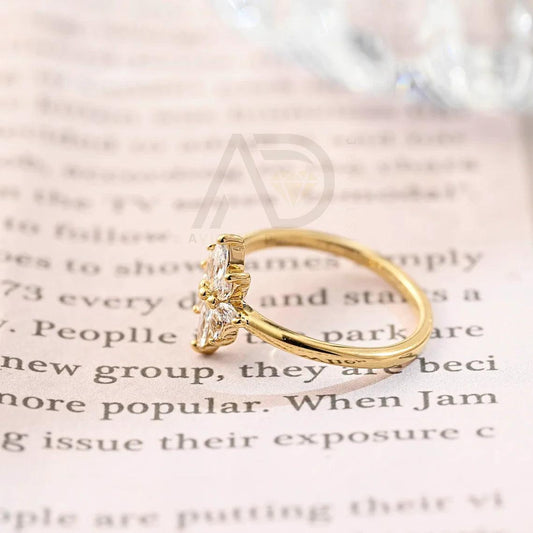
If you’re drawn to this direction, an elongated cushion or baguette cut in an east-west orientation makes a strong statement without overwhelming the finger. The elongated cushion three-stone ring shows how horizontal proportion plays out in a multi-stone design.
7. Vintage and Art Deco Inspired (From ~$300)
Best for: Old-soul romantics who gravitate toward character over trends.
The numbers here are hard to ignore. Searches for “vintage-style engagement rings” have soared by 700%, and vintage-inspired settings (milgrain edges, filigree shoulders, Art Deco geometry) are up 36% year-over-year. This isn’t a passing fad. It’s a full aesthetic movement.
The good news for budget shoppers: vintage-inspired moissanite rings photograph with a warmth and dimension that reads as “expensive” regardless of actual price. A $200 vintage-style moissanite ring in silver generates more compliments than many rings costing twenty times more.
Why it works on a budget:
- Milgrain edges and filigree details catch light in ways that modern clean-line settings simply can’t replicate
- Yellow gold enhances the vintage feel beautifully, and yellow gold’s market share has more than doubled over the past five years
- Cushion cuts and old mine cuts pair naturally with vintage settings, creating a cohesive look
- The intricate design does the heavy lifting, so you don’t need a massive center stone to impress
Honest downsides:
- Intricate details like filigree can trap dirt more easily. Regular gentle cleaning is necessary.
- Detailed work means more labor, which can increase cost compared to a plain solitaire (though still well under $500 in silver or 10K)
- Not everyone appreciates the aesthetic. Make sure the wearer gravitates toward vintage before committing.
The old mine cushion vintage ring uses a cut that was popular in the 1800s, giving the stone a soft, romantic sparkle that looks nothing like a modern brilliant cut. It’s one of those rings people notice across a room.
For a deeper dive into the old mine cut trend (which Taylor Swift’s engagement ring brought into mainstream conversation), the old mine cut glossary and guide covers the history and appeal of this distinctive shape.
8. The Bezel-Set Ring (From ~$200)
Best for: Active lifestyles, healthcare workers, and anyone who works with their hands.
A thin metal rim wraps completely around the edge of the center stone, holding it in place without prongs. The result is a sleek, modern profile that sits low on the finger and catches on absolutely nothing.
Why it works on a budget:
- The most protective setting type available. The stone is shielded from side impacts and snags, meaning fewer repair costs over the years.
- Lowest maintenance of any setting. No prongs to check, minimal crevices to clean.
- The clean metal frame gives a contemporary, architectural feel
- Works with virtually any stone shape, though round and square cuts are most popular
Honest downsides:
- Slightly less light enters the stone from the sides compared to prong settings, which can reduce perceived fire. With moissanite (which already has exceptionally high fire), this is barely noticeable in practice.
- Some buyers feel the metal rim makes the stone look smaller than it is
- Resizing a bezel setting is more complex than resizing a prong setting
The bezel-set princess moissanite ring demonstrates how clean and modern this setting looks with a geometric stone. It’s the ring that nurses, teachers, and athletes keep coming back to.
Why Moissanite Is the Best Stone for Engagement Rings Under $500
This is the decision that shapes your entire budget. For buyers shopping under $500, moissanite is the clear winner.
A one-carat equivalent moissanite typically runs $50 to $150 for the loose stone, which keeps complete rings (stone plus setting) firmly in the sub-$500 range when paired with silver or 10K gold. Lab-grown diamonds of comparable size cost far more, typically pushing finished rings above $600 even in silver settings.
Moissanite has a higher refractive index than diamond, which produces a lively, rainbow-like fire. Some people love this. Others find it a bit much in larger stones. Practitioners on Reddit’s r/Moissanite community consistently note that stones under 1.5 carats equivalent are nearly indistinguishable from diamond to casual observers. The rainbow fire becomes more noticeable in larger stones (2 carats and up) under direct sunlight.
Hardness for daily wear: Moissanite scores 9.25 on the Mohs hardness scale, harder than sapphire at 9. Diamond sits at 10. Both will resist scratching through decades of wear. The practical difference between 9.25 and 10 is negligible for most people. Your moissanite ring will look just as sharp in twenty years as it does on day one.
What about lab-grown diamonds? They’re chemically identical to mined diamonds, and roughly 61% of couples now choose lab-grown. Prices have dropped about 74% since 2022. But even with those drops, a finished lab-grown diamond ring typically starts around $600 and goes up from there. If your budget is firmly under $500, moissanite is the stone that gets you there without compromise.
For a thorough comparison of optical properties, hardness, and long-term value, the moissanite vs. lab-grown diamond guide covers every angle of this decision.
The Budget Metal Guide: Silver vs. 10K vs. 14K Gold
With gold at approximately $4,700 per ounce in May 2026, your choice of metal is the single biggest factor in whether a ring stays under $500 or blows past it. Here’s the honest breakdown.
925 Sterling Silver (Best for staying under $250): The most affordable option. Will tarnish over time and is softer than gold. Community discussions on Reddit consistently warn that silver may not hold up to decades of daily wear, but budget-conscious buyers see it as a worthwhile starting point. Many couples use a silver ring for the proposal and then choose the “forever” metal together afterward. At Avittam, silver is the base option on every ring, which is why starting prices sit around $150 to $300.
10K Gold (Best for staying under $500): This is the under-discussed budget lever. At 41.7% pure gold, it’s actually harder and more scratch-resistant than higher karat options, costs significantly less than 14K, and most people genuinely cannot tell the difference on a finger. Jewelers know this, but it doesn’t get mentioned often because higher-karat gold carries better margins. For budget buyers who want real gold on their finger, 10K is the sweet spot.
14K Gold (Often pushes above $500): At 58.3% pure gold, it balances warmth, durability, and cost. This is what the majority of engagement ring buyers end up choosing, but with current gold prices, many moissanite rings in 14K land in the $400 to $700 range. Some simpler styles (solitaires, bezels) can still squeeze under $500 in 14K, but styles with more metalwork (halos, vintage) will likely go over.
Color note: Yellow gold now accounts for 39% of engagement ring metal choices, with its share more than doubling over the past five years. Rose gold remains popular. White gold continues to hold strong for buyers who want a platinum-like look without the platinum price tag.
7 Tips to Get the Best Engagement Ring Under $500
1. Start with moissanite, not diamond. At this price point, moissanite gives you a larger, more brilliant stone than any diamond alternative. The sparkle difference on a finger? Nobody notices except gemologists.
2. Think about the wedding band now. Designing engagement ring and band as a pair ensures they sit flush and comfortable together. Retrofitting a band later is frustrating and sometimes impossible with certain ring profiles. The wedding ring and bridal set guide walks through how to plan both rings together.
3. Choose 925 silver or 10K gold. These two metals keep virtually every moissanite ring under $500. Silver gets you the lowest entry price; 10K gold gives you a “real gold” ring that will last for years.
4. Consider shape for perceived size. 54% of 2026 buyers chose a center stone under one carat, up from 31% in 2022. Oval and elongated cushion cuts make a 0.9-carat stone look like 1.1 carats because they spread their weight across a larger surface area. The shape does the heavy lifting so you don’t need to buy a bigger stone.
5. Choose a halo if you want maximum size. A halo setting makes a smaller center stone look dramatically bigger. If perceived size matters more than a clean minimalist look, a halo in silver with moissanite gives you the biggest “wow” for the least money.
6. Know the ring size before you buy. Borrow a ring your partner already wears on that finger, or order a free ring sizer. Resizing down is easier than sizing up, and some settings (full eternity pavé, bezel) are difficult or impossible to resize at all.
7. Consider custom without the markup. Buyers on Reddit report positive experiences sending photos or Pinterest boards to indie jewelers who recreate designs at lower cost than big-name retailers. The trust signals they cite: responsive communication and transparent pricing before committing. Avittam accepts custom requests with a $150 minimum order, coordinates via WhatsApp and email, and uses a 70/30 staged payment structure.
Ring Care by Setting Type
Different settings need different maintenance routines. This is one of those things nobody tells you before the purchase, and proper care keeps a $200 ring looking like a $2,000 ring.
Solitaire and bezel: Easiest to maintain. Warm water, mild dish soap, a soft toothbrush. Once a week is plenty.
Hidden halo: That underside cavity collects residue from hand lotion, soap, and cooking oils. A baby toothbrush and a bowl of warm soapy water every week keeps it looking right. If it starts looking cloudy, it’s probably just buildup, not a stone problem.
Classic halo and pavé: These have the most crevices. Soak for 15 minutes in warm water with a drop of dish soap, then gently brush. Professional ultrasonic cleaning every six months is a good investment.
Sterling silver specifically: Silver tarnishes. A polishing cloth and anti-tarnish storage bag go a long way. Store your ring in a sealed bag when you’re not wearing it, and the tarnishing slows dramatically.
White gold specifically: All white gold is rhodium-plated to achieve that bright silver-white color. The plating wears off over time, usually every 12 to 18 months depending on wear. Re-plating costs $50 to $100 at most jewelers and makes the ring look brand new.
Explore the full collection of moissanite engagement rings, available from $150 in 925 silver through 18K gold, with free worldwide shipping.
Frequently Asked Questions
Can you really get a good engagement ring for under $500?
Absolutely. Moissanite in sterling silver or 10K gold produces rings that are visually comparable to diamond rings costing ten times more. Moissanite scores 9.25 on the Mohs hardness scale (harder than sapphire) and costs 70-90% less than diamond. With rings starting around $150, you have plenty of room in a $500 budget for a beautiful setting with a brilliant stone.
Is moissanite a good choice for an engagement ring?
Yes. Moissanite is the second-hardest gemstone used in jewelry, durable enough for decades of daily wear. It costs a fraction of what diamond costs while producing even more sparkle. The main consideration is sparkle character: moissanite produces more rainbow fire than diamond, which some people love and others find too flashy in larger stones. Under 1.5 carats, most people can’t tell the difference.
What engagement ring style gives you the most for your money?
The classic halo. By surrounding a smaller center stone with a frame of accent stones, a halo makes a 0.7-carat stone look like a full carat. For budget buyers, this is the best “wow factor per dollar.” A moissanite halo ring in silver starts around $250.
Is 10K gold good enough for an engagement ring?
10K gold is 41.7% pure gold. It’s harder and more scratch-resistant than 14K or 18K, costs less, and the visual difference on a ring is minimal. Most people genuinely cannot tell 10K from 14K without checking the stamp. It’s an underrated option, especially when gold prices are at record highs, and it keeps most ring styles under $500.
Should I get a lab-grown diamond or moissanite for a budget ring?
For rings under $500, moissanite is the better choice. Lab-grown diamond prices have dropped significantly, but a finished ring with a lab-grown diamond center stone still typically starts above $600. Moissanite gives you a larger stone with more sparkle at a lower price. Both are ethical and durable. If diamond identity and certification matter to you and you can stretch the budget, lab-grown diamond is worth considering.
Can sterling silver work for an engagement ring?
It can, with caveats. Sterling silver will tarnish and is softer than gold. It’s best suited for budget-limited situations, promise rings, or buyers who plan to upgrade the metal later. Many couples use a silver ring for the proposal and then choose the “forever” metal together afterward. With proper care (polishing cloth, anti-tarnish storage), a silver ring holds up well for several years.
What is the most popular engagement ring shape in 2026?
Oval has overtaken round as the most popular shape. The solitaire remains the most purchased setting style at 40.3% of all sales. Hidden halos are rising fast. Vintage-inspired settings are up 36% year-over-year. Classic halos have declined to 5.3%.
How often should I clean my engagement ring?
Once a week for simple settings (solitaire, bezel). Twice a week for hidden halos and pavé settings that trap more residue. Professional deep cleaning every six to twelve months is a good habit for any setting with small accent stones. Clean your ring before any important event or photo, the difference is always visible.
What is the best engagement ring shape for small hands?
Oval and marquise shapes elongate the finger and create the most flattering proportions on smaller hands. Pear shapes also work well. Round brilliants are universally flattering. Princess cuts can look slightly bulky on very petite fingers, though the right setting size can offset this.
Can I get a custom engagement ring for under $500?
Yes. Smaller online jewelers accept image-based recreation requests at lower cost than big-name retailers. Avittam accepts custom orders with a $150 minimum, coordinates via WhatsApp and email, and uses a 70/30 staged payment structure so you’re not paying everything upfront.