
TL;DR
Moissanite (silicon carbide) and cubic zirconia (zirconium dioxide) are both lab-created diamond alternatives, but they perform very differently over time. Moissanite is harder (9.25 Mohs vs. 8-8.5), throws more fire, passes a diamond tester, and won’t cloud with daily wear. CZ costs a fraction of the price but scratches easier, degrades over months or years, and has zero resale value. For engagement rings and daily-wear jewelry, moissanite wins. CZ makes sense for fashion pieces, travel rings, and situations where loss or damage is likely.
Choosing between moissanite v cubic zirconia sounds like splitting hairs until you’ve seen a CZ engagement ring after two years of daily wear next to a moissanite that still looks brand new. These stones sit at very different price points, and the gap in longevity is even wider than the gap in cost.
This guide breaks down every meaningful difference, from optical properties to what happens when a jeweler hits the stone with a torch.
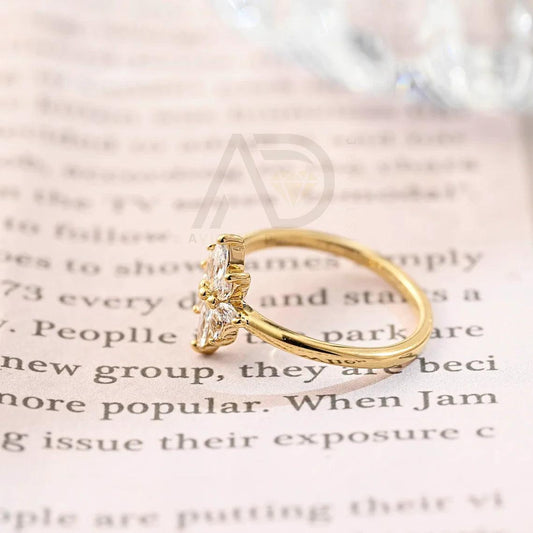
Exploring moissanite engagement rings? Browse options like this sparkling pavé princess-cut ring to see what the stone looks like in a real setting.
What Is Moissanite?
Moissanite is silicon carbide (SiC). The mineral was first discovered in 1893 by Nobel Prize-winning chemist Henri Moissan, who found trace amounts in an Arizona meteorite crater. Natural moissanite is extraordinarily rare, so virtually every moissanite stone sold today is lab-created.
The important word there is “mineral.” Moissanite has a defined crystal structure, genuine hardness, and optical properties that hold up over decades. It isn’t a simulant trying to look like diamond. It’s its own gemstone that happens to outperform diamond in certain optical categories.
What Is Cubic Zirconia?
Cubic zirconia is the cubic crystalline form of zirconium dioxide (ZrO₂). Commercial production began in 1976, and CZ has been the most widely used diamond simulant ever since, thanks to its low cost and close visual resemblance to diamond when new.
Two quick corrections that come up constantly: cubic zirconia is not “cubic zirconium” (a common misspelling), and it should never be confused with zircon, which is an entirely different natural mineral (zirconium silicate, ZrSiO₄).
Both moissanite and CZ are lab-created. Both are diamond alternatives. But that’s roughly where the similarities end.
Moissanite vs. Cubic Zirconia: Side-by-Side Comparison
| Property | Moissanite | Cubic Zirconia | Diamond (reference) |
|---|---|---|---|
| Composition | Silicon carbide (SiC) | Zirconium dioxide (ZrO₂) | Carbon © |
| Mohs Hardness | 9.25 | 8 to 8.5 | 10 |
| Refractive Index | 2.65 to 2.69 | 2.15 to 2.18 | 2.42 |
| Dispersion (fire) | 0.104 | 0.058 to 0.066 | 0.044 |
| Price per Carat | $250 to $600 | $10 to $50 | $5,000+ |
| Density vs. Diamond | Slightly lighter | ~1.7x heavier | Baseline |
| Diamond Tester Result | Passes (thermal) | Fails (reads as glass) | Passes |
| Refraction Type | Double | Single | Single |
| Clouds Over Time? | No | Yes, especially with daily wear | No |
| Resale Value | ~50 to 70% retained | Essentially zero | Varies |
That table tells most of the story. But numbers on a page don’t capture what these differences feel like in practice.
Hardness and Everyday Durability
This is the single most consequential difference for anyone buying a ring they plan to wear every day.
Moissanite sits at 9.25 on the Mohs hardness scale. That makes it the second-hardest gemstone used in jewelry, behind only diamond at 10. Cubic zirconia lands between 8 and 8.5.
A common misconception: the Mohs scale is not linear. The jump from 8.5 to 9.25 represents a much larger real-world difference in scratch resistance than the numbers suggest. Diamond, for instance, is roughly four times harder than sapphire (9), even though the numerical gap is just one point.
What this means in daily life: a moissanite ring worn every day for ten years will still look sharp and clear. A CZ ring worn the same way accumulates micro-scratches across the surface. Those tiny scratches scatter light instead of reflecting it cleanly, and the stone progressively dulls. It’s a slow decline, and you might not notice it week to week, but compare a year-old daily-wear CZ to its original sparkle and the difference is obvious.
If you’re choosing a classic solitaire moissanite ring for daily wear, hardness is the reason it’ll still look the same years from now.
Heat Resistance: The Jeweler’s Torch Test
Here’s a detail almost no comparison article mentions. Professional jewelers use high-heat torches to resize rings, repair prongs, and solder settings. Moissanite survives this process without damage. Tests show it remains intact and brilliant at temperatures exceeding 2,000°F.
Cubic zirconia? It can shatter under the same heat.
This matters for a lifetime piece. At some point, you’ll likely need a ring resized, a prong re-tipped, or a setting repaired. If the stone is CZ, the jeweler either has to remove it first (adding cost and risk) or decline the work altogether.
Brilliance and Fire: How They Handle Light
Moissanite has a refractive index of 2.65 to 2.69. CZ sits at 2.15 to 2.18. Diamond falls between them at 2.42.
In plain terms, moissanite bends light more aggressively than either CZ or diamond. The result is a stone that throws noticeably more brilliance (white light return) and fire (rainbow spectral flashes). Moissanite’s dispersion rating of 0.104 is nearly double that of CZ (0.058 to 0.066) and more than double diamond’s 0.044.
There’s a subjective element here. Some buyers find moissanite’s rainbow fire gorgeous. Others think it looks “too sparkly” or “disco ball-like,” especially in larger stones under direct sunlight. CZ actually produces a more subdued sparkle that can look more diamond-like at first glance. The catch is that CZ’s sparkle fades over time while moissanite’s stays put.
Double Refraction vs. Single Refraction
Moissanite is doubly refractive, meaning it splits each light ray into two as it enters the stone. CZ is singly refractive, like diamond. Under a jeweler’s loupe at 10x magnification, you can identify moissanite by the doubling of its facet junctions, where the flat cut surfaces meet. It looks like you’re seeing double lines where there should be single ones.
This is one of the few ways a trained eye can distinguish moissanite from diamond without instruments. It’s invisible to the naked eye in normal wear, but it’s worth knowing if identification matters to you.
An old mine cut moissanite ring shows this fire beautifully. Vintage cuts with larger facets produce broad, dramatic light flashes rather than the rapid-fire sparkle of modern brilliant cuts.
For a deeper comparison of moissanite against natural diamond, this side-by-side guide covers the optical differences in detail.
Price and Value Over Time
The upfront cost difference is dramatic:
- Moissanite: $250 to $600 per carat, with premium colorless grades like Forever One sitting at the higher end
- Cubic zirconia: $10 to $50 per carat, sometimes less
At first glance, CZ looks like the obvious budget winner. But the math changes when you factor in longevity.
A CZ engagement ring worn daily will typically need its stone replaced every two to five years. Each replacement costs money, time, and sometimes requires finding a new stone that fits the same setting. Over a decade, the total cost of CZ ownership can approach or exceed a single moissanite purchase.
Then there’s resale. Moissanite retains roughly 50% to 70% of its original purchase price. CZ has effectively zero resale value. Nobody is buying secondhand cubic zirconia.
If budget flexibility matters, consider that many moissanite rings come with metal tier options ranging from 10k to 18k gold, letting you adjust the total price without compromising on the stone. For more options under $500, this curated guide is worth a look.
Weight on the Finger
Cubic zirconia is significantly denser than both moissanite and diamond. A CZ stone with the same physical dimensions as a 1-carat diamond can weigh up to 1.7 times more. You feel this on your hand, especially in larger stones.
Moissanite is actually slightly lighter than diamond. Jewelers use a measurement called Diamond Equivalent Weight (DEW) to describe moissanite size in terms buyers can relate to. So when you see a moissanite listed as “1 carat DEW,” it means the stone looks the same size as a 1-carat diamond, even though its actual weight is slightly different.
This isn’t just a spec sheet detail. A ring you wear every day should feel comfortable. CZ’s extra heft can make a difference, particularly in rings with larger center stones or heavy settings.
Diamond Tester Behavior
This is a practical concern that most glossary articles skip entirely, and it matters to more buyers than you’d think.
Standard diamond testers work by measuring thermal conductivity, how quickly heat passes through the stone. Moissanite has thermal conductivity close to diamond’s, so it will register as “diamond” on a standard tester pen. CZ has much lower thermal conductivity and consistently reads as “glass” or “simulant.”
Practitioners on PriceScope forums confirm this directly: on a Presidium gem tester, moissanite tests as diamond, while CZ always tests as glass.
Why does this matter?
For some buyers, perception matters. A moissanite ring passes casual scrutiny. If a curious friend pulls out a tester at a party (yes, this happens), it reads as diamond. CZ doesn’t.
For more technical identification, newer multi-testers that measure both thermal and electrical conductivity can distinguish moissanite from diamond. Moissanite conducts electricity; diamond does not.
Does CZ Really Cloud Over Time?
Yes. But the story is more nuanced than most articles let on.
Early cubic zirconia was highly porous and absorbed body oils quickly, clouding within months. Modern high-grade CZ, particularly stones graded 5A or 6A, is considerably less porous and holds up longer. Most competing articles don’t even acknowledge that CZ quality grades exist, but they make a real difference.
Still, clouding remains a matter of when, not if, for daily-wear CZ rings. User reports from wedding forums show massive variance:
- One WeddingBee user reported their CZ ring turned cloudy after just six months, noting they used hand sanitizer frequently
- Other forum members report CZ lasting five, ten, even twenty-plus years with careful handling
- The consensus among practitioners: most CZ stones need replacement after a few years of regular ring wear
The main culprits accelerating CZ degradation are hand sanitizer, lotions, cosmetics, cleaning chemicals, and the simple abrasion of bumping your hand against things thousands of times a day. That yellowish, dull, gray appearance people associate with “old CZ” comes from a combination of surface scratches, chemical buildup, worn coatings, and aging settings.
Moissanite does not cloud. Period. Its chemical stability and surface hardness mean it maintains its brilliance indefinitely with normal care.
When Cubic Zirconia Is Actually the Right Choice
CZ gets dismissed too quickly in most comparison articles. There are situations where it genuinely makes sense:
- Fashion and costume jewelry. Earrings, cocktail rings, layering necklaces. Pieces you rotate through your wardrobe rather than wearing daily.
- Travel rings. Heading somewhere where you’d worry about losing or damaging your real ring? A $30 CZ stand-in takes the stress away completely.
- Event-specific pieces. A statement ring for a gala or wedding guest outfit that you’ll wear a handful of times.
- Placeholder rings. Couples proposing before they’ve saved for the permanent ring sometimes use CZ as an intentional temporary.
- Earrings and pendants. These take far less abrasion than rings. CZ earrings can last years because they aren’t getting scratched against every surface your hands touch.
Honestly, setting a CZ in solid gold feels like a mismatch. The metal outlasts the stone by decades. Silver or plated settings make more sense for CZ pieces.
When Moissanite Is Worth the Investment
For anything you plan to wear regularly and keep for years, moissanite is the clear choice over CZ. The durability gap is too wide to ignore for daily-wear pieces.
Engagement rings are the most obvious case. But moissanite also makes sense for:
- Wedding bands with stone accents
- Anniversary rings and upgrade pieces
- Heirloom-style jewelry you intend to pass down
- Any ring set in solid gold (10k, 14k, or 18k), where you want the stone to match the metal’s lifespan
A three-stone moissanite engagement ring in solid gold, for example, is the kind of piece that looks as good in twenty years as it does today. That simply isn’t true for CZ in the same setting.
For a full breakdown of how moissanite stacks up against natural and lab-grown diamonds specifically, this comparison guide covers the pricing, sparkle, and pros/cons in detail.
Clarity and Color: A Quick Note
CZ is always manufactured flawless. No inclusions, no blemishes. Moissanite typically ranges from VVS to VS clarity, meaning minor inclusions exist but are only visible under magnification. They don’t affect the stone’s beauty or structural integrity.
Some people actually prefer this about moissanite. Perfect flawlessness can look “too perfect” to a trained eye, while the subtle characteristics in moissanite make it feel more like a genuine gemstone.
The irony is that CZ starts out looking more “perfect” than moissanite, but degrades to look far worse within a few years. Moissanite’s slight imperfections stay stable forever.
Frequently Asked Questions
Is moissanite better than cubic zirconia?
For any jewelry worn regularly, yes. Moissanite is harder (9.25 vs. 8-8.5 Mohs), more brilliant (refractive index of 2.65-2.69 vs. 2.15-2.18), and doesn’t degrade over time. CZ is a perfectly fine choice for fashion jewelry, travel pieces, and occasional wear where long-term durability doesn’t matter.
Does cubic zirconia get cloudy?
It can. Modern high-grade CZ (5A and 6A) resists clouding better than older formulations, but daily wear, hand sanitizer, lotions, and general abrasion will degrade a CZ stone over time. User reports range from six months to twenty-plus years, depending on wear habits and stone quality. Most daily-wear CZ rings need replacement within two to five years.
Can you tell moissanite from CZ just by looking?
In most cases, yes, if you know what to look for. Moissanite throws significantly more fire (rainbow flashes) than CZ. Under magnification, moissanite shows doubled facet lines due to its double refraction, while CZ does not. To the casual observer, though, both can pass as diamond when new.
Does moissanite pass a diamond tester?
Yes. Standard thermal diamond testers will identify moissanite as diamond because their thermal conductivity is similar. CZ always fails, reading as glass. Newer multi-testers that also measure electrical conductivity can distinguish moissanite from diamond.
Which looks more like a real diamond, moissanite or CZ?
When brand new, CZ can look slightly more diamond-like because it shares diamond’s single refraction and subdued fire. Moissanite’s extra rainbow sparkle can be a tell for experienced eyes. However, CZ’s appearance degrades over time, while moissanite maintains its look indefinitely. After a year or two of daily wear, moissanite looks far more like a real diamond than a worn CZ does.
Is CZ worth putting in a gold setting?
Generally, no. Gold settings last decades. CZ stones last a fraction of that under daily wear. Pairing a $20 stone with a $300-plus gold setting means you’ll likely be replacing the stone multiple times over the life of the ring. Moissanite is a much better match for precious metal settings.
How much cheaper is CZ than moissanite?
CZ typically costs $10 to $50 per carat. Moissanite ranges from $250 to $600 per carat. That’s a 5x to 60x difference in upfront cost. But factoring in CZ replacement costs and zero resale value, the lifetime cost gap narrows considerably for daily-wear pieces.
Ready to choose moissanite? Explore customizable cushion-cut rings in your preferred metal and size, with options from 925 silver through 18k gold.