
TL;DR
An engagement ring is given at the proposal and represents the promise to marry. A wedding ring (or wedding band) is exchanged during the ceremony and represents the marriage itself. You don’t technically need both. The engagement ring is typically more ornate, taller in profile, and more expensive, while the wedding band is simpler, slimmer, and designed for everyday wear. How you wear them, what you spend, and whether you buy both are entirely up to you.
Engagement Ring: Definition and Purpose
An engagement ring is given during a proposal. It signals the intent to marry. That’s it. The tradition goes back centuries, with Pope Nicholas I formally declaring the engagement ring a statement of marital intent in 850 AD. One of the earliest recorded diamond engagement rings appeared in 1477, when Archduke Maximilian of Austria gave Mary of Burgundy a diamond ring. Before that, engagement rings featured all kinds of stones, or no stones at all.
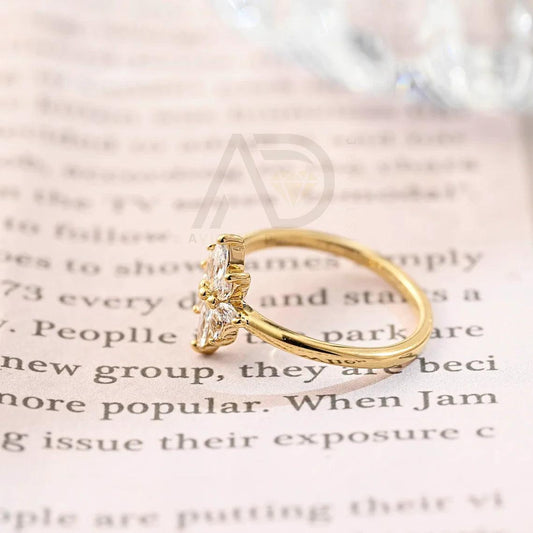
Today, the engagement ring is usually the flashier of the two. It features a center stone (diamond, moissanite, sapphire, whatever you prefer) and a more elaborate setting. Solitaires, halos, three stone designs, hidden halos. The engagement ring is meant to be noticed. For a closer look at setting styles, our guide on best moissanite engagement ring styles covers the most popular options.
Traditionally, only one partner wears the engagement ring, though that convention is shifting. Some couples now buy matching engagement rings. Others skip the engagement ring entirely and go straight to wedding bands.
Explore classic solitaire moissanite rings
What engagement rings actually cost
According to The Knot’s 2024 Jewelry & Engagement Study, the average engagement ring costs $5,200. That number has been falling steadily, down from $6,000 in 2021 to $5,800 in 2022 to $5,500 in 2023. The trend is clear: people are spending less and caring more about what they actually like.
Lab grown diamonds bring the average down further, to about $4,900 versus $7,600 for mined diamonds. And moissanite shifts the math dramatically. With a 9.25 rating on the Mohs hardness scale (diamond is 10), moissanite handles daily wear without issue, and rings start at a fraction of what diamond equivalents cost. For a full breakdown of how the numbers compare, see our engagement ring cost guide.
Wedding Ring (Wedding Band): Definition and Purpose
The wedding ring is exchanged during the ceremony. Both partners typically receive one. Where the engagement ring says “I want to marry you,” the wedding ring says “we’re married.”
Wedding bands tend to be simpler. Plain metal, pavé settings, channel set stones, or eternity styles. The reasoning is practical: this is the ring you’ll wear every single day, potentially for decades. Comfort and durability matter more than how much it sparkles at dinner.
“Wedding band” and “wedding ring” mean the same thing. Historically, “band” implied a plain ring while “ring” could include stones, but that distinction has faded. If you want to understand the nuance more deeply, there’s a good breakdown of the wedding band vs wedding ring distinction.
What wedding bands actually cost
The Knot found that the average wedding band costs about $600 for men and $1,200 for women. Simple metal bands typically range from $150 to $700, while diamond accented bands run between $700 and $2,500. A wedding band’s price is often just a fraction of the engagement ring’s, sometimes as low as 10%.
Browse moissanite wedding bands under $500
Quick Comparison: Engagement Ring vs Wedding Ring
| Feature | Engagement Ring | Wedding Ring |
|---|---|---|
| When given | At the proposal | During the wedding ceremony |
| Who wears it | Traditionally one partner | Both partners |
| Typical design | Center stone, ornate setting | Simple band, sometimes with small stones |
| Average cost | ~$5,200 | ~$600 to $1,200 |
| Profile height | Taller (raised center stone) | Low profile, sits flat on the finger |
| Band width | Often thinner shank to emphasize stone | Varies, but typically 2mm to 6mm |
| Daily wear | Some remove for work or exercise | Worn continuously |
| Symbolism | Promise to marry | The marriage itself |
Size and Profile Difference: Why It Matters More Than You Think
One of the most overlooked distinctions between engagement rings and wedding bands is their physical size and profile. This isn’t just about aesthetics. It affects comfort, daily wearability, and how well the two rings stack together.
Profile height
An engagement ring sits taller on the finger because the center stone needs to be elevated above the band. A standard solitaire prong setting lifts the stone roughly 5mm to 8mm above the finger. Halo settings can add even more height depending on the design. This raised profile is what gives an engagement ring its visual drama, but it also makes it more likely to snag on clothing, catch on gym equipment, or bump against surfaces during manual tasks.
Wedding bands, by contrast, are designed to sit as flat and close to the finger as possible. A plain metal band might rise only 1mm to 2mm above the skin. Even a pavé or channel set wedding band stays relatively low. That low profile is intentional. It’s the ring you’ll never take off.
Practitioners on Reddit frequently mention swapping to just their wedding band during activities like lifting weights, gardening, or cooking. The engagement ring’s height makes it impractical for some tasks, while the wedding band barely registers on the hand.
Band width and thickness
Engagement ring shanks (the part that wraps around the finger) tend to be narrower, usually between 1.5mm and 2.5mm. The narrow shank keeps the visual focus on the center stone. Wedding bands are often wider, ranging from 2mm to 6mm or more, especially for men’s bands.
This difference matters for comfort. A wider band distributes pressure more evenly across the finger, which some people find more comfortable for all day wear. But a wider band can also feel bulky if you’re stacking it with an engagement ring. If your engagement ring already has a thin shank, a medium width (2mm to 3mm) wedding band usually strikes the best balance.
How profile affects stacking
When the engagement ring has a high cathedral setting or a large halo, the wedding band may not sit flush against it. You’ll see a visible gap between the two rings, or the band will tilt slightly. This is a common frustration, and one that’s easy to avoid if you consider band compatibility before buying the engagement ring. For a deeper look at how silhouette shapes interact, see our wedding ring shape guide.
A bezel set engagement ring is one of the most band friendly options. Because the stone is encased in metal rather than raised on prongs, the profile stays low and nearly any straight band will pair with it cleanly.
Budget Allocation Between Rings: A Practical Framework
Most people focus all their budget energy on the engagement ring and treat the wedding band as an afterthought. That’s backwards, or at least incomplete. You’re buying two pieces of jewelry that need to work together visually and financially.
The typical split
Based on industry data and spending patterns reported on wedding forums, most couples spend roughly 75% to 85% of their total ring budget on the engagement ring and 15% to 25% on the wedding band. On a $6,000 total budget, that translates to about $4,500 to $5,100 for the engagement ring and $900 to $1,500 for the band.
But this ratio only makes sense if you’re buying a mined diamond engagement ring at traditional price points. Switch to moissanite and the math changes completely.
The moissanite budget advantage
A moissanite engagement ring typically costs between $150 and $600, depending on the metal and stone size. A matching moissanite wedding band might run $100 to $400. That means a complete set, engagement ring plus wedding band, can come in under $1,000 total. Compare that to the $6,400+ average for a mined diamond engagement ring and wedding band combination.
This isn’t about being cheap. It’s about priorities. One member on a wedding planning subreddit put it simply: they spent $400 on a moissanite set and put the rest toward a down payment. After two years of daily wear, nobody had ever questioned whether the stone was a diamond.
Three budget strategies worth considering
Strategy 1: Go big on the engagement ring, minimal on the band. This is the traditional approach. It works if the engagement ring is the statement piece and the band is just a quiet complement. A plain 14K gold band for $200 to $400 next to a $500 moissanite engagement ring is perfectly proportional.
Strategy 2: Split evenly and get a bridal set. Buying both rings as a matched set often saves 10% to 20% compared to purchasing them separately. More importantly, a set guarantees the pieces fit together without gaps. Our moissanite bridal sets guide covers what to look for.
Strategy 3: Buy one ring, use it for both. This is growing in popularity, especially among couples who prefer simplicity. A slightly ornate band with small accent stones serves double duty. No stacking issues, no second purchase, no pairing headaches.
Don’t forget the hidden costs
Whatever allocation you choose, factor in insurance (typically 1% to 2% of the ring’s appraised value per year), resizing fees ($50 to $150 per ring), and potential future upgrades. Some couples buy a modest ring now with plans to upgrade on a milestone anniversary. That’s a perfectly reasonable approach, and it takes the pressure off the initial purchase.
A Short History of Wedding and Engagement Rings
The wedding ring tradition stretches back roughly 5,000 years to ancient Egypt, where the unbroken circle symbolized eternity. The materials were humble (braided reeds, leather), but the meaning stuck.
The Romans added the finger placement. They believed a vein called the “vena amoris,” or vein of love, ran directly from the fourth finger of the left hand to the heart. Modern anatomy has thoroughly disproven this, but the romantic idea survived anyway. That’s the power of a good story.
Diamond engagement rings didn’t become widespread until much later. After Archduke Maximilian’s 1477 ring, diamonds remained a luxury of royalty for centuries. The modern diamond engagement ring boom really traces back to De Beers’ marketing campaigns in the late 1930s.
Men’s wedding bands have an even shorter history. They only became mainstream during World War II, when soldiers wore rings as reminders of the wives they’d left behind. The custom stuck after the war ended, and now it’s simply expected.
Today, the rules are loosening. Moissanite and lab grown diamonds are gaining ground fast. Colored gemstones are back. Some couples skip rings entirely and get tattoos instead. The tradition is alive, but it bends.
How to Wear Them Together
The standard Western convention: the wedding band goes on first (closest to your heart), and the engagement ring stacks on top.
On the wedding day itself, many brides temporarily move the engagement ring to the right hand before the ceremony. This frees up the left ring finger so the wedding band can slide on during the vows without fumbling. After the ceremony, the engagement ring goes back on top of the band. For a deeper look at ring placement traditions worldwide, see our guide on what hand the wedding ring goes on.
But this is far from universal. In Poland, Greece, Russia, India, and parts of Scandinavia, wedding rings go on the right hand. In Indian traditions, brides may also wear toe rings (bichiya) as part of the marriage customs, and the significance of each hand varies by region.
Some modern approaches worth noting:
- Wearing the engagement ring and wedding band on separate hands
- Soldering the two rings together into a permanent set
- Wearing only the band on workdays (common among nurses, mechanics, chefs, and anyone who works with their hands)
- Skipping one ring altogether
Practitioners on Reddit frequently mention that they only wear their wedding band day to day and save the engagement ring for evenings out. It’s practical, not unromantic.
Do You Actually Need Both Rings?
No.
There’s no rule, legal or otherwise, that requires two rings. Some couples use a single ring for both the engagement and the wedding. Others skip the engagement ring and only exchange bands at the ceremony. Budget, lifestyle, and personal taste are the real deciding factors.
On wedding planning forums, plenty of people share that they wear one ring and feel zero guilt about it. One common approach: buy a slightly nicer ring than a basic band, propose with it, and then use that same ring during the ceremony. Done.
Skipping one ring also opens up budget. Instead of splitting money between two rings, you could put everything toward one piece you truly love. Our guide on engagement ring or wedding band walks through the decision in more detail.
Browse customizable moissanite rings
If you do want both, buying them as a matched set (called a bridal set) guarantees they’ll pair well together.
How Ring Settings Affect Wedding Band Pairing
This is the practical detail that most articles skip, and it matters a lot.
Not every engagement ring plays nicely with every wedding band. If you choose your engagement ring without thinking about what will sit next to it, you might end up with a gap between the two rings, or a band that wobbles against the setting.
Solitaire or low profile settings are the easiest to pair. Almost any straight band will sit flush against them. A classic knife edge solitaire, for instance, works with practically everything.
Halo settings are trickier. The cluster of accent stones around the center gem often extends below the ring’s profile, which means a straight band won’t sit flush. You’ll likely need a contour band or curved band that hugs the shape of the halo. If you’re considering a halo design with double pavé, think about band compatibility from the start.
Hidden halo settings present a similar challenge. The halo sits underneath the center stone rather than around it, and depending on how low it sits, it can still interfere with a flat band. A hidden halo princess cut is stunning on its own but may need a contour band for a comfortable stack.
Cathedral settings (where the center stone is held high between arching metal supports) can leave a visible gap with standard flat bands.
One member on Weddingbee shared that their moissanite engagement ring with a diamond halo looked great stacked together, noting that “although I can tell the difference, I’ve never had anyone else ever point it out. They blend in really well together.” Mixing stone types between your engagement ring and wedding band is more common than people think, and it works.
Moissanite’s 9.25 Mohs hardness means it holds up well to the daily friction of stacking. You won’t see the surface degradation that softer gemstones can develop over years of rubbing against a metal band.
Metal Choices and Why They Matter for Both Rings
Choosing a metal isn’t just about color. Different metals have different hardness levels, and that affects how your rings age together.
Gold karat matters more than people realize. 10K gold is the hardest (more alloy, less pure gold), which makes it the most scratch resistant but slightly less warm in color. 14K is the most popular middle ground. 18K has the richest gold tone but is softer and scratches more easily. If your engagement ring is 14K white gold and your wedding band is 18K white gold, they’ll wear at different rates and may develop slightly different patinas over time.
925 sterling silver is an option that most high end jewelers won’t mention because the margins are lower. But for budget conscious buyers, silver moissanite rings offer genuine brilliance at a much lower price point. The tradeoff is that silver tarnishes and is softer than gold, so it requires more maintenance.
Mixing metals is increasingly popular. A white gold engagement ring with a rose gold band creates a striking contrast. A two tone moissanite ring can achieve this look in a single piece. Just be aware that softer metals will show wear faster when stacked against harder ones.
If you’re curious about how moissanite compares to diamonds from a value and appearance standpoint, our moissanite vs diamond guide covers the full comparison.
Other Terms You’ll Hear
The ring world comes with its own vocabulary. Here are the terms that trip people up most often.
Bridal set: An engagement ring and matching wedding band sold together. The pieces are designed to fit flush and share the same metal color. Buying a set removes the guesswork of pairing.
Eternity band: A wedding band with stones set around the entire circumference. Beautiful, but harder to resize because of all those stones.
Anniversary band: A ring given on a milestone anniversary. It sometimes replaces or sits alongside the original wedding band. Three stone rings are popular anniversary choices because each stone can represent past, present, and future.
Promise ring: A commitment ring given before an engagement. It’s not an engagement ring, and there’s no expectation that a proposal is imminent. Think of it as a placeholder for serious intent without formal engagement.
Ring enhancer (or ring jacket): A decorative band that wraps around the engagement ring, adding extra sparkle or width. It’s essentially a wedding band with a notch cut out for the engagement ring to nest inside.
What About Moissanite for Both Rings?
This is the gap in nearly every competing article on engagement ring vs wedding ring: nobody talks about moissanite specifically.
Moissanite works beautifully for both engagement rings and wedding bands. The stone’s fire (the rainbow flashes you see in light) is actually higher than diamond’s, which means a moissanite center stone paired with a moissanite accented band creates a cohesive, brilliant stack.
From a durability standpoint, moissanite at 9.25 Mohs is second only to diamond. It won’t chip, cloud, or scratch under normal wear. Practitioners on Reddit and wedding forums regularly confirm that after years of daily wear, their moissanite rings look the same as the day they bought them.
The cost difference is where things get interesting. If the average mined diamond engagement ring runs $7,600 and the average wedding band adds another $600 to $1,200, a couple could easily spend $9,000 or more on rings alone. With moissanite, that total drops sharply, often to under $1,000 for both pieces, leaving room in the budget for the honeymoon, a first home, or simply less financial stress at the start of a marriage.
See moissanite engagement rings starting at $150
FAQ
Can I use my engagement ring as my wedding ring?
Yes. There’s no requirement to have two separate rings. Many couples use one ring for both purposes, either to save money or because they prefer a minimalist approach.
Which ring goes on first when stacking?
The wedding band goes on first, closest to your hand (and symbolically closest to your heart). The engagement ring sits on top.
Does an engagement ring have to be a diamond?
Not at all. Moissanite, sapphires, emeralds, rubies, and lab grown diamonds are all popular choices. Moissanite in particular offers diamond like brilliance with a hardness of 9.25 on the Mohs scale, making it a practical everyday stone.
How much should you spend on a wedding band vs an engagement ring?
The averages are roughly $5,200 for an engagement ring and $600 to $1,200 for a wedding band, according to The Knot’s 2024 data. Most couples allocate 75% to 85% of their total ring budget to the engagement ring and 15% to 25% to the band. But averages are just averages. Spend what feels right for your budget.
Can you mix moissanite and diamond in a ring stack?
Absolutely. On wedding forums, couples report that moissanite and diamond blend well together visually. Most people can’t tell the difference at a glance. The two stones have similar enough optical properties that they complement each other in a stack.
Do men wear engagement rings?
Some do, and the practice is growing. There’s no tradition requiring it, but there’s also no tradition forbidding it. It’s a personal choice.
What is a bridal set?
A bridal set is an engagement ring and wedding band designed and sold together. The two pieces are made to fit flush against each other, matching in metal type and design style.
Which hand do you wear a wedding ring on?
In the United States, Canada, the UK, and much of Western Europe, the wedding ring goes on the left hand. In Russia, Poland, Greece, India, and parts of Scandinavia, it traditionally goes on the right hand. Neither is more “correct” than the other.
Are engagement rings supposed to be bigger than wedding bands?
The center stone on an engagement ring creates a visually larger appearance, but the band itself is often thinner (1.5mm to 2.5mm) compared to a wedding band (2mm to 6mm). “Bigger” depends on whether you’re talking about the stone or the metal. They serve different purposes, so direct size comparison isn’t always meaningful.