
TL;DR
Moissanite is not a diamond. It’s a separate gemstone made of silicon carbide, originally discovered in a meteorite crater in 1893. It ranks 9.25 on the Mohs hardness scale (diamond is 10), throws off 2.4 times more rainbow fire than diamond, and costs 70-90% less. The term “moissanite diamond” is a misnomer that confuses two chemically distinct stones.
The phrase “moissanite diamond” gets searched thousands of times a month, and it’s built on a misunderstanding. Moissanite is not a type of diamond. Not a fake diamond. Not a synthetic diamond. It is its own gemstone with its own chemical structure, its own optical behavior, and its own place in the jewelry world. Diamonds are pure carbon. Moissanite is silicon carbide (SiC). Different atoms, different crystal structure, different sparkle.
Once that distinction clicks, everything else about moissanite makes more sense.
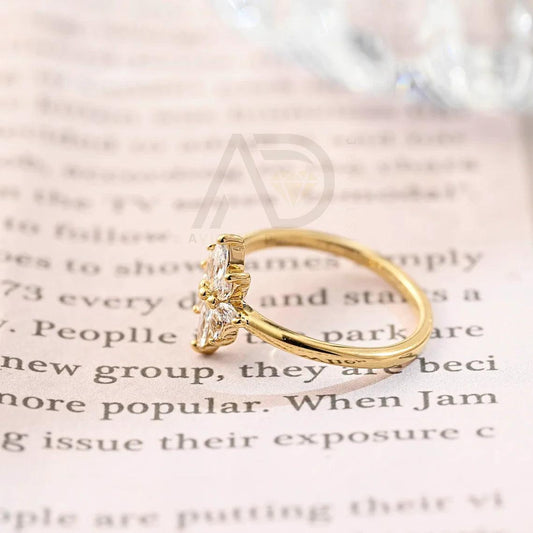
If you want to see how this stone actually looks in a finished ring, a classic solitaire moissanite ring is the clearest example, with nothing distracting from the stone’s natural optics.
Origin and History
In 1893, French chemist Henri Moissan was examining rock samples from a meteorite crater near Canyon Diablo, Arizona. He found tiny crystals he believed were diamonds. It took him over a decade to realize his mistake. In 1904, he identified them as silicon carbide, a mineral that would eventually bear his name.
Natural moissanite is extraordinarily rare. The crystals Moissan found were microscopic, and occurrences in nature are too small and scarce for any jewelry use. Every moissanite stone you see in a ring today is lab-created.
The commercial story began in the late 1990s when researchers at Research Triangle Park in North Carolina developed a process for growing gem-quality silicon carbide crystals. Charles & Colvard became the first company to bring moissanite jewelry to market, holding patents that gave them a near-monopoly for years.
That monopoly ended. Patents expired. Competitors entered. And in early 2026, Charles & Colvard filed for Chapter 11 bankruptcy, listing $19.2 million in assets against $10.5 million in debts. Their revenues had dropped from $30 million in 2023 to roughly $16 million in 2025.
The company expects to keep operating. But the filing signals something broader: moissanite as a category has outgrown its pioneer. Dozens of producers now cut and sell the stone worldwide. If you’re drawn to a vintage-inspired moissanite ring, the options available today dwarf what existed even five years ago.
Key Properties at a Glance
Here’s how moissanite and diamond compare on the metrics that actually matter for jewelry:
| Property | Moissanite | Diamond |
|---|---|---|
| Chemical composition | Silicon carbide (SiC) | Carbon © |
| Mohs hardness | 9.25-9.5 | 10 |
| Refractive index | 2.65-2.69 | 2.42 |
| Dispersion (fire) | 0.104 | 0.044 |
| Refraction type | Double (birefringent) | Single (isotropic) |
| Specific gravity | 3.22 | 3.52 |
Numbers on a chart only go so far. What do they mean on your hand?
The refractive index tells you how much light bounces back to your eye. Moissanite returns more light than diamond. The dispersion number tells you how much of that light splits into rainbow colors. Moissanite produces 2.4 times more fire than diamond. And the specific gravity difference means moissanite is lighter, which is why the industry sizes moissanite in millimeters rather than carats. A 6.5mm moissanite is roughly equivalent in visual size to a 1-carat diamond, even though it weighs less.
What the Sparkle Actually Looks Like
This is where people either fall in love with moissanite or decide it’s not for them. There’s no wrong answer.
Diamond sparkle is predominantly white and silver. Light enters, bounces around, and comes back as bright white flashes. Moissanite does that too, but with significantly more color. Those rainbow flashes, the fire, are more intense and more frequent. Under direct sunlight, the effect becomes especially pronounced.
Some people call it the disco ball effect. That phrase shows up constantly in wedding forums and Reddit discussions. Practitioners on Reddit report that the rainbow fire is most noticeable in larger stones (above 1.5 carat equivalent) and under strong overhead lighting. Smaller stones are harder to distinguish from diamond with the naked eye.
The mechanism behind this difference is double refraction, also called birefringence. When light enters moissanite, it splits into two rays. Diamond is singly refractive, meaning light stays as one ray. This creates a fundamentally different light pattern, and it’s the reason gemologists can identify moissanite under a 10x loupe by looking for doubled facet edges visible through the table of the stone.
Good cutters minimize the visual effects of double refraction by cutting the table perpendicular to the crystal’s optical axis. Well-cut moissanite won’t show obvious doubling to the naked eye. But under magnification, it’s always there.
A sparkling pavé princess-cut moissanite ring is a good example of how smaller accent stones and a well-cut center stone work together to produce that distinctive brilliance without overwhelming the eye.
The disco ball criticism is overblown. In practice, most friends and family notice that a ring sparkles beautifully. The person most aware of the difference is usually the wearer, because they know it’s moissanite and start looking for it. Community members on The Knot and WeddingWire consistently report satisfaction when they chose moissanite for what it is rather than as a stand-in for something else.
Hardness, Toughness, and Daily Wear
At 9.25 on the Mohs scale, moissanite is the second hardest gemstone used in jewelry. Only diamond sits above it at 10. For context, sapphire is a 9. Anything you encounter in daily life, kitchen counters, car doors, zippers, falls below moissanite on the hardness scale. Scratching it is extremely difficult.
But here’s something almost no competitor article covers: hardness and toughness are different properties. Hardness measures scratch resistance. Toughness measures resistance to chipping and fracturing. Diamond has perfect cleavage along four planes, which means a sharp impact at the right angle can chip or even split a diamond. Moissanite has no strong cleavage planes, making it actually tougher than diamond in terms of fracture resistance.
For someone wearing a ring every day, this matters. A protective setting like a bezel-set moissanite engagement ring adds another layer of durability, but even in a prong setting, moissanite handles daily wear better than most people expect.
Two more practical points. Moissanite doesn’t cloud, haze, or degrade over time. It looks the same in year ten as it did on day one. And it handles extreme heat: moissanite remains intact at temperatures above 2,000°F, which means jewelers can safely resize, re-tip prongs, and make repairs without removing the stone. Diamonds can handle heat too, but moissanite’s thermal stability gives jewelers more flexibility during bench work.
How to Tell Moissanite Apart from Diamond
If you’re wondering whether someone can “tell,” the honest answer is: almost never with the naked eye, especially in smaller stones. But there are reliable ways professionals distinguish them.
Double refraction under magnification. Look through the table of the stone with a jeweler’s loupe at 10x. In moissanite, the back facets appear doubled, as if you’re seeing two sets of lines instead of one. Diamond never shows this.
Stronger fire in sunlight. Side by side under natural light, moissanite throws more rainbow flashes. This is the most visible difference to an untrained eye, but only when the stones are compared directly.
Weight difference. Moissanite is about 15% lighter than diamond for the same dimensions. A jeweler with a scale and calipers can spot this quickly.
Diamond testers can be fooled. Standard thermal conductivity testers often read moissanite as diamond because both stones conduct heat similarly. Newer electrical conductivity testers can distinguish them, but the older pen-style testers are unreliable for this purpose.
For a deeper comparison of how these two stones stack up across every buying factor, the guide on moissanite vs diamond covers the full picture.
Moissanite Is Not Cubic Zirconia
This confusion is everywhere, and it deserves a direct correction. Cubic zirconia (CZ) is made from zirconium dioxide. Moissanite is silicon carbide. They are completely different materials with different performance in every measurable way.
CZ rates 8.0-8.5 on the Mohs scale. It scratches. Moissanite is 9.25 and above.
The bigger issue is longevity. CZ is a porous material that absorbs skin oils, lotions, and cleaning products over time. It turns cloudy and milky, and that degradation is permanent. Moissanite doesn’t absorb anything. It stays clear indefinitely.
If someone tells you moissanite “will cloud up eventually,” they’re confusing it with cubic zirconia. The two stones occupy entirely different tiers in terms of quality and durability. A three-stone cushion moissanite ring will look just as sharp years from now as it does when it arrives, which is something you genuinely cannot say about CZ.
Grading and Certification
This is where the moissanite market gets a little murky, and buyers should understand what they’re actually getting with a certificate.
GIA, the most respected gemological laboratory in the world, does not grade moissanite. They will identify it, confirming that a stone is lab-created silicon carbide. But they don’t evaluate cut quality, color on the D-to-Z scale, or clarity the way they do for diamonds. Just identification, nothing more.
GRA (Global Gemological Research Association) does issue 4Cs-style reports for moissanite. These are legitimate documents that record a stone’s dimensions, color grade, clarity, and cut. But a GRA certificate is best understood as a spec sheet and transparency tool, not a prestige credential equivalent to GIA diamond grading. It confirms what you have. It doesn’t tell you how it compares to every other moissanite on the market, because there’s no universally adopted standard.
Because moissanite is less dense than diamond, comparing stones by carat weight produces misleading results. The industry standard is to describe moissanite by its millimeter dimensions and then reference the “diamond equivalent weight” (DEW) for the buyer’s convenience. A 6.5mm round moissanite is visually equivalent to a 1-carat round diamond. An 8mm stone approximates a 2-carat diamond.
Most moissanite sellers offer stones in color tiers. D-F is considered colorless. G-H is near-colorless, with a very faint warmth that’s essentially invisible once set in yellow or rose gold. The price difference between these tiers is modest compared to the massive premium that diamond color grading commands.
Price Context for 2026
Here is where moissanite’s value proposition becomes concrete. A 1-carat equivalent moissanite stone (6.5mm) typically costs between $300 and $800. A comparable lab-grown diamond runs $800 to $3,000. A mined diamond of similar specifications can easily reach $5,000 to $10,000 or more.
That’s a 70-90% savings versus mined diamonds and roughly 50-70% less than lab-grown diamonds.
But the real advantage shows up in larger sizes. Diamond pricing scales exponentially. A 2-carat diamond doesn’t cost twice as much as a 1-carat, it costs three to four times as much. Moissanite pricing is linear. A 2-carat equivalent moissanite costs roughly double the 1-carat. This makes designs with larger center stones or multiple stones far more accessible.
A vintage split-shank moissanite ring available in 10k, 14k, or 18k gold illustrates how metal choice and moissanite’s affordable pricing work together to create flexibility across budgets.
For a more detailed breakdown of pricing, sparkle differences, and when each stone makes sense, the moissanite or diamond price guide walks through the trade-offs.
One honest caveat: moissanite has essentially zero resale value. The secondary market is thin, and most jewelers won’t buy back moissanite stones. If you’re buying a ring to wear and enjoy, this doesn’t matter. If you’re thinking of jewelry as an investment, moissanite is the wrong choice. Diamonds hold some resale value (though far less than most people assume), while moissanite holds almost none.
The market has also shifted in interesting ways. Lab-grown diamond prices have dropped 50-70% since 2021, narrowing the price gap between lab diamonds and moissanite. When lab-grown diamonds cost five times more than moissanite, choosing moissanite was a no-brainer for budget-minded buyers. Now that the gap is closer to two times, some buyers who would have picked moissanite are choosing lab-grown diamonds instead. This was a major factor in Charles & Colvard’s revenue decline.
Still, moissanite remains the most affordable option for anyone who wants a large, hard, brilliant stone without spending thousands.
Ethical Considerations
All jewelry-grade moissanite is lab-created. There is no mining involved, no conflict sourcing concerns, and the environmental footprint is smaller than that of mined gemstones. The production process takes two to three months per crystal, using controlled laboratory conditions rather than open-pit or underground extraction.
For buyers motivated by ethical sourcing, moissanite offers a straightforward answer. There’s no supply chain ambiguity to navigate.
A Stone on Its Own Terms
Moissanite works best when it’s chosen for what it is. Buyers on wedding forums who treat it as its own stone, rather than a cheaper stand-in for diamond, are consistently the happiest. One community member on The Knot put it well: moissanite crystals were originally discovered as sky-gems, fragments from space. There’s something appealing about that origin story.
The stigma around non-diamond engagement rings has faded rapidly. Practitioners across Reddit and wedding communities report that family judgment, while it still exists in some circles, is far less common than it was five or ten years ago. Most people simply notice a ring sparkles and move on.
If you’re exploring moissanite rings, consider browsing options like an elongated cushion three-stone ring to see how multi-stone designs take advantage of moissanite’s pricing and fire across several stones.
Frequently Asked Questions
Is moissanite a real diamond?
No. Moissanite is a completely separate gemstone. Diamonds are made of carbon. Moissanite is silicon carbide. They look similar to the naked eye but have different chemical compositions, different crystal structures, and different optical properties. The term “moissanite diamond” is a common misnomer.
Can a jeweler tell the difference between moissanite and diamond?
Yes, using the right tools. Double refraction (facet doubling) visible under 10x magnification is the most reliable visual indicator. Newer electrical conductivity testers can also distinguish them, though older thermal testers sometimes misidentify moissanite as diamond.
Does moissanite get cloudy over time?
No. Unlike cubic zirconia, moissanite does not absorb oils or degrade. It maintains its clarity and sparkle indefinitely. If someone tells you moissanite clouds, they’re confusing it with CZ.
How much does a moissanite ring cost compared to a diamond ring?
A 1-carat equivalent moissanite stone runs $300-$800. A comparable lab-grown diamond costs $800-$3,000, and a mined diamond of similar quality can exceed $5,000. The savings are even greater for larger stones because moissanite pricing scales linearly while diamond pricing scales exponentially.
Is moissanite durable enough for an engagement ring?
Absolutely. At 9.25 on the Mohs hardness scale, moissanite is harder than sapphire and second only to diamond. It also has no cleavage planes, making it more resistant to chipping than diamond in practical terms. It handles daily wear without issue.
Does GIA certify moissanite?
GIA will identify moissanite as lab-created silicon carbide, but they do not grade it for cut, color, or clarity the way they grade diamonds. GRA certificates provide 4Cs-style details for moissanite, serving as spec records rather than prestige grading reports.
Why does moissanite sparkle differently than diamond?
Moissanite has a higher refractive index (2.65-2.69 vs. diamond’s 2.42) and 2.4 times more dispersion. This means it returns more light overall and splits more of that light into rainbow colors. It’s also doubly refractive, creating a subtly different light pattern than diamond’s single refraction.
Is moissanite worth buying in 2026?
For buyers who want a large, hard, brilliant stone at a fraction of diamond pricing, moissanite remains an excellent choice. The gap between moissanite and lab-grown diamond prices has narrowed, but moissanite is still significantly cheaper, especially in larger sizes. The main trade-off is minimal resale value and a sparkle profile that some people prefer and others don’t.