
A Tale of Two Silhouettes: Defining Your Love Story
For the discerning couple, the journey toward the perfect ring begins with a single, defining decision: the cut of the center stone. Two silhouettes stand apart, each a distinct language of light and form. The emerald cut, with its elongated step-cut facets and quiet, mirror-like glow, speaks of subtle confidence. The princess cut, a square brilliant cut developed in the 1960s, is a modern icon built on sharp corners and intense sparkle.
Choosing between them is not a matter of better or worse, but of which aesthetic tells your story. This comparison applies to both diamonds and moissanite, though the stone's unique optical properties will influence the effect. A well-chosen moissanite in either shape can reveal exceptional brilliance and fire, often at a significantly lower cost than a diamond of equivalent visual size.
Let this guide serve as a starting point for the personal exploration ahead. Whether you are drawn to the graceful, elongated silhouette of an emerald cut or the bold, architectural fire of a princess cut, understanding their distinct characters will help you find the ring that truly reflects your style.
The Classic Elegance of the Emerald Cut
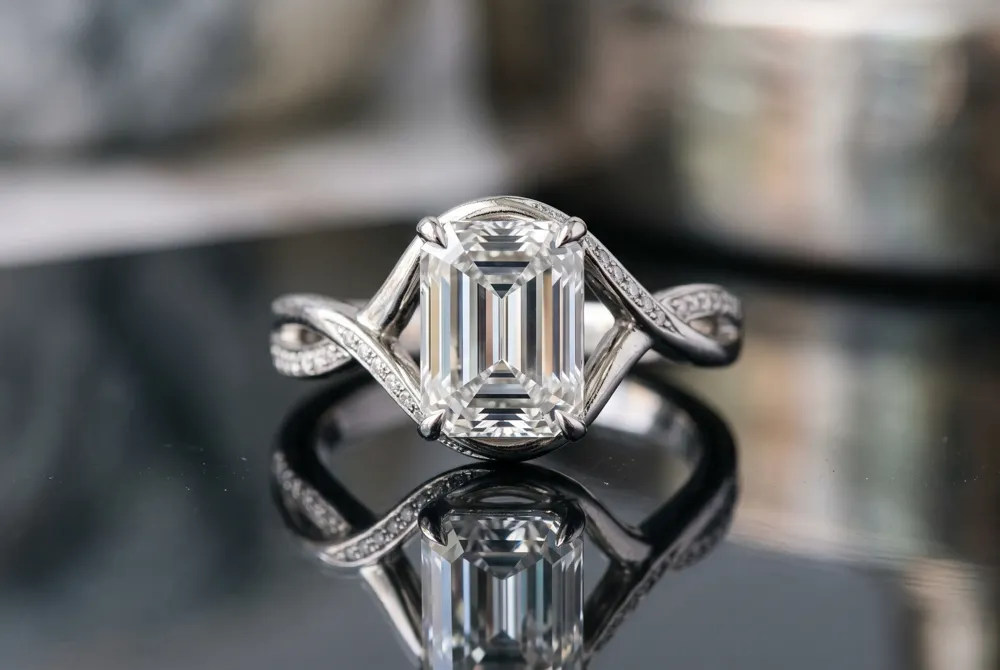
The emerald cut is a study in refined geometry and understated luxury—a silhouette that may speak to your own appreciation for architectural precision. Defined by its elongated rectangular silhouette, cropped corners, and step-cut facets, it produces a distinctive 'hall of mirrors' effect: broad, mirror-like flashes of light rather than the scattered sparkle of brilliant cuts. This cut emphasizes clarity and symmetry above all else, making it a perfect canvas for your personal style.
Our experts are here to guide you through the emerald cut's rich history, which began in the 1500s when it was first developed for emeralds to reduce pressure during cutting and prevent chipping. It rose to prominence during the Art Deco period of the 1920s and 1930s, when clean lines and geometric forms were celebrated. Today, its enduring appeal continues to inspire, and we take pride in helping you select an emerald cut that reflects your unique vision. With our personalized service, every detail—from clarity to symmetry—is tailored to your desires.
The Modern Brilliance of the Princess Cut
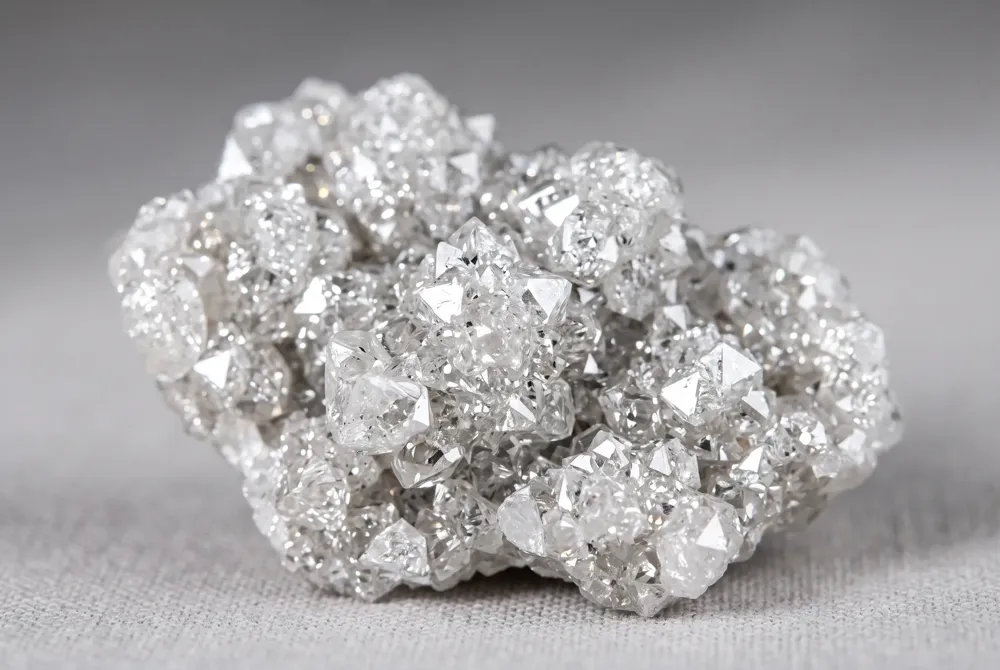
For those drawn to a bold, geometric silhouette and dazzling light performance, the princess cut stands as a defining choice. Developed in the 1960s, this square, brilliant-cut stone features 58 to 76 facets arranged in an inverted pyramid base. Its sharp, pointed corners and crisp lines create a contemporary, architectural appeal, making it one of the most popular diamond shapes today.
The princess cut's exceptional fire and sparkle result from its 'crushed ice' facet pattern, which delivers intense flashes of rainbow light. This brilliant-style cutting not only maximizes brilliance but also helps mask small inclusions, so a slightly lower clarity grade can still appear eye-clean. For those who want visible impact, a princess cut engagement ring offers a strong, luminous presence on the hand.
The princess cut has a notable place in modern design history, having been worn by style icons such as Meghan Markle, who chose a trilogy princess cut ring for her engagement. This geometric cut also makes efficient use of rough diamond material, often making it more affordable per carat than round brilliants. At Avittam Diamond Jewels, our curated princess cut rings pair this modern silhouette with traditional craftsmanship, offering options in solitaire, halo, and three-stone settings that highlight the stone's fire while ensuring a secure, protective prong arrangement around the vulnerable corners.
Sparkle. Princess cuts produce intense 'crushed ice' brilliance with strong fire and rainbow flashes, whereas emerald cuts create a more subdued 'hall of mirrors' gleam.Silhouette. The princess cut is square with sharp corners and a deep pavilion, while the emerald cut is elongated with cropped corners and a wider table that makes it appear larger face-up.Durability. Princess cuts require protective V-prongs or bezel settings to guard the pointed corners; emerald cuts' cropped corners are inherently less vulnerable.Clarity. The princess cut's intricate faceting hides inclusions well; the emerald cut's open step facets reveal them, demanding higher clarity grades.
A Tale of Two Silhouettes: Hall of Mirrors vs Crushed Ice
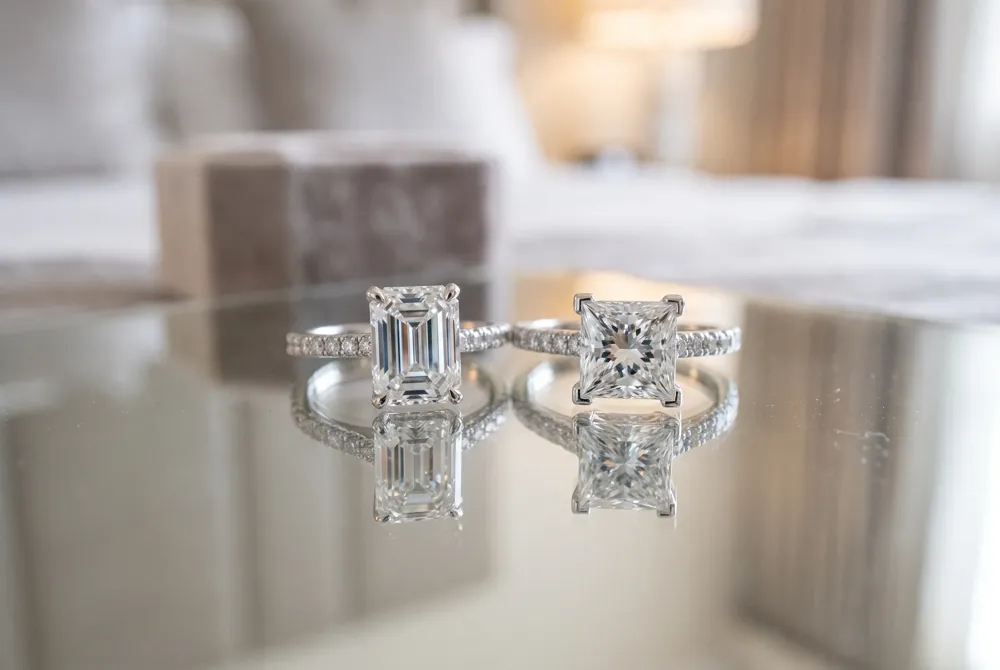
The most defining difference between these two silhouettes lies not in their outline but in their facet architecture. The emerald cut is a step cut with approximately 57 long, parallel facets that run like rungs across the stone. This structure creates the signature "hall of mirrors" effect — broad, deliberate flashes of light that move slowly as the ring turns, emphasizing clarity and geometry over scattered fire.
The princess cut belongs to the brilliant-cut family, typically carrying 58 to 76 facets arranged in a chevron pattern beneath a square face. This dense facet layout produces an intense "crushed ice" sparkle — a shower of tiny, rainbow-colored points of light that give the stone exceptional brilliance. The princess cut's sparkle is active and lively in almost any lighting condition.
When set in moissanite, both cuts are affected by the gemstone's double refraction, which bends light along two paths instead of one. In the emerald cut, double refraction softens the step facets, producing a slightly warmer, more fluid glow. In the princess cut, it amplifies the already intense fire, creating an even more dramatic display of spectral color.
The two cuts also differ in how they handle clarity and color. The emerald cut's large, open table acts like a window into the stone, making any inclusion or hint of warmth clearly visible. The faceting of the princess cut, by contrast, breaks up the internal view, effectively masking small imperfections and allowing slightly lower color grades to still appear bright to the eye.
Face-Up Size and Finger Appearance
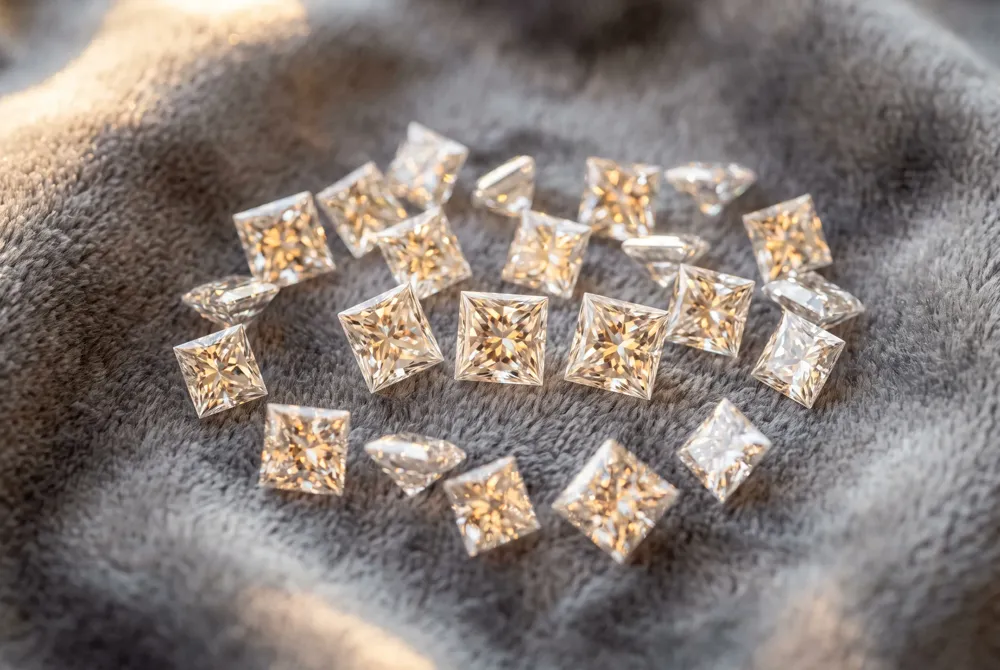
The visual presence of a center stone on the hand is shaped by more than its carat weight. How its proportions and facet structure distribute that weight determines how large the stone appears when viewed from above.
An emerald cut typically shows a larger face-up size per carat than many other cuts. Its elongated, rectangular silhouette and broad, open table create generous surface coverage, often making the stone appear more substantial than its carat weight would suggest. The classic length-to-width ratio of 1.30–1.50 extends the shape along the finger, producing a lengthening effect that many find flattering.
The princess cut presents a different visual dynamic. A significant portion of its carat weight sits in the deep pavilion, so the face-up table can appear deceptively smaller compared to an emerald cut of the same carat weight. Its ideal proportions hover near a square ratio of 1.00–1.05, creating a compact, geometric silhouette that concentrates its sparkle into a dense, brilliant focal point.
This difference means that buyers who prioritize a bold, elongated look often gravitate toward the emerald cut. Those who favor a well-defined, brilliant square may prefer the princess cut, while noting that the same carat weight yields a smaller face-up spread. At Avittam Diamond Jewels, our detailed product guides and virtual consultations help couples see exactly how each cut's proportions translate to real-world size on the hand, so the choice reflects personal style rather than guesswork.
Durability and Protective Settings
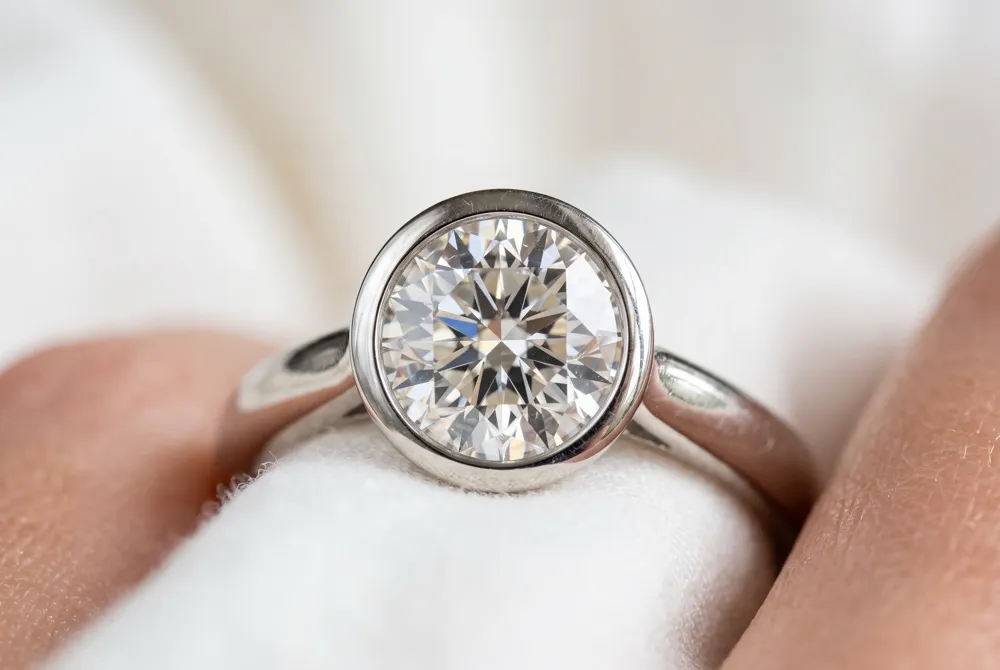
For your emerald cut or princess cut engagement ring, the corners benefit from thoughtful setting design. Your emerald cut's four cropped corners are less vulnerable than sharp points but still deserve protection from daily wear. Your princess cut, with its four pointed corners, or marquise cut, with its two pointed ends, requires deliberate shielding to prevent chipping over years of use.
Standard prongs leave pointed corners exposed to snagging and impact. Jewelers recommend V-shaped prongs that cradle each corner individually, or a setting that wraps the stone completely. Prongs that resemble claws are another solid option for both cuts. A setting that surrounds the stone entirely, often available through Avittam Diamond Jewels custom design service, provides the most complete protection while lending a clean, modern silhouette.
The gemstone material also plays a role in long-term durability. Moissanite ranks 9.25 on the scale of mineral hardness, second only to diamond's 10, making it suitable for everyday wear in either cut. Diamond, while the hardest natural substance, has a natural direction of weakness along which it can split under a sharp blow. Moissanite has no such natural plane of weakness, offering a practical advantage in chip resistance. For a ring worn daily, both stones are robust when paired with a protective setting.
Moissanite vs Diamond: Understanding the Gemstone Choice
Moissanite and diamond share a similar elegant silhouette, but their chemistry and optical personalities are distinctly different. Diamond is pure carbon, while moissanite is silicon carbide, a material discovered in 1893 by scientist Henri Moissan inside a meteorite. Natural moissanite is exceedingly rare, so nearly all moissanite available today is lab-created, offering an ethical, traceable alternative for the conscientious couple.
The visual distinction comes down to light performance. Moissanite has a refractive index of 2.65 to 2.69, significantly higher than diamond's 2.42, which means it bends and returns light with more intensity. The result is greater fire and brilliance, producing vivid rainbow flashes of light that a diamond's predominantly white sparkle does not replicate. In direct sun, a moissanite can appear to shimmer with a vibrant, fiery radiance that some describe as a '"disco ball"' effect.
Price and Practical Considerations
The most dramatic difference is in cost. Moissanite typically sells for 80 to 90 percent less than a comparable diamond, allowing you to select a larger center stone without exceeding your budget. Because moissanite is measured by millimeter rather than carat weight, a 1.0 carat equivalent moissanite (roughly 6.5 mm) costs a fraction of a similarly sized diamond. For example, a princess cut moissanite in a delicate solitaire setting can achieve the same commanding presence as a far more expensive natural diamond.
Trained jewelers can distinguish moissanite from diamond using a loupe to observe double refraction, where facet edges appear slightly doubled. But to the untrained eye, high-quality moissanite is essentially indistinguishable from a diamond. With a Mohs hardness of 9.25, moissanite is durable enough for daily wear and can last a lifetime with proper care. For those who prize brilliance, sustainability, and exceptional value, moissanite stands as a legitimate gemstone in its own right.
Addressing Concerns About Moissanite
As with any gemstone, moissanite has a few defining characteristics that every discerning buyer should consider before making a commitment. Its higher refractive index, while responsible for the stone's dazzling fire, can also produce a pronounced rainbow effect in certain lighting that some may find less subtle than the classic white flash of a diamond. Additionally, some moissanite stones may display a faint yellow or green tint under specific conditions, though premium grades are carefully selected to minimize this. On value retention, moissanite does not hold its resale value in the same way a diamond does, as it is a simulant rather than a precious gem.
In terms of daily wear, moissanite's hardness of 9.25 on the Mohs scale makes it exceptionally durable, but it is slightly more prone to surface scratching over a lifetime than a diamond, which ranks a perfect 10. For a ring meant to accompany you every day, this is a practical factor to weigh when choosing between an emerald cut engagement rings moissanite or a princess cut design.
It is, however, entirely suited for fine jewelry. Moissanite is not a cheap imitation; it is a distinct, lab-created gemstone prized for its exceptional brilliance and ethical provenance. The very qualities that invite scrutiny—its brilliant fire and near-flawless clarity—are the same attributes that make it a sophisticated and conscientious choice. Whether set in a simple solitaire or an elaborate halo, the stone’s beauty stands on its own merit.
A growing number of affluent individuals choose moissanite for its ethical sourcing and remarkable value. Wealth does not dictate gemstone preference; personal style and values guide the choice. For those who appreciate both artistry and responsibility, an emerald cut engagement rings moissanite offers the same refined elegance found in fine jewelry. Ultimately, the decision reflects a modern understanding of luxury that prioritizes beauty, craftsmanship, and integrity over convention alone.
Emerald Cut vs Radiant Cut: A Common Point of Confusion
Both the emerald cut and the radiant cut share a rectangular silhouette, but their personalities could not be more different. The emerald cut belongs to the step-cut family, with long, parallel facets that create a "hall of mirrors" effect of broad, deliberate reflections. This design emphasizes clarity and symmetry, offering an understated, refined glow rather than scattered sparkle.
The radiant cut, in contrast, is a brilliant cut with a fully faceted pavilion engineered to deliver exceptional brilliance and fire. A radiant moissanite in a rectangular shape captures light from every angle, producing the intense, colorful sparkle that many associate with a princess cut. For those drawn to a rectangular outline but who want the vibrant light performance of a brilliant stone, the radiant cut is a compelling choice.
Emerald Cut. Step-cut facet structure. Broad, mirror-like light reflections. Prioritizes clarity and a linear, architectural aesthetic. Appears larger face-up for its carat weight.Radiant Cut. Brilliant-cut facet structure with a faceted pavilion. Maximizes sparkle and fire with up to 70 facets. Forgiving of minor inclusions. Offers a vibrant, luminous appearance.
When choosing between an emerald cut and a radiant cut, consider how you want the gemstone to interact with light. If your preference leans toward the quiet poise of the "hall of mirrors" effect, the emerald cut reflects your love of subtle luxury. If you desire a rectangular silhouette that sparkles with the same intensity as a princess cut, a radiant cut delivers that modern brilliance without compromising on shape.
Princess Cut vs Cushion Cut: Modern vs Vintage
The choice between a princess cut and a cushion cut engagement ring often reflects a deeper aesthetic preference: modern precision versus vintage romance. Both are square silhouettes, yet their personalities diverge completely in facet structure and light performance.
The Princess Cut: Bold Geometry and Dazzling Sparkle
The princess cut is defined by its sharp, right-angled corners and brilliant-cut faceting with 58 to 76 facets, creating intense fire and a vibrant, crushed-ice sparkle. This square modified brilliant delivers a crisp, architectural look that feels distinctly contemporary. Its deep pavilion places much of the carat weight below the surface, so a princess cut of a given weight may appear slightly smaller face-up than a cushion cut of the same carat weight.
The Cushion Cut: Soft Curves and Romantic Glow
The cushion cut, one of the oldest diamond shapes dating back nearly two centuries, features soft, rounded corners and larger, more open facets. Its pillow-like silhouette produces a gentle, romantic glow rather than sharp flashes, evoking a vintage or antique-inspired charm. The cushion cut often appears larger face-up per carat than a princess cut due to its shallower depth and broader surface area.
For the modern bride drawn to strong lines and high fire, the princess cut excels. For those who desire a softer, Old World aesthetic with subtle warmth, the cushion cut is a natural fit. Avittam Diamond Jewels offers both shapes in moissanite and lab-grown diamond, allowing you to select the silhouette that best expresses your love story.
Face-Up Size and Finger Appearance
Because a cushion cut is less deep, a 1-carat cushion stone typically spreads wider than a 1-carat princess cut. The cushion's rounded profile also creates a softer visual on the finger, while the princess cut's sharp corners produce a more assertive, angular presence. Both shapes can be set in solitaire, halo, or three-stone settings to enhance their character.
| Feature | Princess Cut | Cushion Cut |
|---|---|---|
| Corners | Sharp, right-angled | Soft, rounded |
| Faceting | Brilliant (58–76 facets) | Brilliant or modified; larger facets |
| Sparkle pattern | Crushed ice / high fire | Gentle glow / romantic sheen |
| Face-up size per carat | Smaller (deep pavilion) | Larger (shallower depth) |
| Vibe | Modern, architectural | Vintage, romantic |
The Marquise Cut: A Third Alternative for Elongated Elegance
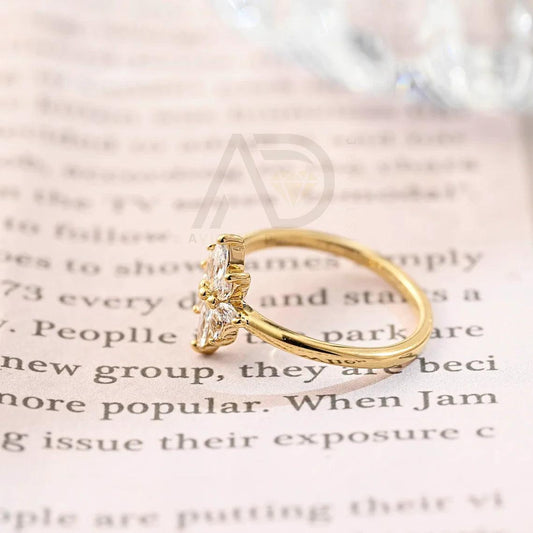
For couples drawn to the graceful elongation of an emerald cut but seeking a silhouette with even more drama and history, the marquise cut offers a compelling third option. Its distinctive boat shape with pointed ends creates a sweeping, elongated line that immediately draws the eye along the finger.
The marquise cut is steeped in romance, with its origins traced to 18th-century France, where it was reportedly inspired by the smile of the Marquise de Pompadour. This classical heritage lends the cut a vintage elegance that feels both storybook and sophisticated. With its many facets, the marquise cut produces a flowing, liquid shimmer rather than the blocky flashes typical of step-cut styles, giving it a distinctly different sparkle from the emerald cut.
One of the marquise cut's most practical advantages is its face-up size: at the same carat weight, a marquise typically offers 15-20% more visible surface area than a round cut, meaning your stone appears larger without increasing carat weight. This elongated shape is also flattering on the hand, as it creates the illusion of longer, more slender fingers — an effect it shares with the emerald cut.
Like the princess cut, the marquise has vulnerable pointed ends that require a protective setting to prevent chipping. Protective prongs or a setting that surrounds the stone are excellent choices for guarding these tips. At Avittam Diamond Jewels, our experts work closely with you to select marquise cut moissanite options in settings that balance the stone's vintage charm with secure, everyday durability, ensuring a piece that reflects your personal style.
Popular Ring Settings for Emerald and Princess Cuts
The setting you choose frames the center stone and shapes the ring's personality. Both the emerald cut and the princess cut offer distinct silhouettes that pair beautifully with different setting styles. Understanding how each setting enhances the cut's unique character helps you find a ring that feels truly yours.
Settings for the Emerald Cut
A solitaire setting places the focus entirely on the emerald cut's clean lines and the hall-of-mirrors effect created by its step-cut facets. A pavé band adds a delicate contrast of sparkle along the shank, while a hidden halo provides a subtle glint of brilliance from beneath the stone without distracting from its geometry. Three-stone settings with tapered baguette side stones emphasize the emerald cut's Art Deco elegance. For those who prefer a more protective frame, a bezel setting wraps the gem completely, safeguarding its cropped corners while preserving its sleek profile.
Settings for the Princess Cut
The princess cut moissanite engagement ring shines in settings that accentuate its modern, architectural shape. A solitaire lets the stone's 58 or more facets capture light from every angle. A halo of smaller stones amplifies the princess cut's already intense fire, making the center appear larger. The compass setting rotates the princess cut 45 degrees to create a diamond-within-a-diamond effect, a favorite for those who appreciate unconventional styling. Three-stone arrangements and pavé bands also work well, drawing the eye to the stone's brilliant sparkle.
Metal Choices
Platinum offers natural white brilliance and exceptional strength, ideal for protecting the princess cut's vulnerable corners or holding the emerald cut's open setting. White gold provides a similar cool look at a more accessible price point. Yellow gold warms the stone and pairs especially well with the vintage character of an emerald cut. Rose gold lends a romantic blush that complements both shapes.
At Avittam Diamond Jewels, each setting is crafted to highlight the individual character of your chosen cut, whether you prefer the understated elegance of an emerald cut or the bold sparkle of a princess cut. The ability to mix a refined solitaire with a pavé band allows you to create a ring that reflects your personal style while ensuring the stone's beauty is the star of the design.
Making Your Choice: Timeless Grace or Modern Fire
The decision between these two iconic silhouettes is a reflection of the story you wish your ring to tell. The emerald cut moissanite engagement ring speaks with understated elegance and a quiet, hall-of-mirrors grace. Its elongated facets create broad, deliberate flashes of light and offer a larger surface area for its weight, making it a classic choice for those who favor refined symmetry over scattered sparkle.
The princess cut moissanite, by contrast, declares its presence with brilliant fire and modern geometry. Its many facets produce a vibrant, crushed-ice sparkle that seems to dance with every movement. For the value-conscious couple, its exceptional brilliance and value offer an exceptional blend of visual impact and affordability.
Your final choice should consider not only your personal style but also your daily lifestyle. Do you prefer the graceful, architectural statement of the emerald cut or the bold, lively shimmer of the princess? Both cuts are well-suited for a lifetime of wear in moissanite, and each tells a distinct story. Explore both in their full radiance at Avittam Diamond Jewels to see which silhouette feels like your own.
Your Ring: Your Narrative
The selection between an emerald cut and a princess cut ultimately reflects the narrative you wish to tell. An emerald cut speaks to those who find beauty in restraint, clarity, and the quiet confidence of understated luxury. A princess cut resonates with those who embrace bold geometry, vibrant light, and a modern, celebratory sparkle.
At Avittam Diamond Jewels, our commitment is to help you discover a ring that feels authentically yours. Through our bespoke ordering service, you can customize every detail, from the metal to the engraving, while our virtual try-on tools and detailed product guides bring the journey to you. We invite you to consider a piece that celebrates your unique connection, crafted to be a lasting symbol of the beauty you have built together.