
The Marquise Shape and Its Appeal
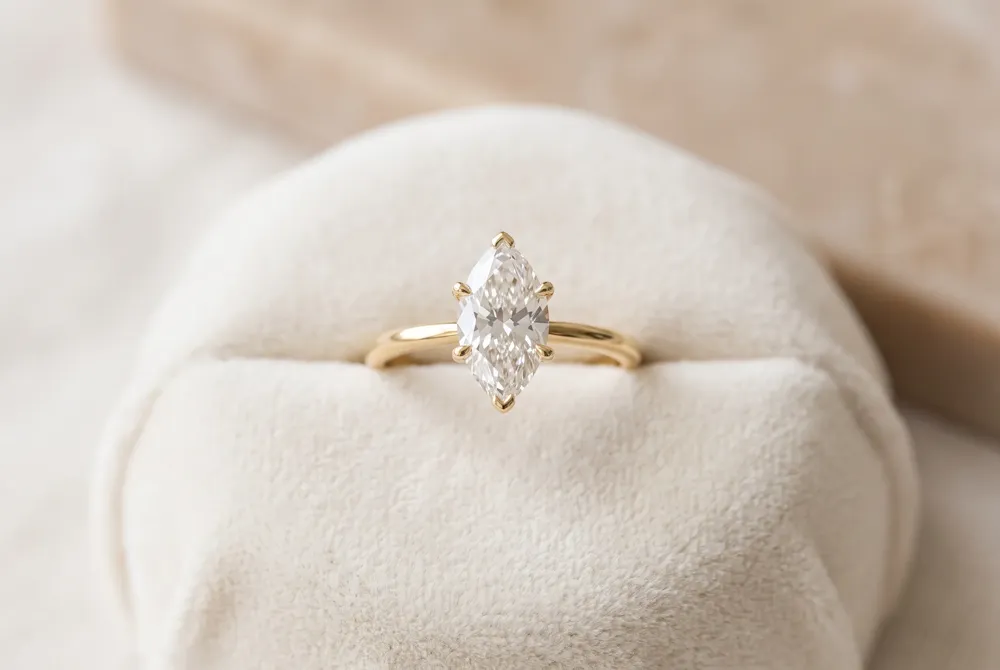
A marquise cut engagement ring stands apart through its long, boat-like outline, gently curved sides, and two pointed ends. GIA also calls the shape a navette, from the French word for “little ship,” a fitting description of its graceful silhouette.
That elongated form spreads the diamond’s weight across a broad face-up surface, so a marquise can appear larger than a round diamond of the same carat weight. Its length may also create the impression of longer, more slender fingers. These visual qualities make the shape distinctive without relying on a larger carat number. GIA’s guide to choosing a marquise diamond explains how face-up appearance and proportions affect the way a stone looks.
The setting shapes the ring’s overall impression, too. A solitaire leaves the marquise outline unobstructed, drawing attention to its sweeping length and pointed tips. A halo or smaller accent diamonds frame the center stone, adding detail and making the design feel more ornate. The right choice depends on whether you prefer the clean presence of the center diamond or a more embellished composition.
At Avittam Diamond Jewels, the bespoke ordering service lets couples customize a ring’s design and metal, helping them consider the center stone as part of a complete piece rather than on its own. When comparing options, look at how the setting balances the marquise’s length, the band, and any accent stones.
The shape also carries a history in bridal jewelry. Marquise diamonds appeared in Edwardian designs and returned to prominence in 1970s bridal styles, giving today’s rings a link to earlier eras while retaining a distinct, contemporary presence. Whether paired with a simple band or a detailed setting, a marquise offers a silhouette with a character all its own.
Carat Weight Versus Visible Size
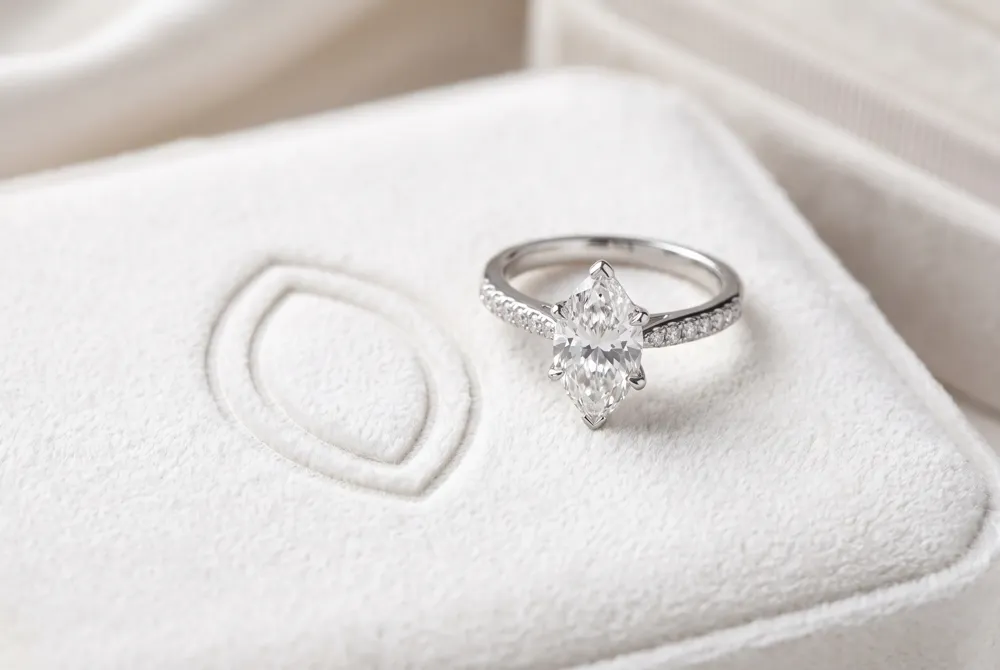
When comparing a marquise cut engagement ring, remember that carat describes a diamond’s weight, not the dimensions visible from above. Length and width show its face-up spread, while proportions and depth affect how much of its weight contributes to that visible area. A marquise can appear large for its weight, but the individual stone matters more than the carat figure alone.
Two marquise diamonds with the same carat weight may have different measurements and a different presence on the hand. A deeper stone can carry more weight below the surface, while a stone with a broader spread may look larger face-up. The GIA guide to choosing a marquise diamond explains why comparing a stone’s dimensions and proportions alongside its weight gives a fuller picture.
As a rough reference, a one-carat marquise may measure about 10 × 5 mm, while a two-carat stone may be around 13 × 6.5 mm. These are estimates, not fixed conversions. Actual dimensions vary with the diamond’s proportions and depth, so a chart cannot guarantee how a particular stone will look.
For a more useful comparison, review each diamond’s listed length and width as well as its carat weight. Millimeter measurements help you consider finger coverage; viewing the stone face-up reveals its outline and overall visual presence. At Avittam Diamond Jewels, a curated selection of diamonds and detailed product guidance can help couples weigh those measurements against the appearance they want in a finished ring.
Choosing a Marquise Proportion
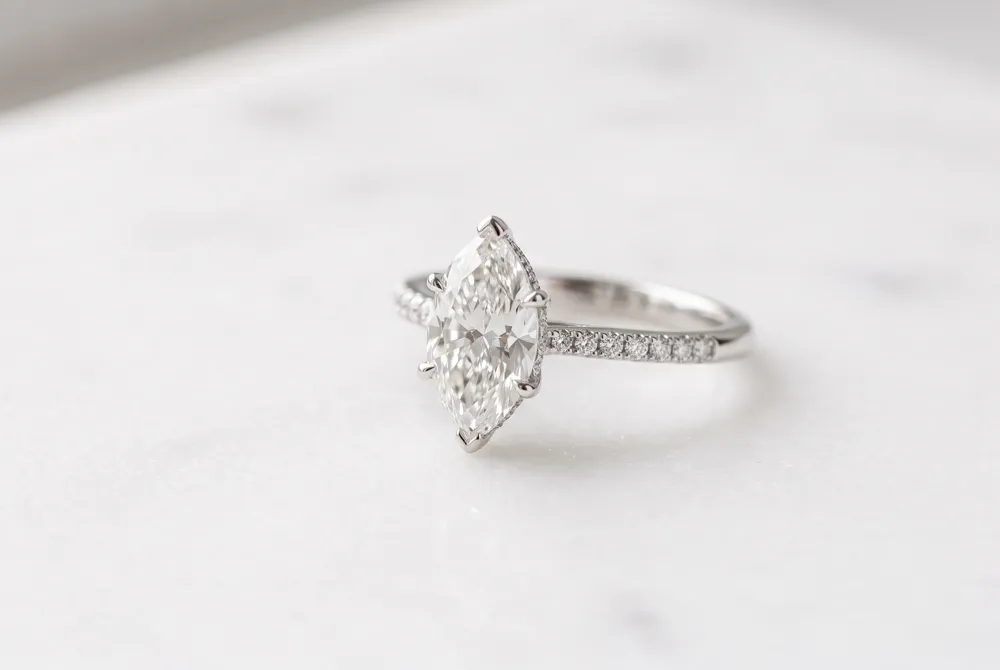
When comparing a marquise cut engagement ring, look beyond carat weight to the diamond’s outline. Its length-to-width ratio is calculated by dividing the point-to-point length by the width across its widest central area, called the belly.
A range of roughly 1.75:1 to 2.15:1 can be a useful starting point, not a universal ideal or a measure of cut quality. GIA notes that marquise diamonds submitted to its laboratory commonly fall between 1.6:1 and 2.2:1, while a proportion close to 2:1 is often preferred for a balanced outline. GIA’s marquise diamond guide offers a helpful reference, but your own sense of proportion should guide the choice.
A lower ratio creates a broader, fuller silhouette; a higher one produces a longer, narrower look. Neither is inherently better. The right proportion depends on the character you want, whether that is a softly balanced shape or a more elongated line.
Ratio alone cannot tell you exactly how a diamond will look. Stones with the same ratio may differ in their measurements, point definition, and balance of curved sides. Compare clear face-up images and inspect each stone’s outline rather than treating a number as a verdict. Avittam Diamond Jewels offers a virtual try-on tool, which can help you consider a preferred silhouette in context on your hand.
What length-to-width ratio should you consider for a marquise diamond? If virtual viewing is available, try the shape against your hand and choose the outline that feels harmonious to you.
Assessing Shape, Symmetry, and Light
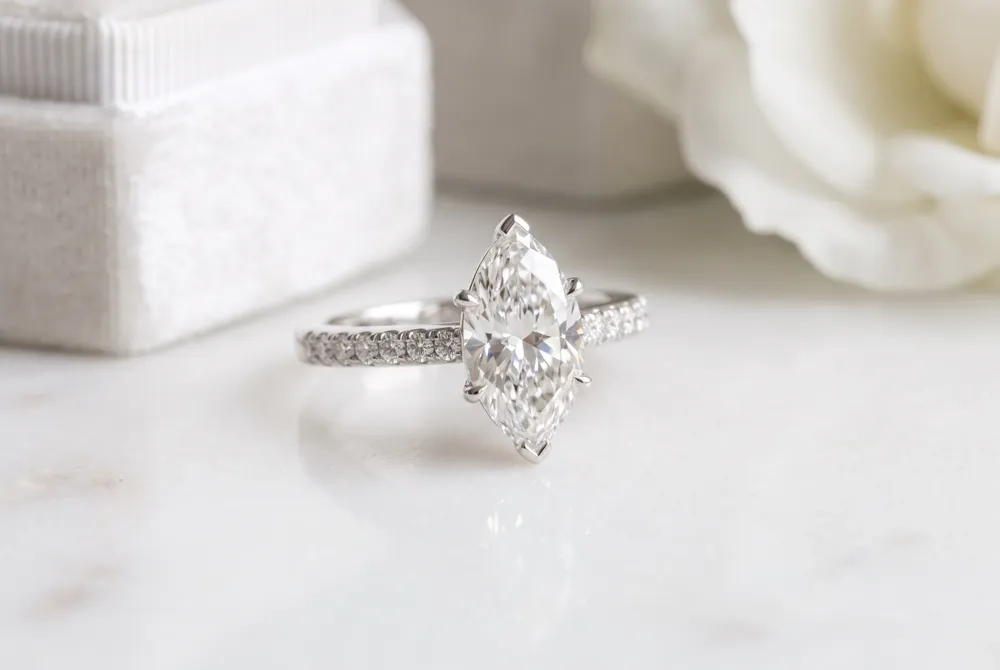
When assessing a marquise cut engagement ring, consider the diamond’s outline and light performance together. From above, the two points should align, the halves should look balanced, and the wings should form smooth, even curves. Clearly defined tips preserve the shape’s crisp silhouette, while flat or bulging wings, uneven curves, or rounded points can make it look less graceful.
Symmetry and shape appeal are related, but they are not the same. A grading report can offer useful information about symmetry, yet it cannot tell you whether the overall outline feels pleasing. The GIA’s guidance on choosing a marquise diamond recommends considering the whole stone, including the balance of its halves and the placement of corresponding facets.
Many brilliant-style marquise diamonds show a bow-tie, a darker area across the center created by the way their facets reflect light. Some degree is typical, and a soft shadow can contribute character. A dark or wide bow-tie, however, may distract from the diamond’s brightness. The aim is not necessarily to find a stone with none, but to decide whether the effect is pleasing on that individual diamond.
What should I look for in a marquise diamond’s cut and proportions?
Start with an unaided, face-up view in ordinary lighting, at the distance from which the ring would normally be seen. Check whether the points align, the wings mirror each other, and the facets return light attractively. Watch the stone move if possible, since the bow-tie and brightness can change with its angle and surroundings.
Photos and video can help when an in-person inspection is not possible, especially if they show the diamond face-up in neutral lighting and in motion. At Avittam Diamond Jewels, detailed product guidance and virtual try-on tools support online shoppers, while a bespoke service allows the ring’s design to be personalized around the chosen stone.
Table and depth percentages can help you compare candidates, but they do not provide a definitive cut grade for a marquise. GIA notes that the shape’s appeal depends on how the outline, symmetry, facet pattern, brightness, and bow-tie work together. A ratio can serve as a starting point for comparing silhouettes, but direct visual assessment should decide whether a particular stone is right for you.
Settings That Frame and Protect
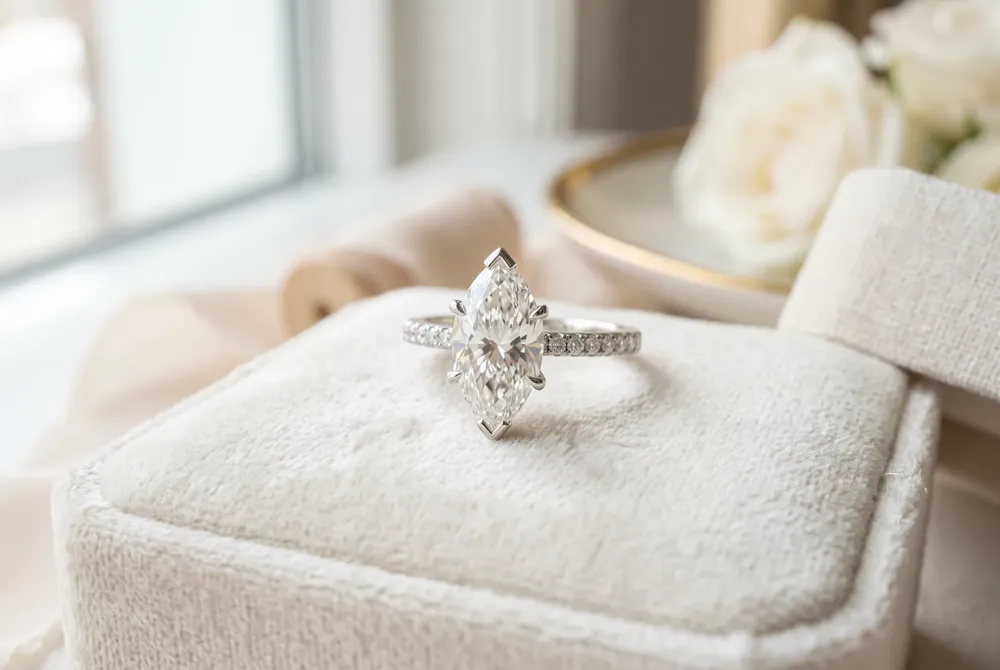
A setting for a marquise cut engagement ring should do more than complement its graceful outline. The pointed ends are especially vulnerable to chipping, so protection at both tips deserves attention alongside the diamond’s appearance. The Gemological Institute of America’s guidance on marquise diamonds notes that the points are the stone’s most vulnerable areas and that a setting can help protect them.
V-prongs are shaped to cover each point, while additional prongs can provide support along the stone’s sides. A bezel, which surrounds more of the diamond’s edge, offers another protective approach, but it also changes how much of the outline and edge remain visible. The right choice depends on how you balance security, comfort, and the look you want for daily wear.
A solitaire leaves the marquise outline at the center of attention. A halo or side stones add surrounding brilliance, while a slim band can make the center diamond appear more prominent by contrast. Neither approach is universally best: consider the wearer’s style and how the center stone relates to the band and any wedding ring.
Orientation also shapes the finished design. A traditional north-south setting follows the finger’s length; an east-west setting places the diamond across it for a distinct profile. Band width and metal color contribute to the overall balance, as does whether the engagement ring sits comfortably beside a wedding band.
At Avittam Diamond Jewels, bespoke ordering allows couples to personalize a ring’s design, metal, and engraving. Virtual try-on tools can help compare how different proportions and orientations look, while a design discussion can bring comfort and everyday wear into the decision. Consider the complete ring on the hand, not just the center stone in isolation.
Considering Larger Carat Sizes
A 2.5- or 3-carat marquise diamond is not inherently too large for an engagement ring. The right size depends on the wearer’s taste, comfort, hand proportions, chosen setting, and budget. Since a marquise can look especially prominent face-up, compare its actual dimensions as well as its carat weight, as GIA’s guide to marquise diamonds advises.
As one example, a 2.5-carat marquise may measure around 13.08 × 7.03 mm. Individual stones vary, so treat those measurements as a reference rather than a guarantee. A diamond’s proportions and depth affect its face-up spread, and two stones with the same carat weight may not occupy the same amount of space on the hand.
For a marquise cut engagement ring, seeing the stone in context can make the decision more intuitive. Compare clear images or a virtual try-on against the wearer’s hand, and consider how the center diamond sits alongside the band. A larger stone should feel balanced with the hand and comfortable for the wearer’s daily life, not simply impressive on paper.
The setting also matters, particularly because the marquise’s pointed ends need protection. Confirm that both tips are securely held, whether by protective prongs or another suitable design, while ensuring the setting still suits the wearer’s preferred look. At Avittam Diamond Jewels, bespoke ordering lets couples tailor a ring’s design and metal, helping them consider the center stone and setting as a complete piece.
There is no universal maximum carat size for an engagement ring. The most fitting choice is the one that feels natural on the hand and reflects the wearer’s sense of presence and comfort. Comparing dimensions, trying a clear visualization, and planning the setting together can help make that choice with confidence.
Balancing Presence, Quality, and Budget
A marquise cut engagement ring is best judged as a complete diamond, not by its carat number alone. Balance visible spread and light performance with color, clarity, budget, and the look you want on your hand. GIA’s marquise diamond guidance recommends assessing the individual stone’s outline, proportions, and appearance rather than treating one measurement as a universal ideal.
Color can be more noticeable near a marquise diamond’s pointed ends, while the visibility of inclusions varies from stone to stone. A grading report helps describe a diamond, but it cannot tell you exactly how those features will appear face-up. Consider the actual stone in clear images or video, and compare it in the setting you have in mind.
A smaller diamond with pleasing brightness and balanced proportions may feel more beautiful than a larger one that asks you to compromise on qualities you value. Conversely, a larger diamond with slightly lower color or clarity may matter more to you than maximum brilliance. The right choice is the one that aligns with your personal preferences and the way the ring will be worn every day. Balance presence, quality, and budget together, and let the stone itself guide your decision rather than a number on the report.
Choose the Diamond That Feels Yours
Choosing a marquise cut engagement ring is a matter of weighing more than carat weight. Compare each diamond’s face-up length and width, then consider whether its proportions create the outline you prefer. A marquise can appear larger than a round diamond of the same weight, so measurements offer useful context alongside the carat figure. GIA’s marquise diamond guide explains why both weight and visible dimensions matter.
Look at the diamond face-up in ordinary lighting to judge its brightness, symmetry, and any central bow-tie shadow. Consider how the setting will frame the stone and protect its pointed ends, as well as how its style and scale feel on the wearer’s hand. At Avittam Diamond Jewels, bespoke ordering allows couples to personalize a ring’s design, metal, and engraving around the stone they choose.
There is no universal ideal carat size or length-to-width ratio. The right marquise feels balanced on the hand, reflects the wearer’s taste, and fits the budget without sacrificing the qualities that matter most. Take time to compare individual stones, and seek personalized guidance as you consider the details. A thoughtful choice is one you will be glad to wear for years to come.