
Two Brilliant Stones for a Timeless Silhouette
Choosing a center stone for your engagement ring is a deeply personal decision, one that balances beauty, budget, and meaning. The pear‑shaped silhouette, with its graceful teardrop form and rich history dating back to the 15th century, presents a particularly elegant canvas for either of the two leading contenders: moissanite and diamond.
This guide offers a side‑by‑side comparison of these two extraordinary gemstones, from the quality of their sparkle to their durability, cost, and long‑term value. Whether you are drawn to the white brilliance of a diamond or the vivid fire of a moissanite, understanding how they differ will help you select the stone that best reflects your own kind of timeless elegance.
Moissanite vs Diamond Side by Side: What Sets Them Apart
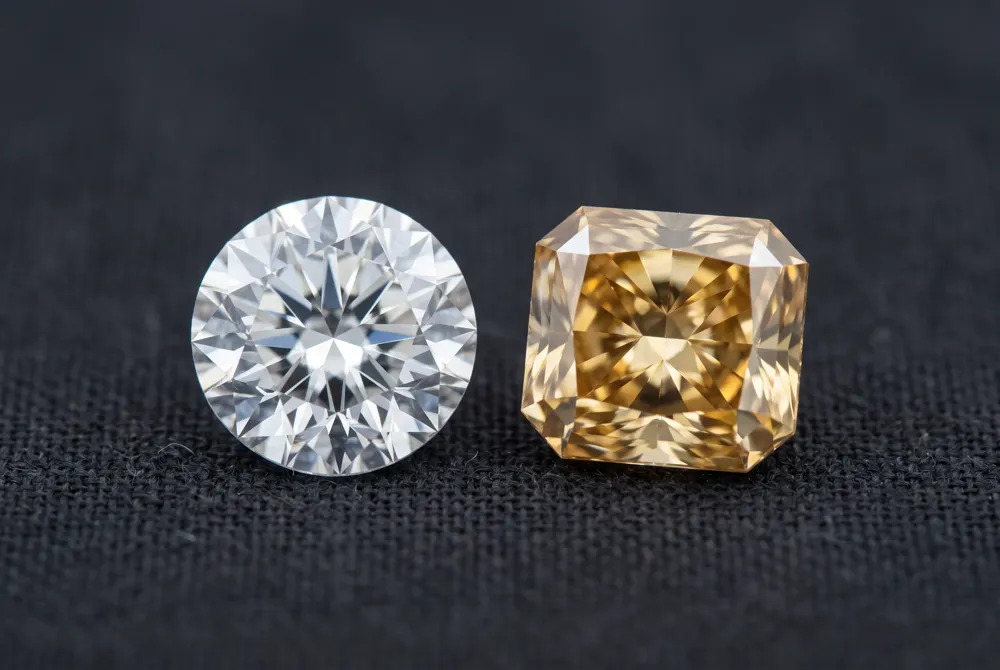
When comparing moissanite and a diamond, the most notable differences lie in their material composition and optical properties. A diamond is pure carbon, formed under extreme pressure over billions of years, while moissanite is silicon carbide, a rare mineral discovered in a meteorite and now exclusively lab-created for jewelry use.
Moissanite is not a lab-grown diamond. While both are created in laboratories, they are chemically distinct: lab-grown diamonds are crystallized carbon, just like natural diamonds, whereas moissanite is composed of silicon carbide. This makes moissanite a diamond simulant, not a diamond itself, a distinction that matters when evaluating beauty and value.
Optically, the stones produce very different kinds of light. Moissanite’s higher refractive index and dispersion produce a vivid, colorful sparkle known as fire, while a diamond’s sparkle is subtler and more focused on white brilliance. Price adds one more clear difference: moissanite costs 80 to 90 percent less than a comparable natural diamond, positioning it as an exceptional choice for budget-minded buyers who still want a large, striking stone.
At Avittam Diamond Jewels, you can view these distinctions firsthand. Each pear-shaped engagement ring in the collection can be set with either a natural diamond or a premium moissanite, allowing you to compare their fire, brilliance, and presence on your hand before making your choice.
Optics Revealed: Moissanite Fire vs Diamond Brilliance
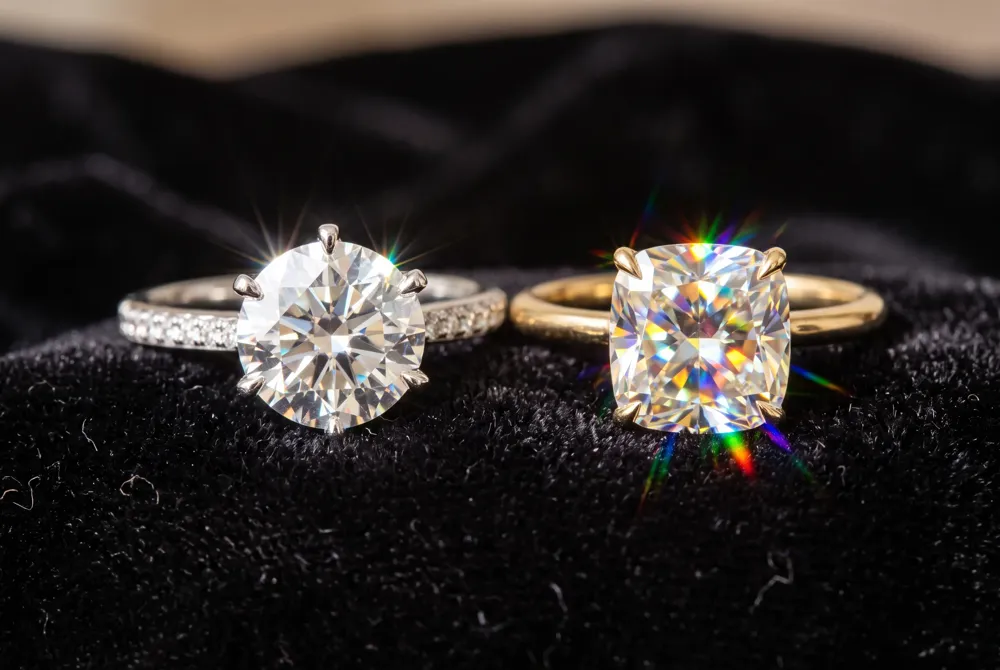
When placed side by side, the first thing you notice is how the two stones handle light. A diamond’s sparkle is precise and white, a classic ice-like brilliance that has defined diamond engagement rings for generations.
Moissanite, by contrast, is a gem of pure light play. Its refractive index of 2.65–2.69 (compared to diamond’s 2.42) means it bends light more dramatically. Its dispersion value of 0.104 is roughly 2.4 times that of diamond’s 0.044, translating into vivid rainbow flashes—especially apparent in pear shaped engagement rings, where the broad facets catch and split light into a fiery display.
Moissanite is also doubly refractive. Under a loupe, you may see “doubling” of the back facet junctions—a hallmark that trained gemologists use to distinguish it from singly refractive diamond. In strong overhead fluorescent or direct sunlight, that extra fire can make moissanite appear more intensely colorful, while a diamond stays crisp and subdued.
For a side-by-side comparison, the difference is straightforward: diamond offers a controlled, white radiance, while moissanite delivers a more exuberant, multicolored sparkle. Couples drawn to a dramatic, luminous presence often find moissanite’s optical personality a natural fit.
Hardness and Durability: Moissanite Closes the Gap on Diamond
When two gemstones are placed side by side, their beauty is the first thing you notice. Their ability to endure a lifetime of daily wear is what makes that beauty last. Both diamond and moissanite rank among the hardest materials used in jewelry, but they achieve their hardness through different crystal structures.
On the Mohs scale of mineral hardness, diamond holds the top position at 10, while moissanite scores a 9.25. This makes moissanite the second-hardest gemstone in common use, well above sapphires, rubies, and emeralds. A diamond will scratch a moissanite if they come into direct contact, but in everyday wear, moissanite resists abrasion from dust, metal, and most household surfaces with ease. Neither stone will cloud or dull over time, and both are far more durable than cubic zirconia.
The less obvious factor is a gemstone's resistance to chipping. Diamond can chip or split if struck sharply in certain directions due to its crystal structure. Moissanite is less likely to chip from side impacts, making it more forgiving. In practical terms, a pear-shaped moissanite with its vulnerable tip is often more resilient against an accidental knock than a pear-shaped diamond. For couples choosing a pear-shaped engagement ring, this extra toughness offers real peace of mind without sacrificing brilliance.
Both stones are well suited for a lifetime of daily wear. Diamond retains a slight edge in long-term scratch resistance due to its absolute hardness, but moissanite closes that gap with better resistance to chipping. When you choose a pear-shaped engagement ring from Avittam Diamond Jewels, the setting is crafted to protect the tip either way, so the stone’s durability complements the design rather than dictating it.
The Price Difference: Moissanite vs Diamond Cost Comparison
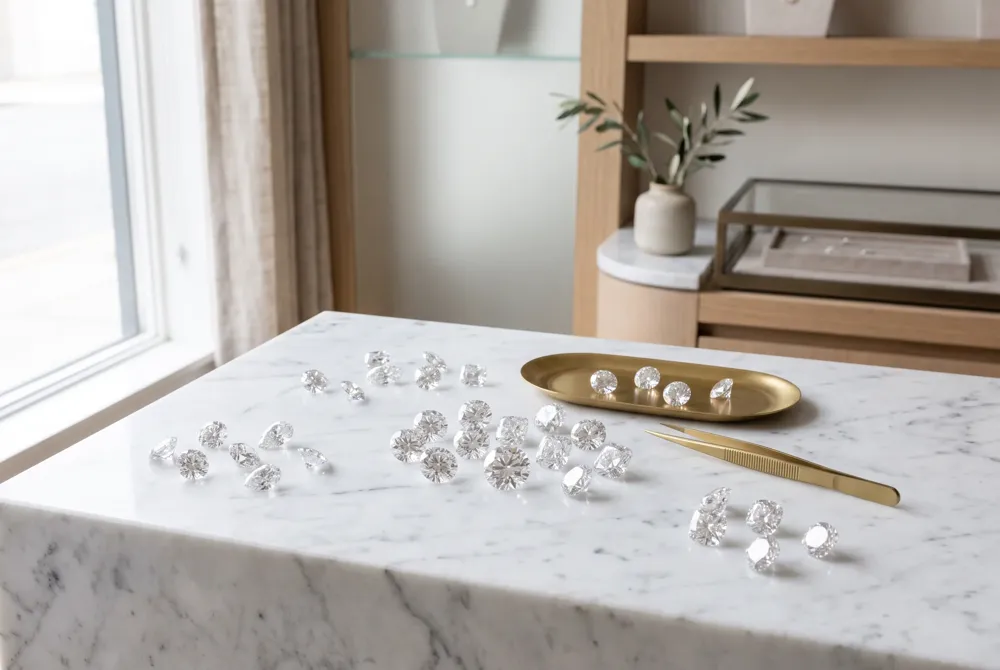
For many couples, the choice between moissanite and a diamond comes down to budget without sacrificing beauty. Moissanite typically costs 80% to 90% less than a comparable natural diamond, making it one of the most cost-effective gemstones available. A premium one-carat moissanite, for example, is often priced around $300 to $600, while a natural diamond of the same size and quality can range from $4,000 to over $10,000. This dramatic price difference allows you to select a larger center stone or invest in a more elaborate setting for your pear-shaped engagement rings.
Lab-grown diamonds offer a middle ground, costing less than natural diamonds but significantly more than moissanite. Their pricing still follows the traditional 4 C's, whereas moissanite pricing is determined more by size, cut quality, and brand. When comparing moissanite vs diamond side by side, the price contrast is often the most striking difference—and one that lets couples allocate their budget toward other priorities, like the perfect setting or a unique design. At Avittam Diamond Jewels, we offer both moissanite and diamond options,, so you can find the gemstone that fits your vision and your budget.
The Pear-Shaped Silhouette: Elegance and Symbolism
The pear cut, also called a pendeloque, is a teardrop-shaped modified brilliant with one rounded end and one pointed tip. Its 58 facets are designed to maximize brilliance, creating a silhouette that balances the fire of a round cut with the elongation of a marquise.
Credit for this shape is given to Flemish diamond polisher Lodewyk van Berquem, working in Bruges around 1475. This makes the pear one of the oldest fancy diamond cuts still in use, surviving through Victorian, Edwardian, and Art Deco periods as a classic rather than a trend-dependent choice.
Symbolism and Visual Presence
The pear shape is often called a "teardrop of joy," symbolizing the tears of happiness shared during life's most emotional moments. For many, it represents a love that brings both deep sentiment and joyful celebration. It also stands for individuality—it merges two distinct qualities into one, mirroring a balanced partnership.
A pear cut faces up roughly 15 to 20 percent larger than a round brilliant of the same carat weight because more weight is distributed along the stone's length. The classic length-to-width ratio ranges from 1.50 to 1.70, with 1.50 to 1.65 offering the most balanced appearance. Ratios below 1.45 appear short and rounded, while above 1.75 create a noticeably elongated look.
Like oval and marquise cuts, a pear can show a bowtie effect across the belly of the stone. A faint, even bowtie is normal, but a heavy opaque bowtie can indicate poor cut quality. At Avittam Diamond Jewels, each pear-shaped moissanite or diamond is selected for balanced proportions and centered symmetry, ensuring the silhouette is as graceful as the moment it commemorates.
Disadvantages of Choosing Moissanite
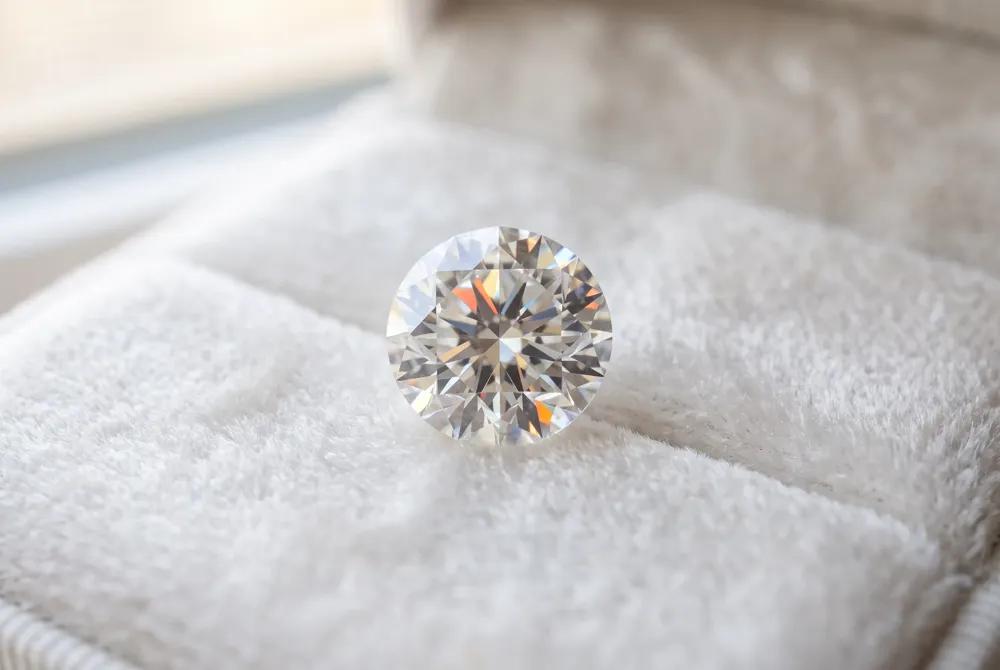
Moissanite's intense rainbow fire is its signature feature, but for some couples comparing moissanite vs diamond side by side, that same quality can feel excessive. A diamond's brilliance is subtler and more crystalline, returning mostly white light. Moissanite's higher dispersion, roughly 2.4 times that of diamond, can appear artificial or overly flashy under direct sunlight or bright overhead fixtures, particularly in larger pear-shaped engagement rings.
The question of prestige is another consideration. A diamond carries centuries of tradition and cultural symbolism as the ultimate token of commitment. Moissanite, as a lab-grown simulant, does not share that heritage. For buyers seeking a stone with enduring symbolic weight, a diamond — whether natural or lab-grown — offers the time-honored narrative that moissanite cannot match.
Resale value is also a real difference. Natural diamonds typically retain 35–50% of their original retail price, and lab-grown diamonds retain 20–40%. Moissanite, by contrast, has minimal to no resale value. Some owners also report that certain moissanite stones, especially larger ones, can occasionally show a faint greenish or greyish tint under specific lighting, and in rare cases develop a slightly hazy or oily appearance over extended periods. A diamond's clarity remains consistent for a lifetime.
For those who prioritize long-term value, tradition, and a classic white sparkle, a diamond engagement ring remains the definitive choice. Avittam Diamond Jewels offers a curated selection of ethically sourced diamonds in timeless pear-shaped silhouettes, providing the prestige and enduring beauty that moissanite, for all its affordability, cannot replicate.
Pear Cut Color, Clarity, and Carat: Diamond Grading Nuances
When evaluating a pear-shaped diamond, the traditional 4 Cs take on subtle importance, as GIA does not assign an overall cut grade to this fancy shape. Instead, the stone's beauty is determined by evaluating the bowtie effect, length-to-width ratio, depth, table, polish, and symmetry.
For color, G-H grades are commonly recommended for pear diamonds set in platinum or white gold, as they appear near-colorless while keeping costs reasonable. An I-color pear may show a yellowish tint at the pointed tip, though this can be less noticeable in yellow or rose gold settings. For clarity, VS2 to VS1 is the usual recommendation, though an eye-clean SI1 stone with inclusions cleverly hidden under prongs or in the wings can also be a wise choice.
A pear cut faces up 15 to 20 percent larger than a round brilliant of the same carat weight, meaning a 1.00-carat pear can look more substantial on the finger. Popular weight ranges fall between 1.00 and 2.00 carats. Buyers seeking a balanced silhouette often choose 1.50 carats, while a 0.75 to 0.90-carat stone offers notable presence for smaller budgets. At Avittam Diamond Jewels, each pear-shaped diamond is individually assessed to ensure it offers an exceptional balance of brilliance, color, and proportion.
Moissanite Color Grades: From Classic to Colorless
Moissanite is graded by color, much like diamond, but follows its own naming conventions. Understanding these tiers helps you choose the stone that best matches your aesthetic when comparing moissanite vs diamond side by side.
Classic. The original moissanite grade carries a greenish-yellow hue, similar to a K-color diamond on the GIA scale. While still beautiful, it is generally considered less desirable for those seeking a bright white look.Forever One Near Colorless. This grade has a faint warmth comparable to G-H-I color diamonds. It appears mostly white to the eye, with only a subtle hint of color in certain lighting, and is a popular choice for a natural-looking sparkle.Forever One Colorless. The most diamond-like option, Forever One Colorless moissanite matches D-E-F color standards. It shows no visible color and delivers the crisp, icy white appearance that many shoppers associate with a premium diamond.Hearts & Arrows Cut. Available in round and cushion shapes, this precision cut balances moissanite's signature fire with increased white brilliance. The result is a stone that mimics a diamond's optical behavior more closely than standard cuts.
Setting and Style for Your Pear Engagement Ring
When you have chosen your stone, the setting defines the ring's character and ensures its safety. The pear silhouette's pointed tip is the most vulnerable area, so reliable protection comes from a V‑tip prong that cradles the point or a bezel that wraps around it entirely. Many jewelers, including those at Avittam Diamond Jewels, incorporate this guard as a standard feature on every pear ring they craft.
Popular Settings for the Pear Cut
A solitaire setting lets the pear shape command attention with a simple band and a secure four- or six-prong head. A halo of smaller diamonds frames the stone, amplifying its visual size and adding extra sparkle. Three-stone designs flank the center with two side gems, creating a classic trilogy look. For a modern twist, an east-west orientation sets the pear sideways across the finger, while a hidden halo nestles accent diamonds beneath the center stone for a subtle glow. Bezel and half-bezel settings wrap the pear in metal, offering a sleek, contemporary aesthetic and maximum edge protection.
Orientation: Tip Up or Down?
For generations, the traditional convention has pointed the tip toward the fingertip, a position that elongates the finger and follows the historic teardrop orientation. Many wearers today reverse the tip toward the wrist, which can make the ring more comfortable when stacking with a wedding band underneath. Avittam Diamond Jewels offers both orientations as standard options, allowing you to choose the silhouette that feels most natural on your hand.
Pairing With Wedding Bands
Pear-shaped engagement rings pair beautifully with wedding bands, offering a versatile and elegant bridal stack. Because the pear cut features a tapered point and a rounded base, many brides choose a curved or contoured wedding band that nestles snugly against the stone's unique silhouette. Alternatively, a straight band can sit flush beneath the pear shape depending on the ring's setting and basket design, while a small gap between rings can create a modern, intentional look. For a more dramatic effect, a chevron or V-shaped band frames the point of the pear cut gracefully, enhancing its distinctive profile.
Prestige and Resale: Diamond Holds the Edge
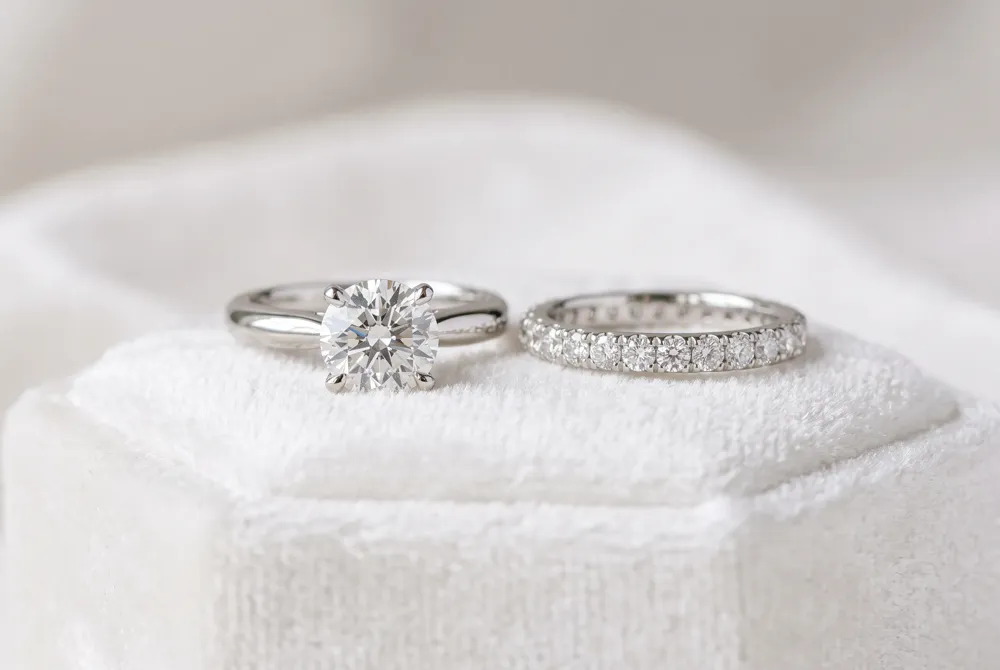
For many couples, comparing moissanite vs diamond side by side extends beyond optics into long-term value and tradition. Diamond carries centuries of cultural weight as the classic symbol of commitment, and natural diamonds retain roughly 35-50% of their original retail price. This enduring value makes a diamond engagement ring a tangible heirloom, an asset that can be passed down or sold.
Moissanite occupies a different position entirely. While it delivers extraordinary beauty at a fraction of the cost, its resale value is negligible. A moissanite center stone, once purchased, holds little to no secondary market value. Lab-grown diamonds occupy the middle ground, retaining an estimated 20-35% of purchase price, though that percentage has been declining as production scales and consumer familiarity grows.
This distinction frames the purchase as a values-based decision. Choosing moissanite is a cost-saving choice that frees budget for other priorities — a larger stone, a more elaborate setting, or a contribution to a new home. Choosing a natural diamond is an heirloom investment, a piece rooted in tradition with a financial asset that can be reclaimed. At Avittam Diamond Jewels, your selection guide helps you navigate this trade-off so your ring reflects both your values and your vision.
Sustainability and Ethical Sourcing
For many couples comparing moissanite vs diamond side by side, the origin of each stone carries as much weight as its sparkle. Lab-created moissanite requires no mining — it is grown from silicon carbide in a controlled environment, making it traceable from start to finish and entirely conflict-free.
The environmental footprint of a lab-made gem is strikingly small. Moissanite production has an estimated carbon footprint of roughly 0.02 kg of CO₂ per carat, in contrast to the 160 kg per carat associated with mined diamonds. This drastic reduction can be important for couples who want their ring to reflect their values without sacrificing beauty or durability.
Lab-grown diamonds offer a middle ground for those who desire the chemical structure and prestige of a diamond but also want a conflict-free, eco-conscious stone. Like moissanite, they are cultivated in laboratories and can carry third-party certifications verifying their ethical origin.
Avittam Diamond Jewels designs its collections around these priorities, offering both ethically sourced diamonds and premium moissanite. By choosing a lab-created stone, you are selecting a gem that is brilliant, enduring, and in harmony with a modern sense of responsibility.
Care and Maintenance: Keeping Your Ring Brilliant
A beautiful ring deserves thoughtful care, and both moissanite and diamond are designed for a lifetime of daily wear. For routine cleaning, warm water, a drop of mild dish soap, and a soft-bristle brush will restore your stone's natural brilliance. Moissanite naturally resists grease and dirt, so it often stays sparkling longer between cleanings than a diamond does.
Biannual professional check-ups are wise for any engagement ring. A jeweler will inspect the prongs for wear, perform a thorough cleaning, and, for white gold bands, renew the rhodium finish every 12 to 18 months. This routine keeps your setting secure and your metal looking fresh.
At home, avoid exposing your ring to harsh chemicals like chlorine bleach or strong cleaning solutions, and avoid high-heat steam cleaners when caring for moissanite. With these simple precautions, your stone will remain as radiant as the day you first wore it.
Your Perfect Brilliance Awaits
Choosing between moissanite and diamond for a pear-shaped engagement ring ultimately comes down to what matters most to you. Moissanite offers exceptional fire and brilliant rainbow sparkle at a fraction of the cost, making it a compelling choice for those who prioritize vivid brilliance and value. Diamond, on the other hand, delivers unmatched hardness, timeless prestige, and stronger resale value.
Both stones provide lifelong durability and enduring beauty, so neither choice sacrifices quality. The decision is personal, guided by your sense of style and priorities. Visit Avittam Diamond Jewels for expert guidance and explore their virtual try-on tools to see each stone on your hand before you decide. With a curated collection of premium diamonds and moissanite, the perfect ring for your story awaits.