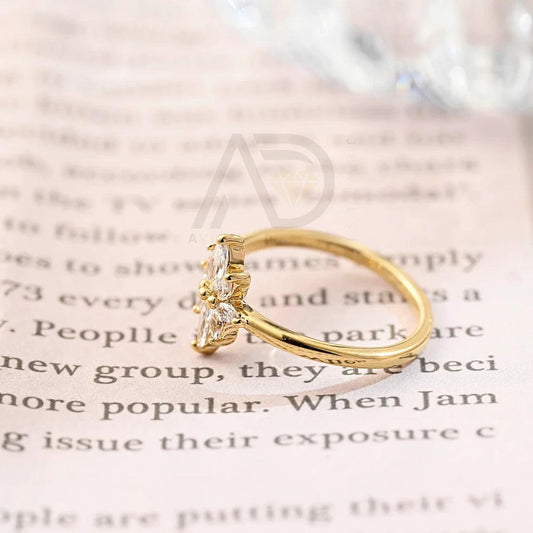

A Study in Refined Presence
Moissanite engagement rings in an emerald cut bring together a clean, elongated outline and a gemstone known for vivid light return. The effect is distinctive: broad, orderly facets give the center stone a composed, architectural presence, while moissanite adds lively flashes of light. For couples drawn to elegance without excess, that balance can feel both modern and enduring.
The terms describe two separate choices. Emerald cut refers to the stone’s shape and step-facet pattern; moissanite names the gemstone. Pairing them creates a ring whose look depends on more than either choice alone. Proportion, cut, color, setting, metal, and workmanship all influence how the finished piece sits on the hand and catches the light.
A considered purchase begins with those details, rather than price alone. A well-proportioned center stone can return light with clarity, while a setting determines how much of its outline remains visible and how securely it is held. Metal contributes another layer of character, from a crisp, bright finish to a warmer tone. Each decision shapes the ring’s presence in a different way.
At Avittam Diamond Jewels, customization lets you select a design, metal, and engraving to suit your preferences. That personal approach is useful when the goal is not simply to choose a stone, but to bring its proportions and setting into harmony with your style. The sections ahead explore how those choices work together, including what to look for in product details and craftsmanship.
The result need not be showy to feel luxurious. With emerald-cut moissanite engagement rings, refinement comes from considered proportions, a balanced setting, and a finish that feels right for the wearer. Understanding how each element contributes makes it easier to compare designs thoughtfully and choose a ring with lasting personal meaning.
The Emerald Cut’s Measured Light
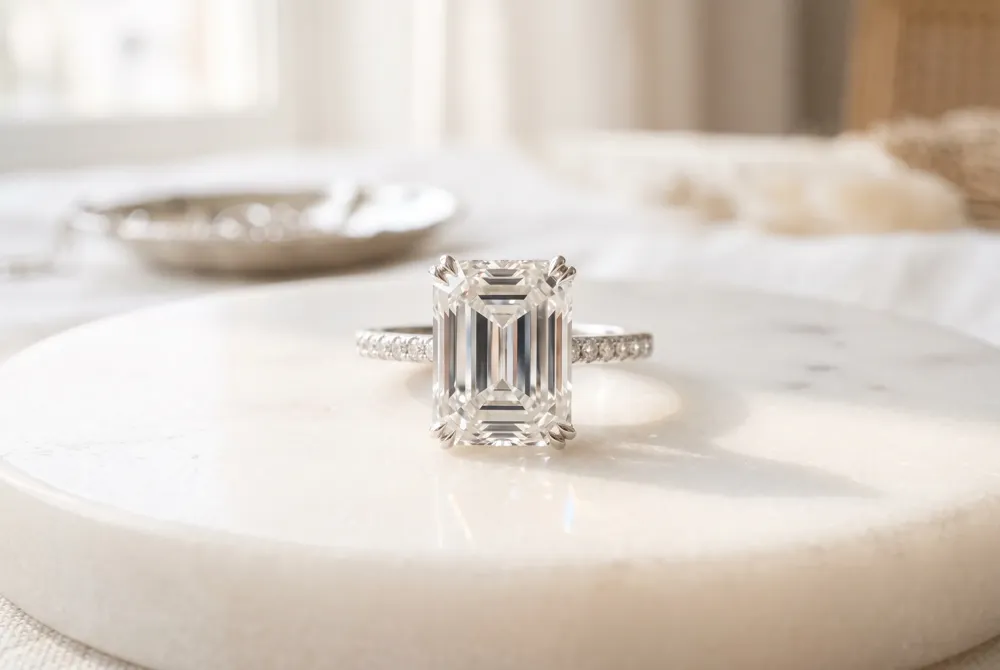
For couples considering emerald-cut moissanite engagement rings, the appeal often lies in the way the stone handles light. Its long, rectangular outline is paired with step facets, not the triangular pattern used in brilliant cuts. These broad, parallel facets create spacious reflections that move across the gem in a measured way.
This effect is often called a hall-of-mirrors look. Rather than scattering many tiny flashes across the surface, the emerald cut shows larger planes of light and shadow. The result can feel composed and architectural, with the outline and facet alignment easy to appreciate at a glance.
Because the facets are broad and open, symmetry has a visible role in the stone’s appearance. Evenly aligned facets give reflections a balanced rhythm, while the clear center lets the eye follow the cut’s geometry. In an emerald-cut moissanite, this can temper the gem’s lively light return into a more restrained display.
A round brilliant offers a different experience. Its many facets are designed to produce frequent, concentrated flashes as the ring moves, while an emerald cut tends to show broader reflections with more visual quiet. Neither shape is inherently more refined or luxurious. The choice is a matter of the light pattern and silhouette you prefer.
The setting can support that impression without competing with it. A clean solitaire leaves the center stone’s outline in clear view, while a finely detailed band can add character around the geometric shape. Avittam Diamond Jewels offers bespoke ordering, so couples can personalize a ring to suit their preferences. Its emerald-cut moissanite ring styles provide further examples of how setting and cut can work together.
When comparing stones, look at them in more than one lighting condition and notice how their reflections sit within the outline. A well-balanced emerald cut should feel intentional, not overly busy or dim. Pay attention to the center’s symmetry and the overall proportions, then consider whether you prefer its measured reflections or the more frequent sparkle of a round brilliant.
Moissanite’s Distinctive Fire
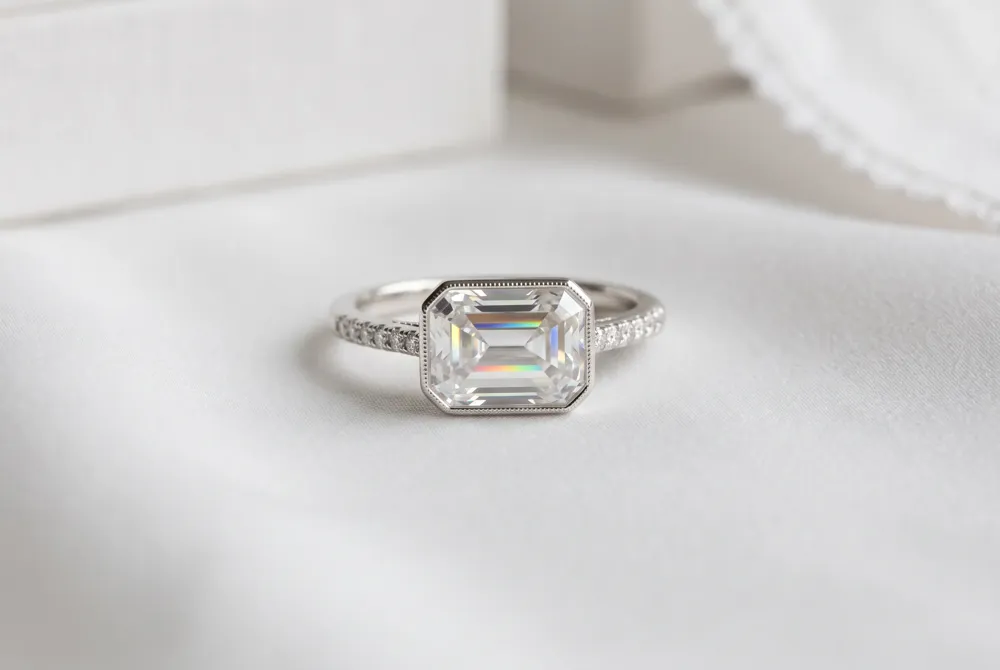
When comparing emerald-cut moissanite engagement rings with diamond designs, the difference is not simply one of price. The stones have distinct identities and respond to light in their own ways. Moissanite is silicon carbide, not a diamond or a lab-grown diamond. The moissanite used in jewelry is lab-created because natural crystals are exceptionally rare and too small for practical use in rings.
That distinction matters if you want to choose a center stone for its particular character rather than treat the gems as interchangeable. Moissanite’s optical properties can produce stronger light return and more visible rainbow flashes than diamond. In an emerald cut, the broad step facets temper that display, creating a more measured effect than the brilliant sparkle associated with round cuts. The exact balance of white light and color varies from stone to stone.
How does moissanite compare with diamond in appearance and durability?
Both stones can give an emerald-cut ring a graceful, elongated outline, but their flashes may look different. Diamond often presents a subtler balance of white light and fire, while moissanite may show more pronounced rainbow color. Neither description guarantees how a particular ring will appear: cut, color, proportions, lighting, and the individual stone all influence its face-up look. Viewing a stone in more than one kind of light can help you decide which effect feels right.
Moissanite is well suited to regular wear, though diamond is harder and offers greater resistance to scratching. Hardness is only one part of a ring’s everyday practicality; the setting, fit, and care also matter. If you plan to wear your ring daily, consider how exposed the center stone will be and whether the design suits your routines. A knowledgeable jeweler can explain how a chosen setting supports the stone without obscuring its outline.
The decision, then, is a matter of preferred light performance, character, durability, and budget. Moissanite’s vivid flashes appeal to some couples, while others prefer diamond’s more restrained fire and greater scratch resistance. There is no need to describe one as a substitute for the other. Each brings a different visual experience, and the right choice is the one whose qualities you will enjoy seeing on your hand.
Avittam Diamond Jewels focuses on diamond jewelry and offers bespoke ordering for ring design, metal, and engraving. Couples considering moissanite can explore the retailer’s linked guide to emerald-cut moissanite styles for design inspiration. For shoppers still weighing the visual character of an emerald cut, this guide to emerald-cut moissanite styles offers another perspective on how the shape frames a center stone.
Proportion Makes the Difference
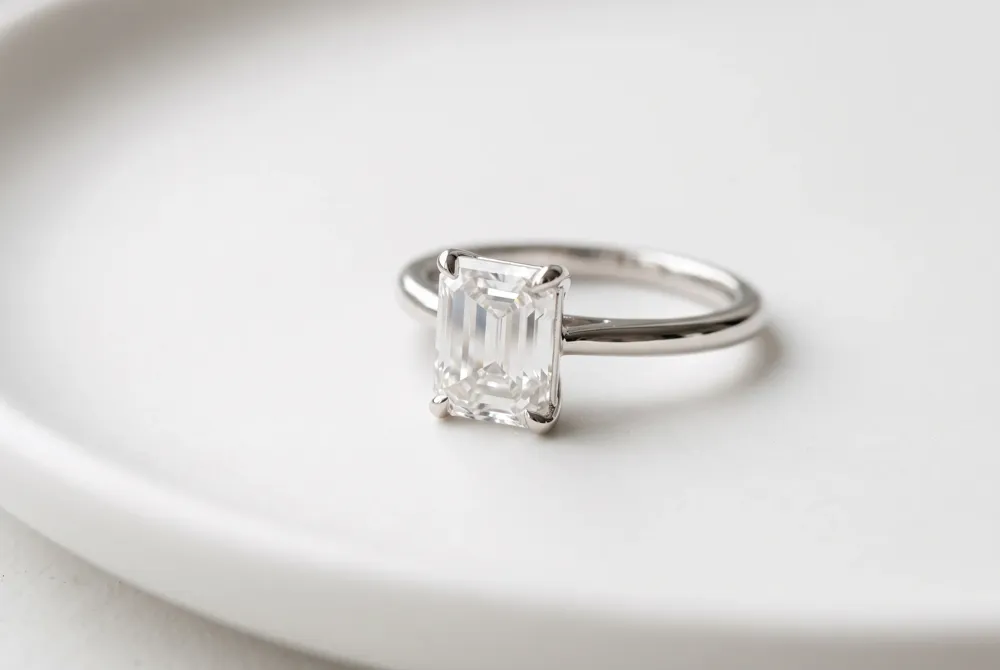
When choosing emerald-cut moissanite engagement rings, look beyond the carat-equivalent label. The stone’s proportions and measurements shape how it returns light and how much presence it has on the hand.
An emerald cut’s broad, step-like facets make the quality of its proportions especially visible. A well-cut moissanite can return light evenly across the face, while a stone that is too shallow or too deep may lose light through the sides or bottom and appear dull. Ask for clear images or video in different lighting, and review the cut information alongside the stone’s dimensions.
Where a cut grade is provided, excellent or ideal can be a useful starting point. Treat that grade as a specification for the individual stone, not a guarantee that every moissanite in a particular shape or size will look identical. A product listing that describes its center stone as ideal cut is reporting a detail about that ring alone.
How should you compare millimeter size and carat equivalent?
Moissanite is commonly sold by its millimeter dimensions and may also be described using diamond-equivalent weight. Because moissanite is lighter than diamond, the equivalent figure helps shoppers relate its size to a familiar diamond measure, but it does not replace the actual length and width.
Round-stone comparisons can offer a rough sense of scale: a round moissanite measuring 6.5 mm is about one carat equivalent, 8 mm about two, and 10 mm about four. These are reference points for round stones, not exact conversions for an emerald cut. Emerald cuts are rectangular, and their length-to-width ratio changes how large or elongated the stone appears.
For a more useful comparison, check the listed length and width, then consider the outline you prefer on your hand. A longer, narrower stone can read differently from a squarer one even when their equivalent weights are similar. Avittam Diamond Jewels offers bespoke ordering, so shoppers can discuss design and center-stone preferences together rather than treating a single number as the whole decision.
A thoughtful review of proportion brings measurements, light performance, and personal taste into the same conversation. At avittamdiamondjewels.com, detailed product guidance and virtual try-on tools can help you assess how a chosen scale may suit your hand before settling on a design.
Settings That Frame the Center Stone
Which settings best complement emerald-cut moissanite engagement rings?
The setting should frame the emerald cut’s long, clean lines without competing with them. When considering emerald-cut moissanite engagement rings, think about how much detail you want around the center and how the ring should feel in daily wear. A guide to emerald-cut moissanite ring styles can help you compare the visual effect of different designs.
A classic solitaire is a natural choice when you want the stone to take center stage. Its uncluttered setting keeps attention on the emerald cut’s outline, and its simpler construction is generally less expensive than a more elaborate design. Avittam Diamond Jewels offers bespoke ordering, so couples can customize a ring’s design and metal rather than relying only on a fixed combination.
For a broader look across the finger, consider a three-stone design. Side stones add balance and width while keeping the center stone prominent. Their shape and scale matter: tapered or discreet side stones can complement the emerald cut without making its crisp geometry feel crowded. If you prefer a more defined frame, a delicate halo adds sparkle and visual presence around the center.
A hidden halo offers a subtler alternative. Set beneath the center stone, it adds detail when viewed from the side while preserving a cleaner top view. This can suit someone drawn to a restrained silhouette who still wants a small decorative touch. Compare the ring from several angles, since a design that looks minimal from above may have more detail along the gallery or shoulders.
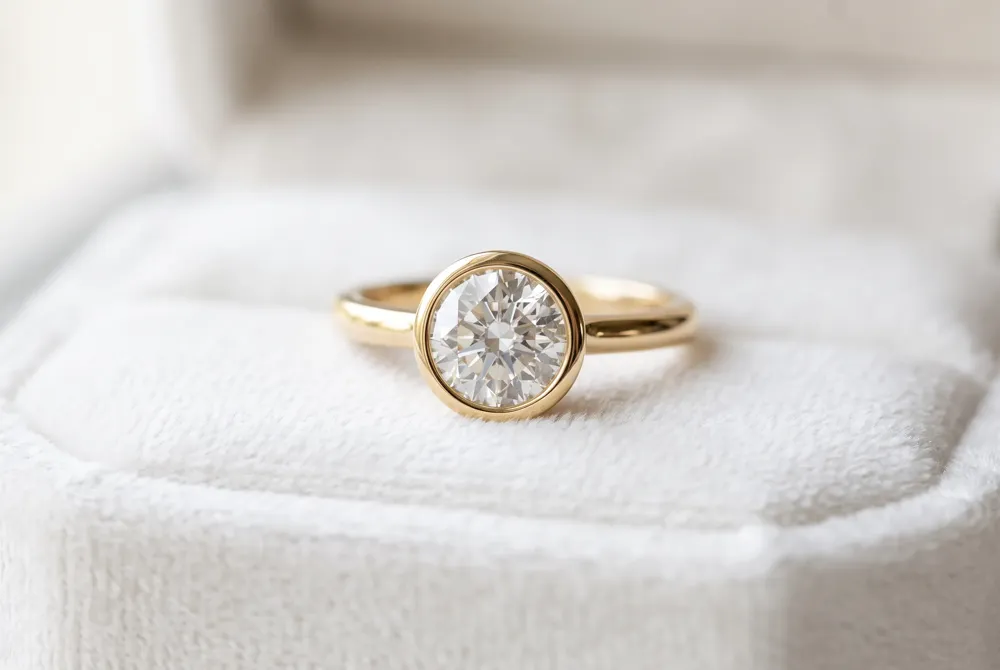
Protection is another consideration. Emerald cuts have clipped corners, and prong settings can secure those edges with V-shaped or clipped-corner prongs. Ask how the prongs cover the corners and whether they sit smoothly against the stone. A slim bezel surrounds the stone’s edge for a modern profile and added protection. It creates a different visual effect from prongs, framing the stone more continuously, so consider whether that stronger outline suits your taste.
Avittam Diamond Jewels provides detailed product guides and virtual try-on tools to help shoppers assess a design before ordering online. These can help you compare a simple solitaire with a halo or bezel, but also consider comfort, maintenance, and how the setting pairs with a wedding band. A low profile may feel practical if you prefer a ring that sits closer to the hand; the shape and height of the setting should still allow the center stone to be cleaned and inspected.
There is no single best setting. Choose a solitaire for visual simplicity, three stones for a wider balance, a halo for extra sparkle, or a bezel for a more protective frame. The right design is the one that supports the center stone and reflects your preferences for detail, security, and everyday wear.
Metal Sets the Ring’s Mood
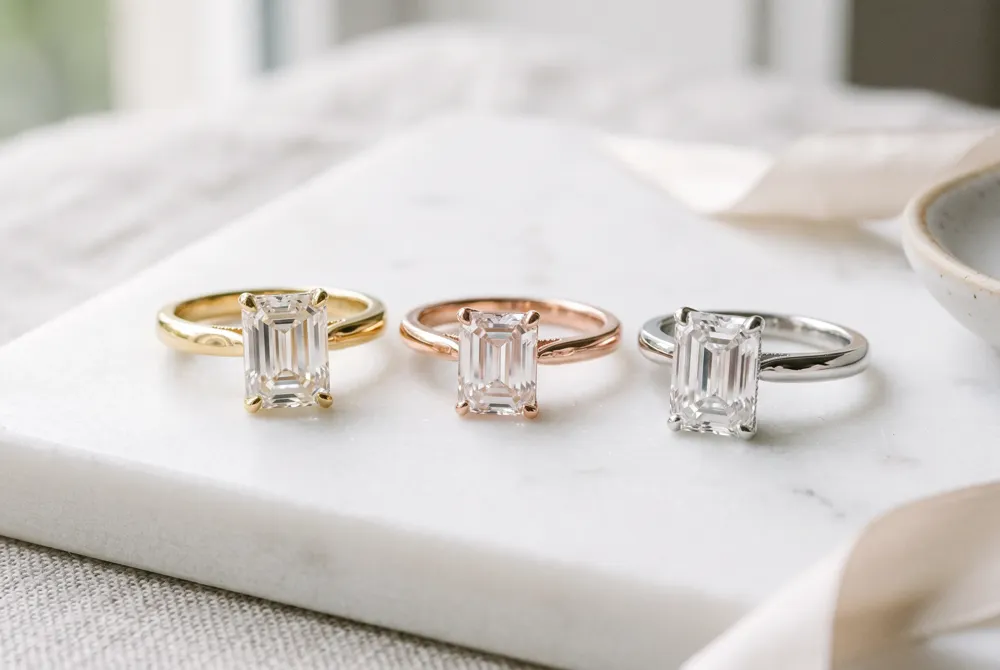
For emerald-cut moissanite engagement rings, metal is more than a finishing choice. It frames the stone’s long, geometric outline and broad facets, shaping whether the ring feels warm, romantic, or cool and crisp. At Avittam Diamond Jewels, bespoke ordering lets you choose the design and metal, so the setting can reflect your preferences rather than dictate them.
Yellow gold brings warmth and a classic, vintage-inspired character. Its rich tone can also soften the impression of slight tint in near-colorless G–I stones. Rose gold lends the ring a softer, romantic quality, while white gold and platinum create a bright, cool look that pairs naturally with colorless D–F stones for an icy appearance. These pairings are starting points, not strict rules: the stone and metal work together to set the overall impression.
When considering how a gold setting affects the look of an emerald-cut moissanite ring, notice how its color interacts with the stone in different light. White metals keep the composition cool and clear; yellow gold adds contrast and warmth. Couples who favor a coordinated, traditional look may match the ring to their everyday jewelry, while those who enjoy contrast can choose a different tone. Skin tone, wardrobe, and personal taste all matter more than following a fixed formula.
The band’s shape and visual weight also influence how the center stone reads. A slim band can make the rectangular center feel more prominent, while a bezel adds a clean border and extra definition. Diamond accents introduce additional detail and presence around the center. If you prefer the emerald cut’s composed geometry, a restrained band may keep attention on its facets; if you want a more decorative look, accents can add contrast without changing the center stone.
Metal purity affects both color and everyday wear. Fourteen-karat gold is harder-wearing than 18-karat gold, while 18-karat gold has a richer color and is slightly softer. That distinction can help narrow the choice: consider how often you expect to wear the ring and whether durability or a deeper gold tone matters more. A jeweler can help you assess the balance alongside the setting’s design.
At Avittam Diamond Jewels, shoppers can consider metal and design choices together. Explore the emerald-cut moissanite ring style guide for further design context, then compare metal tones with your preferred stone color. The most harmonious combination is the one that feels natural beside your other jewelry and true to your own style.
Clarity, Color, and Trustworthy Details
For emerald-cut moissanite engagement rings, clarity deserves attention, but it rarely needs to dominate your decision. Most gem-quality moissanite is graded VVS or better, and inclusions are generally difficult to see without magnification. A clear, well-documented description matters more than a high clarity label on its own.
Compare the details that shape the ring as a whole: cut quality, color, millimeter dimensions, and setting. Avittam Diamond Jewels supports a more considered choice with bespoke options for the design and metal, alongside detailed product information. Ask how each specification applies to the exact stone you are considering, rather than relying on a broad grade or carat-equivalent description.
What should a moissanite grading report include?
There is no single universal grading body for moissanite, and GIA does not grade it. That makes the contents of a report especially useful. Look for the stone’s stated color and clarity grades, millimeter measurements, diamond-equivalent weight, cut grade, and a unique identifier that connects the report to the individual stone.
Specific measurements are more informative than phrases such as “premium quality” or “excellent brilliance,” which do not explain how the stone was assessed. If a listing provides only a carat-equivalent figure, ask for the dimensions as well. Fancy shapes such as emerald cuts do not necessarily match round stones in face-up size at the same equivalent weight.
Treat product specifications as details of one particular ring, not as standards for every emerald-cut moissanite. For example, a retailer listing may describe its featured stone as D color, VVS clarity, and ideal cut. Those are claims about that listed product; they do not mean all emerald-cut moissanite has those grades. Read the accompanying documentation and confirm that the report refers to the stone being offered.
Color should also be considered in context. A color grade describes the stone, while the chosen metal affects the ring’s overall impression. White gold or platinum can create a crisp, bright look, while yellow or rose gold brings warmth. Avittam Diamond Jewels offers metal customization, so shoppers can weigh the stone’s stated color against the setting they want rather than treating either choice in isolation.
A reliable purchase begins with specifications you can understand and verify. Before committing, check that the report identifies the stone clearly, compare its measurements with the design, and confirm which details are documented rather than simply described in promotional language. This careful review leaves room to choose the balance of color, proportions, and setting that feels right to you.
Budget, Craft, and Long-Term Expectations
For couples comparing emerald-cut moissanite engagement rings with diamond designs, the center stone can leave more room in the budget. Moissanite generally costs a fraction of a comparable diamond, allowing you to consider a more intricate setting, a different metal, finer workmanship, or a larger center stone without making the gemstone alone dictate the design.
A ring’s total price reflects more than its center stone. Metal choice and setting complexity can contribute substantially, so compare complete designs, including the band, finish, stone security, and quality of construction. At Avittam Diamond Jewels, bespoke ordering lets you shape the finished ring around your preferences.
Prices for emerald-cut moissanite solitaires vary by product and seller, and any listed price may change. Customization terms also vary by jeweler.
Lab-created origin is part of moissanite’s ethical appeal for shoppers seeking a gemstone made without mining. That point alone does not establish a particular certification or sourcing standard, so review a jeweler’s specific disclosures if those details matter to your decision.
Long-term expectations matter, too. Moissanite has little resale value, so it is best chosen for its appearance, durability, and price rather than as an investment. Avittam Diamond Jewels offers detailed product guidance and a virtual try-on tool to help shoppers assess a ring’s look before ordering, while its bespoke service supports choices tailored to personal taste.
Care That Preserves Its Finish
A little thoughtful care helps emerald-cut moissanite engagement rings retain their clean, bright appearance. For routine cleaning at home, mix warm water with a small amount of mild dish soap. Let the ring soak briefly, then gently brush around the stone and setting with a soft toothbrush. Rinse it well and pat it dry with a lint-free cloth.
Pay particular attention to the area beneath the center stone, where everyday residue can collect. Use a light touch around the prongs rather than pressing or pulling on them. If the ring has a detailed setting, take care not to snag the brush on fine details. A careful clean is more useful than vigorous scrubbing.
Moissanite itself is not harmed by chlorine or bleach, but these chemicals may damage the metal in the setting. Remove your ring before using household cleaners or entering a chlorinated pool, and avoid leaving it where chemicals may splash onto it. When you are not wearing it, store it separately from other jewelry to help prevent scratches to the metal or contact with harder pieces.
Arrange an annual inspection of the prongs and setting. A jeweler can check for looseness or wear and address concerns before the center stone is at risk. If your ring has a custom design, Avittam Diamond Jewels’ bespoke ordering service allows the setting and metal to be tailored to your preferences, so keep the final design details available when discussing care or repairs. Avoid wearing the ring during activities that could knock or catch it, and have it checked promptly if the stone feels loose.
Choose the Details That Feel Yours
A beautifully resolved ring is the result of details working together. Proportion gives the emerald cut its balanced outline, while an effective cut brings life to its broad facets. Color and metal should feel harmonious, and the setting should frame the center stone without distracting from it.
As you compare emerald-cut moissanite engagement rings, look beyond a carat-equivalent label. Check the stone’s measurements, observe how it handles light, and review the setting’s construction and the details supplied about the stone. These practical checks help you judge the ring as it will appear and wear, rather than relying on a description alone.
At Avittam Diamond Jewels, bespoke ordering allows you to shape a ring around your preferences. That service can help bring individual preferences into the choices that shape the finished piece, while detailed product guidance supports a more informed decision.
The best balance is personal: perhaps a restrained setting, a warmer metal, or a center stone with vivid light return. Choose details that suit the wearer’s style and daily life, and consider the care the ring will need to remain at its best.
Moissanite has its own appeal, combining lively light, durability, and an accessible price. It is best valued for those qualities, not as an investment or as a diamond in disguise. When its distinct character feels right, the ring can be meaningful on its own terms.