
TL;DR
There is no magic number for how much an engagement ring should cost. The “three months’ salary” rule was invented by De Beers to sell more diamonds, not to guide your finances. In 2025, the average American spent around $4,600 to $6,500 on a ring, but a third of couples spent under $3,000. With moissanite starting around $150 in sterling silver and gold prices surging past $4,700 per ounce in 2026, the smartest move is understanding what actually drives cost, not following someone else’s formula.
The question of how much an engagement ring should cost has haunted ring shoppers for decades. And the anxiety is real. You want to give something beautiful and meaningful, but you also don’t want to start your life together buried in debt over a piece of jewelry.
Here’s the honest truth from someone who’s watched thousands of people navigate this decision: the “right” amount is whatever fits your financial reality while getting you a ring your partner will genuinely love wearing every day. That could be $200. It could be $5,000. Both are perfectly valid.
What matters is understanding the levers that move the price up and down, so you can make a smart choice instead of an emotional one.
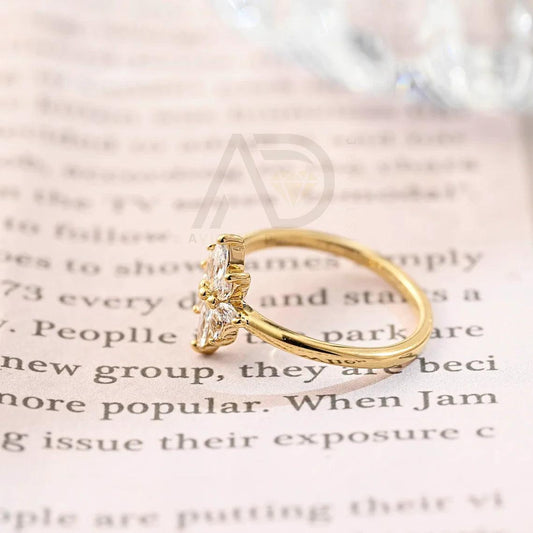
If you want to see what a stunning moissanite ring actually costs at different metal tiers, browse options like this princess-cut halo pavé ring to get a sense of real pricing from 925 silver through 18K gold.
Average Engagement Ring Cost: What People Actually Spend
Let’s start with the numbers everyone wants to know.
According to The Knot’s annual survey (via Rapaport), consumers paid an average of $4,600 for engagement rings in 2025, down from $5,200 the year before. BriteCo’s appraisal data puts the 2025 average higher at $6,504, reflecting the influence of high-end purchases on the mean.
But averages are misleading. They get dragged upward by six-figure celebrity rings and wealthy outliers. The more useful figure: nearly two-thirds of couples (64%) spend under $6,000, and a full third spend under $3,000, according to Ben Garelick’s analysis of The Knot data. Ben Garelick, a family-owned jeweler operating for over 70 years, reported that their own average engagement ring sale with a lab-grown center diamond was just $2,408 in 2025.
That gap between the publicized “average” and what most people actually pay should be freeing. If your budget is $1,500, you’re not an outlier. You’re closer to the norm than the person spending $10,000.
The “Three Months’ Salary” Rule: Where It Came From and Why You Should Ignore It
Almost everyone has heard some version of this rule. Two months’ salary. Three months’ salary. Some people treat it like gospel.
It’s advertising copy.
De Beers, the diamond mining giant, created this guideline in the 1930s as part of an ad campaign. It originally started as one month’s salary, then grew to two months by the 1960s, and reached three months by the 1980s as De Beers ramped up marketing spend. Before their campaign took hold, even on the eve of World War Two, only about 10% of engagement rings contained diamonds at all.
The rule was never financial advice. It was designed to make you spend more money on a specific product from a specific company.
What are people actually spending relative to income? Current data suggests Americans spend roughly 17% of their annual income on engagement rings, which works out to about two months’ salary rather than three. And that figure is still inflated by high earners. For someone making $50,000 a year, 17% would mean spending $8,500, which is well above what most couples in that income range actually do.
Spend what makes sense for your household. Period.
Moissanite: The Budget Optimizer That Changed Everything
If you’re asking how much engagement rings should cost in 2026, you need to understand moissanite, because it has fundamentally changed the math.
Moissanite is a lab-created gemstone made of silicon carbide. It scores 9.25 on the Mohs hardness scale (diamond is 10), making it extremely durable for daily wear. It actually has a higher refractive index than diamond, which means it throws more fire and rainbow sparkle in direct light.
The cost difference is staggering. A high-quality 1-carat moissanite stone runs between $50 and $600 depending on size, cut quality, and brand. A finished moissanite engagement ring (center stone plus setting plus any accent stones) typically costs between $500 and $2,500, per Molly Jewelry’s 2026 pricing survey.
Compare that to a comparable mined diamond, which could easily run $5,000 to $8,000 for the loose stone alone. Moissanite costs approximately 90% less than mined diamonds and 50% to 70% less than lab-grown diamonds.
This isn’t a compromise. It’s a strategic choice. The visual difference between a well-cut moissanite and a diamond is essentially invisible to the naked eye. Even jewelers need specialized equipment to tell them apart.
For buyers who want something unexpected, options like black moissanite rings expand the definition of what an engagement ring can look like, and they come at the same accessible price points.
For a deeper comparison, our guide on moissanite vs. diamond differences breaks down sparkle, durability, and cost side by side.
Lab-Grown Diamonds: The Middle Ground
Lab-grown diamonds are chemically, physically, and optically identical to mined diamonds. They’re real diamonds. The only difference is origin: a lab reactor instead of the earth’s mantle.
The market has shifted dramatically. According to JCK (citing The Knot’s 2026 Real Weddings Study), lab-grown center stones now account for 61% of all engagement ring purchases, a 239% increase since 2020.
Pricing has crashed. An unbranded, round, 1-carat lab-grown diamond cost an average of $845 in Q1 2025, per analyst Paul Zimnisky. Lab-grown prices fell about 74% from 2022 to 2025 and sit roughly 96% below their 2018 peak, according to GOODSTONE’s market analysis.
The average finished lab-grown diamond engagement ring runs about $5,188, compared to $10,760 for a natural diamond ring (BriteCo data). That’s still considerably more than moissanite, but it’s half the price of going natural.
The trade-off? Resale value is poor. You might recoup 30% to 40% of what you paid. But frankly, natural diamonds lose 50% to 75% at resale too. Buy a ring to wear it, not as an investment vehicle.
Our moissanite vs. lab-grown diamond guide covers the detailed trade-offs between these two options.
Natural Diamonds: When They Make Sense
Natural diamonds remain the traditional choice, and for some buyers, tradition matters deeply. They’re valued through the 4Cs system (cut, color, clarity, carat weight), and prices vary wildly based on those grades.
A loose 1-carat natural diamond of decent quality will typically cost $3,000 to $6,000 or more. The average finished natural diamond engagement ring is around $10,760.
When does paying the premium make sense? If your partner specifically wants a natural diamond for sentimental or cultural reasons. If you’re buying an heirloom piece intended to pass through generations. Or if the knowledge of a stone’s geological origin genuinely matters to one or both of you.
But if you’re buying natural purely because you think you “should,” reconsider. The price gap is enormous, and the visual result on a finger is indistinguishable to 99% of people.
Metal Karat: The Hidden Budget Lever Most Guides Skip
Here’s something most “how much should an engagement ring cost” articles gloss over: in 2026, the metal might cost more than the stone.
Gold prices have surged to around $4,700 per ounce as of May 2026, up from roughly $2,700 in early 2025. That’s a 70%+ increase in raw material costs. According to Washington Diamond, a standard 14K gold setting now costs 40% to 50% more than it did two years ago.
This makes your karat choice a serious financial decision.
10K gold (41.7% pure gold): The most affordable gold option. Harder and more scratch-resistant than higher karats because of greater alloy content. Visually, most people cannot distinguish 10K from 14K, especially in white gold. Yet many competitors don’t even offer it.
14K gold (58.3% pure gold): The industry standard for engagement rings in the U.S. Good balance of gold content, durability, and cost. This is what most people end up choosing.
18K gold (75% pure gold): Richer, deeper gold color (especially noticeable in yellow gold). Costs 20% to 30% more than 14K. Slightly softer, which means more susceptible to scratches over years of daily wear.
To see this metal step-up in action, look at a ring like this three-stone cushion moissanite available in 10K, 14K, and 18K. You can see exactly how the same design changes price across gold purity levels.
With gold at current prices, 10K gold has gone from “budget option” to “smart money move.” Don’t overlook it.
Sterling Silver (925): A Legitimate Starting Point
Sterling silver, an alloy of 92.5% silver and 7.5% other metals, costs roughly 2 to 3 times less than gold for the same ring setting. This makes it the entry point for engagement rings starting around $150.
Is it a real engagement ring metal? Yes, with caveats.
Silver tarnishes over time and needs periodic cleaning. It’s softer than gold, so prong settings may need inspection more frequently. Practitioners on forums like Weddingbee note that “sterling silver could work, but you’d have to check up on it often to make sure it’s holding up. Silver’s just not that strong.” Some recommend argentium silver (a harder, more tarnish-resistant alloy) as a step up.
That said, sterling silver makes perfect sense for several scenarios: couples who prioritize saving money for other life goals, promise rings that precede a future upgrade, fashion-forward buyers who enjoy swapping styles, and anyone who’d rather put $2,000 toward a honeymoon fund than a ring setting.
It’s not the right choice for everyone. But pretending it doesn’t exist, as most competitor guides do, ignores a real segment of buyers.
Setting Styles and What They Cost
The setting, meaning the metalwork that holds and frames your center stone, impacts both cost and appearance significantly.
Solitaire
A single center stone on a plain or minimally detailed band. The simplest and often the most affordable setting. A moissanite solitaire can start well under $500. Classic, timeless, and hard to get wrong.
A knife-edge solitaire in princess cut is a good example of how minimal design keeps the price accessible while looking clean and modern.
Halo
A ring of small accent stones surrounding the center stone. This makes the center stone appear larger, which is a genuine budget hack: a 0.75-carat center with a halo can look like a 1.25-carat stone. A hidden halo setting tucks those accent stones underneath the center stone for a subtler effect that’s trending heavily right now.
Pavé
Tiny stones set along the band itself. Adds continuous sparkle without a dramatic cost increase since accent moissanites are quite small and inexpensive. Half-pavé designs keep costs even lower by only covering the visible top portion of the band.
Three-Stone
A center stone flanked by two side stones, traditionally representing past, present, and future. More stones mean more material cost, but with moissanite, the step-up is modest. An elongated cushion three-stone ring demonstrates how this style creates impressive finger coverage without a massive center stone.
The 4Cs: What Actually Matters for Your Budget
Cut, color, clarity, and carat weight determine a stone’s price. But their relative importance shifts depending on the stone type.
Cut is the most important factor across all stone types. A well-cut moissanite or diamond maximizes light return and sparkle. A poorly cut 2-carat stone will look worse than a well-cut 1-carat stone. Never sacrifice cut to save money on a bigger carat weight.
Carat weight is what most people focus on, but here’s a budget trick: buy just under common weight thresholds. A 0.90-carat stone can cost 20% to 30% less than a 1.00-carat stone, and no one can see the difference on a finger. Similarly, elongated shapes (oval, marquise, elongated cushion) face up larger than round stones of the same weight.
Color and clarity matter less with moissanite than with natural diamonds. Lab-created moissanite is produced in near-colorless grades with excellent clarity as a standard. You’re not paying premiums to avoid visible inclusions the way you would with a mined stone.
Custom Engagement Rings: More Affordable Than You Think
Most people assume “custom” means expensive. At traditional jewelers, custom designs often start at $5,000 to $10,000 or more. But that equation changes completely with moissanite-focused online retailers.
Avittam Diamond Jewels, for example, offers custom orders starting at a $150 minimum. You can send an image of a ring you love, and the team will recreate it or modify it to your preferences. Production begins after a 70% upfront payment, with the remaining 30% due before shipping. This approach gives you a one-of-a-kind ring without the luxury markup.
If you have a specific design in mind, explore customizable engagement rings as a starting point, or reach out directly with reference images.
Hidden Costs: What the Sticker Price Doesn’t Tell You
The ring itself isn’t the only expense. Plan for these:
Wedding bands. Ben Garelick recommends setting aside $1,800 to $3,000 for both partners’ bands combined in 2026. Many couples forget this when budgeting for the engagement ring and face sticker shock six months later. Our wedding band guide covers how to pair bands with your engagement ring.
Ring resizing typically runs $50 to $150 depending on the metal and complexity. If you’re guessing your partner’s size, factor this in. (Our ring sizing guide can help you avoid this cost entirely.)
Insurance varies by the ring’s appraised value. For a $2,000 ring, expect around $30 to $60 per year.
White gold replating costs $75 to $150 every few years. White gold is actually yellow gold with rhodium plating, which wears off with daily use. Rose and yellow gold don’t have this issue.
Returns and restocking fees vary by retailer. Some charge 15% to 20% for returns. Read the policy before you buy.
What Does Each Budget Tier Actually Buy?
Let’s put concrete examples to common budget ranges.
Under $500
A moissanite center stone (1 to 2 carats) in sterling silver or 10K gold. Solitaire or simple pavé settings. This tier is entirely achievable and produces rings that photograph beautifully. For a deeper look, check our guide on engagement rings under $500.
$500 to $1,500
A moissanite center stone in 14K gold with more elaborate settings: halo, hidden halo, three-stone, or vintage-inspired designs. This is the sweet spot where you get premium metal and eye-catching design without financial strain.
$1,500 to $3,000
Larger moissanite stones in 18K gold, or a lab-grown diamond in 14K gold. Multi-stone designs, custom work, or designer-inspired pieces become accessible here.
$3,000 to $6,000
Lab-grown diamond rings with higher carat weights, or natural diamonds in the 0.50 to 0.75 carat range. This is where most of the U.S. market actually shops.
$6,000 and Up
Larger natural diamonds, premium brand settings, or designer pieces. This range is where Washington state shoppers average ($10,109) and California buyers ($9,482) tend to land, according to World Population Review data.
Generational Expectations vs. Reality
There’s a fascinating gap between what people think a ring should cost and what they actually spend.
Millennials reported an ideal ring price of around $13,000, while Gen Z said they believe an engagement ring should cost close to $11,400, according to 2 Urban Girls citing survey data. Yet actual median spending falls far below both numbers.
This disconnect probably reflects social media influence. Instagram and TikTok showcase aspirational rings, which skews perception of what’s “normal.” Meanwhile, the average center stone is 1.8 carats (up from 1.7 the previous year), which suggests people are getting bigger stones by switching to moissanite and lab-grown, not by spending more money.
Smart shoppers are optimizing, not overspending.
Resale Value: An Uncomfortable Truth
No engagement ring is a good financial investment. None.
Natural diamonds lose 50% to 75% of their retail value the moment you walk out of the store. Lab-grown diamonds fare slightly better in percentage terms but still resale for roughly 30% to 40% of purchase price. Moissanite has essentially zero resale value as a gemstone.
But here’s the thing: nobody buying an engagement ring at any price point should be thinking about resale. You’re buying something to wear every day for decades. Judge it on beauty, durability, and what it means to your relationship. The engagement ring’s value is sentimental, not financial.
Quick Reference: Cost Comparison Table
| Stone Type | 925 Silver Ring | 10K Gold Ring | 14K Gold Ring | 18K Gold Ring |
|---|---|---|---|---|
| Moissanite (1 ct) | $150 - $400 | $300 - $700 | $400 - $1,000 | $550 - $1,500 |
| Lab-Grown Diamond (1 ct) | Rarely offered | $1,200 - $2,500 | $1,500 - $3,500 | $2,000 - $5,000 |
| Natural Diamond (1 ct) | Not typical | $3,500 - $6,000 | $4,000 - $7,500 | $5,000 - $10,000+ |
Ranges reflect typical 2026 pricing for finished rings with simple to moderate settings. Custom, halo, and multi-stone designs adjust upward.
Your Budget Should Match Your Life, Not an Ad Campaign
How much an engagement ring should cost comes down to one question: what can you comfortably afford without compromising other financial goals?
If that number is $300, a moissanite ring in sterling silver will give you a gorgeous, durable ring that looks spectacular. If it’s $1,500, you’re in the sweet spot for 14K gold with elaborate moissanite designs. If it’s $5,000, the entire market opens up.
The ring doesn’t define your commitment. Your partnership does.
Ready to see what your budget can get? Explore the complete moissanite ring collection with pricing across every metal option, from 925 silver to 18K gold, with free worldwide shipping.
Frequently Asked Questions
Is the three months’ salary rule a real guideline for engagement rings?
No. It was created by De Beers’ advertising department in the 1930s and gradually inflated to three months by the 1980s. Most couples today spend one to two months’ salary, and many spend considerably less. There is no financial basis for this “rule.”
How much does a moissanite engagement ring cost compared to a diamond?
A finished moissanite engagement ring typically costs between $150 and $2,500, depending on metal and setting. That’s roughly 80% to 90% less than a comparable natural diamond ring and 50% to 70% less than a lab-grown diamond ring of similar appearance.
Why are engagement ring prices rising in 2026 if lab-grown diamonds are getting cheaper?
Gold prices have surged past $4,700 per ounce in 2026, driving setting costs up 40% to 50% across the industry. So while the stones are cheaper than ever, the metal holding them is significantly more expensive. This is why choosing 10K gold or sterling silver has become a more popular strategy.
What is the most popular engagement ring center stone in 2025?
Lab-grown diamonds accounted for 61% of all engagement ring center stones in 2025, according to The Knot’s Real Weddings Study. Moissanite continues to grow as well, particularly among budget-conscious buyers shopping online.
Can you get a good engagement ring for under $500?
Absolutely. A 1 to 2 carat moissanite in sterling silver or 10K gold with a solitaire or pavé setting falls well within this range. These rings are visually stunning and durable enough for daily wear.
Does the metal karat really make a visible difference?
Between 10K and 14K, most people cannot tell the difference visually, especially in white or rose gold. The jump from 14K to 18K is slightly more noticeable in yellow gold, where the higher gold content produces a richer warm tone. The biggest difference is price and hardness: lower karats are harder and cheaper.
Should I buy a natural diamond for better resale value?
Natural diamonds lose 50% to 75% of their retail price at resale. Lab-grown diamonds lose 60% to 70%. Neither is a good investment vehicle. Buy whichever stone your partner will enjoy wearing, and don’t factor resale into the decision.
How much should I budget for wedding bands on top of the engagement ring?
Industry estimates suggest $1,800 to $3,000 combined for both partners’ wedding bands in 2026. This is a cost many couples forget to plan for, so include it in your overall jewelry budget from the start.