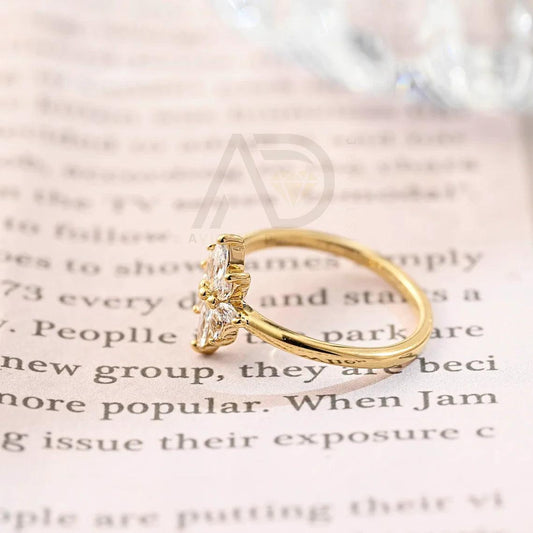

TL;DR
Most couples spend around $1,500 total for both wedding bands. Men’s bands typically run $300 to $800, while women’s bands range from $500 to $1,800. The biggest cost drivers are metal type and whether you add stones. Moissanite and lab-grown options can cut costs by 50% to 90% compared to natural diamonds, and buying online saves another 30% to 50% over traditional jewelers.
Figuring out how much a wedding ring should cost is one of those questions that sounds simple until you actually start shopping. Prices swing from $100 to $5,000+ depending on choices most people don’t even know they’re making yet. And the internet is full of conflicting advice, outdated salary “rules,” and engagement ring prices masquerading as wedding band prices.
This guide breaks down real wedding ring costs by metal, stone, and style so you can set a budget that makes sense for your life, not someone else’s marketing campaign.
Looking for a starting point? A classic moissanite solitaire ring in solid gold starts well under $500, which gives you a sense of where the floor actually sits.
Wedding Ring vs. Engagement Ring: Why the Price Difference Is Huge
Before talking numbers, this confusion needs clearing up. A lot of people searching “how much wedding ring” are actually looking at engagement ring prices without realizing it. The two are different purchases.
A wedding band is the ring exchanged during the ceremony. It’s typically simpler: a metal band, sometimes with small accent stones. An engagement ring is the proposal ring, usually featuring a prominent center stone.
The price difference is substantial. According to The Knot’s 2024 Real Weddings Study, the average engagement ring costs about $5,200. Wedding bands? About $600 for men and $1,200 for women. That’s a fraction of the engagement ring price because wedding bands focus on the metal and accent details rather than a large center diamond.
If you’ve been panicking because you thought wedding rings cost $5,000 each, take a breath. They almost certainly don’t, unless you want them to.
The Real Average Wedding Ring Cost
Here are the actual numbers most couples are working with in 2025:
- Men’s wedding bands: $300 to $800, with an average around $600
- Women’s wedding bands: $500 to $1,800, with an average around $1,200
- Combined for both rings: roughly $1,500
Those averages come from The Knot’s survey data, but averages can be misleading. A handful of $10,000 purchases pull the number up. The median, what most people actually spend, sits lower. Practitioners on Reddit’s r/weddingplanning regularly report spending $200 to $600 on men’s bands and $400 to $1,000 on women’s bands, with many expressing relief that the numbers weren’t as bad as they’d feared.
Regional variation matters too. Couples in Mid-Atlantic states average approximately $6,900 on engagement rings alone, while those in Midwestern states like Illinois, Michigan, and Minnesota average around $4,900. Wedding band spending follows a similar geographic pattern, though the gaps are smaller.
What Drives the Price: Metal Type
For wedding bands, metal choice is the single biggest cost factor. Unlike engagement rings where the center stone dominates the price tag, a wedding band’s cost is overwhelmingly about what it’s made of.
Here’s the realistic cost ladder:
925 Sterling Silver
Range: $50 to $300
The most affordable option and one that gets unfairly dismissed. Sterling silver is softer than gold, needs more care, and will tarnish over time. But it looks beautiful, and for couples on a tight budget, it’s a real option, not a consolation prize. Many people don’t realize that sterling silver variants exist for popular engagement ring designs as well.
10K Gold
Range: $200 to $600
This is where gold begins. 10K contains 41.7% pure gold. It’s the hardest and most scratch-resistant gold alloy, which actually makes it practical for daily wear. The color is slightly less rich than higher karats, but most people can’t tell the difference on a band.
14K Gold
Range: $400 to $1,200 for a plain band
The sweet spot, and honestly what I recommend to most buyers. 14K gold is harder and more durable than 18K because it contains more alloy metals. It costs meaningfully less and holds up better to the daily abuse a wedding ring takes. This counterintuitive fact surprises a lot of people: paying less actually gets you a tougher ring.
18K Gold
Range: $600 to $2,500
Richer, warmer color. 75% pure gold. Softer and more prone to scratching. If you prioritize that deep gold tone and don’t work with your hands much, 18K is gorgeous. But for most lifestyles, 14K is the smarter buy.
Platinum
Range: $800 to $3,000 for a simple band
The premium tier. Platinum is denser, heavier, and more durable than gold. It doesn’t need replating like white gold does. But it typically adds $800 to $1,500 per ring compared to gold options, which is a steep jump for a metal most people can’t visually distinguish from white gold.
A Note on White Gold
White gold deserves a special mention because of a hidden cost most guides gloss over. White gold is actually yellow gold plated in rhodium to achieve that silvery color. The rhodium wears off over time, typically every 1 to 2 years, and replating costs $25 to $50 each time. Over 30 years, that’s $375 to $750 in maintenance. Factor that into your decision when comparing it to platinum or sterling silver.
A two-tone moissanite ring shows the visual difference between gold tones clearly if you’re trying to decide between yellow, rose, and white.
What Drives the Price: Stone Choice
Not every wedding ring has stones, and that’s perfectly fine. Plain bands are the most traditional option. But for those who want some sparkle, the stone you choose dramatically affects how much the wedding ring costs.
Natural Diamonds
A diamond wedding band (think pavé or eternity styles) runs $1,000 to $5,000 depending on the total carat weight and design complexity. Natural diamonds remain the most expensive option per carat.
Lab-Grown Diamonds
Lab-grown diamonds are chemically identical to natural diamonds. They cost roughly half as much. According to industry data, lab-grown diamond rings average $5,187 compared to $10,760 for natural diamond rings. However, lab-grown prices have been in freefall. The average cost of the highest-grade lab-grown diamonds dropped $8,613 over the past five years. That’s a concern: buying lab-grown today might feel like overpaying in a few years as production scales up further.
Moissanite
This is where the math gets interesting. A 1-carat moissanite typically costs $300 to $600. A 1-carat natural diamond? $3,000 to $6,000. That’s a 90%+ savings.
Moissanite isn’t a “fake diamond.” It’s a distinct gemstone (silicon carbide) that actually outperforms diamond in brilliance, with a higher refractive index of 2.65 to 2.69. It scores 9.25 on the Mohs hardness scale (diamond is 10), making it the second-hardest gemstone used in jewelry. For a wedding band with accent stones, moissanite is the best value proposition available today.
One thing to be honest about: moissanite has minimal resale value as a gemstone. If resale matters to you, natural diamonds hold their value better (though “hold their value” is doing heavy lifting in that sentence, since most jewelry loses 30% to 50% the moment you walk out of the store). For something you plan to wear for decades, resale is largely irrelevant.
Moissanite wedding bands start around $300 and can reach $1,200 depending on the design and metal.
No Stone (Plain Band)
The simplest, most affordable choice. A plain 14K gold band can be as low as $300. Nothing wrong with that.
What Drives the Price: Design and Setting Style
After metal and stone, design is the third cost lever. Here’s how different styles affect how much a wedding ring costs:
Plain bands are cheapest. Simple, elegant, and timeless.
Pavé bands feature tiny stones set into the band surface. In diamond, these run $800 to $1,500. In moissanite, significantly less. A pavé moissanite ring gives you that continuous sparkle at a fraction of the diamond price.
Eternity bands have stones circling the entire band. More stones means more cost, plus eternity bands are harder to resize.
Halo designs surround a center stone with smaller accent stones. A hidden halo setting offers a subtler version that adds sparkle without the visual bulk.
Vintage and art deco styles often feature intricate metalwork. The craftsmanship involved can add to the price, though the premium varies widely. A vintage-inspired split-shank ring demonstrates how ornate design doesn’t have to mean ornate pricing when paired with moissanite.
Three-stone designs are a popular alternative to solitaires, with the three stones symbolizing past, present, and future. They generally cost more than solitaires because of the additional stones but less than full eternity bands.
One design tip that saves real money: switching from platinum to white gold can save several hundred dollars per ring without significantly changing its appearance. Unless you’re placing the two metals side by side under jewelry store lighting, most people won’t notice.
The “Salary Rule” Is Marketing, Not Tradition
You’ve probably heard some version of: spend two months’ salary (or three months, depending on who’s telling you) on an engagement ring. This rule was not born from tradition, romance, or cultural practice. It was invented by De Beers in the 1930s as a marketing campaign to sell more diamonds.
The campaign worked spectacularly. According to the American Gem Society, diamond sales increased 50% after those ads ran. Before World War Two, only about 10% of engagement rings contained diamonds. By the end of the 20th century, 80% did. That’s not tradition. That’s advertising.
Real couples are increasingly ignoring these fabricated rules. Nearly two-thirds (64%) of couples spend less than $6,000 on engagement rings, and a third spend under $3,000. The national average has been dropping steadily: from $6,000 in 2021 to $5,200 in 2024.
Here’s a sobering stat: more than 70% of engagement ring buyers report carrying some form of debt. Starting a marriage with unnecessary financial strain over a piece of jewelry that loses value the moment you buy it is not romantic. It’s reckless.
How to Set a Realistic Wedding Ring Budget
Forget salary rules. Here are practical ways to think about how much to spend on wedding rings:
Allocate 1% to 3% of your total wedding budget for rings. If your wedding costs $30,000, that’s $300 to $900 for rings. Reasonable and proportional.
Think about cost per day of wear. A $600 wedding band worn for 40 years costs $0.04 per day. Even a $1,200 ring comes to about $0.08 per day. When you frame it that way, almost any reasonable wedding ring purchase feels manageable.
Choose your metal strategically. Moving from 18K to 14K gold saves real money and gets you a more durable ring. If budget is very tight, 10K gold or sterling silver are legitimate options.
Choose your stone strategically. Moissanite delivers 90%+ savings over natural diamonds with comparable visual brilliance. Lab-grown diamonds split the difference. For rings you can explore in that under-$500 price range, moissanite opens up options that would otherwise be impossible.
Buy online. Independent jewelers and online retailers commonly offer identical quality at 30% to 50% savings compared to brick-and-mortar stores. The overhead difference (no mall lease, no sales floor) translates directly into lower prices.
Consider carat weight price cliffs. Diamond prices jump significantly at popular carat weights (1.00, 1.50, 2.00 carats). Buying a 0.95-carat stone instead of a 1.00-carat stone can save hundreds with no visible size difference. Moissanite doesn’t have these same sharp price cliffs, which is another advantage.
Moissanite Wedding Rings: The Smart Budget Play
Moissanite deserves its own section because it’s the single biggest opportunity for couples wondering how much a wedding ring needs to cost.
Quick facts:
- A 1-carat moissanite costs $300 to $600. A 1-carat natural diamond costs $3,000 to $6,000.
- A 2-carat moissanite ring typically costs $1,500 to $3,000. The diamond equivalent? Easily $15,000+.
- Moissanite is approximately 15% lighter than diamond, so “1-carat equivalent” moissanite is actually measured by millimeter size, not weight. This rarely gets mentioned, but it means a “1-carat” moissanite is sized to look like a 1-carat diamond rather than literally weighing one carat.
- Moissanite scores 9.25 on the Mohs hardness scale. It won’t scratch, cloud, or lose its brilliance over time.
Practitioners on Reddit and YouTube frequently share side-by-side comparisons showing that most people, including jewelers in casual settings, can’t distinguish moissanite from diamond without specialized equipment. The visual performance is that close.
Couples increasingly choose moissanite for both wedding bands and complete bridal sets, combining an engagement ring and wedding band in a coordinated design.
The honest downside: moissanite has minimal resale value. If you ever sell it, you’ll get very little for the stone itself. But given that natural diamonds also lose significant value on resale (despite what the industry implies), this trade-off is smaller than it appears. You’re buying a ring to wear, not an investment vehicle.
Hidden Costs Most Guides Don’t Mention
When calculating how much your wedding ring will really cost, factor in these commonly overlooked expenses:
Resizing. Fingers change size over the years. Resizing a gold ring typically runs $30 to $100. Titanium and tungsten rings cannot be resized at all, which means buying a new ring if your finger size changes. Check a ring sizing guide before purchasing to minimize this risk.
White gold replating. As mentioned earlier, white gold needs rhodium replating every 1 to 2 years at $25 to $50 per visit.
Insurance. Jewelry insurance typically costs 1% to 2% of the ring’s value annually. A $1,500 ring costs about $15 to $30 per year to insure. Worth it for peace of mind, but it adds up over decades.
Custom work. Many people assume custom rings are prohibitively expensive. That’s not always true. Custom orders can start at surprisingly accessible price points, especially with online jewelers who don’t carry the overhead of traditional custom jewelry shops.
Quick-Reference Price Comparison Table
| Category | Budget Option | Mid-Range | Premium |
|---|---|---|---|
| Men’s plain band | $100 to $300 (silver/10K) | $400 to $800 (14K gold) | $800 to $2,000 (platinum) |
| Women’s plain band | $150 to $400 (silver/10K) | $500 to $1,200 (14K gold) | $1,000 to $3,000 (platinum) |
| Women’s band with stones (moissanite) | $300 to $600 | $600 to $1,200 | $1,200 to $2,000 |
| Women’s band with stones (diamond) | $800 to $1,500 | $1,500 to $3,000 | $3,000 to $5,000+ |
Frequently Asked Questions
How much does a men’s wedding band cost?
Most men’s wedding bands cost between $300 and $800. A basic 14K gold band sits in the $400 to $600 range. Platinum bands push toward $800 to $1,500. Tungsten and titanium are budget options at $50 to $200 but can’t be resized.
How much does a women’s wedding band cost?
Women’s wedding bands average $500 to $1,800 depending on the metal and whether stones are included. A plain 14K gold band starts around $400. Add moissanite accent stones and you’re looking at $500 to $1,200. Diamond bands start around $1,000.
Are wedding bands cheaper than engagement rings?
Yes, significantly. Wedding bands average $600 to $1,200 per ring, while engagement rings average about $5,200. The difference comes down to the center stone: engagement rings feature a large solitaire or equivalent, which drives the cost up dramatically.
Is moissanite a good option for wedding rings?
Absolutely. Moissanite is the second-hardest gemstone used in jewelry (9.25 on the Mohs scale), it won’t cloud or degrade over time, and it costs 90% less than a comparable natural diamond. The main trade-off is minimal resale value, which is irrelevant for a ring you plan to wear forever. Read more in this moissanite vs. diamond comparison.
Should I buy wedding rings online?
Online retailers typically charge 30% to 50% less than brick-and-mortar stores for equivalent quality. The savings come from lower overhead, not lower quality. Look for retailers that offer clear return policies, warranty coverage, and responsive customer support.
Is 14K gold better than 18K for a wedding ring?
For most people, yes. 14K gold is harder, more scratch-resistant, and less expensive than 18K. The color difference is subtle. Unless you specifically want the richer yellow of 18K and don’t mind a slightly softer ring, 14K is the practical choice.
How much should we spend on both wedding rings combined?
The national average is about $1,500 for both rings together. But “should” is the wrong framing. Spend what your budget allows without creating financial stress. A $400 pair of rings worn with love is worth infinitely more than a $4,000 pair bought on credit.
Do I need to follow the salary rule for wedding rings?
No. The salary rule was created by De Beers advertising in the 1930s to sell more diamonds. It has no basis in tradition, culture, or financial sense. Spend based on your actual budget and priorities.
Ready to see what’s possible within your budget? Browse moissanite rings in 10K, 14K, and 18K gold to compare prices across metal options on the same design, or explore customizable options if you want something uniquely yours.