
TL;DR
Moissanite ring jewelry has moved well past “diamond alternative” status. It’s now a $1.15 billion market growing at 12% annually, chosen deliberately by buyers who want more fire, more ethical sourcing, and 60-75% lower prices than diamond equivalents. This guide walks through 12 distinct moissanite ring styles, from classic solitaires to trending black moissanite, with honest tradeoffs, real price expectations, and practical buying advice for every budget from $150 to $2,500.
Roughly 66% of US jewelry buyers are now open to lab-created gemstones. That number alone should tell you something about where the market has moved. Moissanite isn’t the stone people settle for when they can’t afford a diamond. It’s the stone people choose because they’ve done the math, read the reviews, and decided they’d rather have a bigger, more brilliant stone and keep a few thousand dollars in their pocket.
The moissanite jewelry market hit $1.15 billion in 2023 and is projected to reach $3.58 billion by 2033. Rings account for 44.2% of that market, making them the dominant product category by a wide margin. What’s driving this isn’t just price consciousness. It’s a genuine shift in values, particularly among Millennial and Gen Z buyers who actively prefer lab-created stones for ethical reasons.
This guide covers every major style of moissanite ring jewelry worth considering right now, whether you’re shopping for an engagement ring, a promise ring, an anniversary upgrade, or something you just want to wear every day because it makes you happy.
→ Browse moissanite rings starting from $150 in 925 silver through 18K gold.
At-a-Glance Comparison: 12 Moissanite Ring Styles
| Style | Best For | Typical Price Range | Key Differentiator | Trending in 2026? |
|---|---|---|---|---|
| Classic Solitaire | First-time ring buyers | $150 – $800 | Timeless, versatile | Always |
| Halo | Budget-conscious, max sparkle | $250 – $1,200 | Makes stone look 50% larger | Yes |
| Hidden Halo | Minimalism lovers | $250 – $1,000 | Secret sparkle, less wear | Strong trend |
| Pavé Band | Shimmer from every angle | $300 – $1,200 | Continuous side sparkle | Yes |
| Three-Stone | Sentimental buyers | $350 – $1,500 | Past/present/future symbolism | Yes, mixed shapes |
| Vintage / Art Deco | Old-world romance | $300 – $1,500 | Milgrain, filigree details | Dominant trend |
| East-West Setting | Fashion-forward buyers | $250 – $1,000 | Horizontal stone orientation | Celebrity-driven |
| Black Moissanite | Statement makers | $200 – $800 | Bold, non-traditional | Up 340% |
| Cushion Cut | Vintage-adjacent seekers | $250 – $1,200 | Romantic pillow shape, max fire | Yes |
| Princess Cut | Clean-line lovers | $200 – $1,000 | Sharp, geometric, modern | Steady |
| Stackable / Eternity | Collectors, milestone markers | $150 – $600 per band | Build over time | Defining trend |
| Custom Design | Couples wanting one-of-a-kind | $150+ (varies) | Your vision, recreated | Growing fast |
1. Classic Solitaire Moissanite Rings
Best for: First-time ring buyers who want something that works with everything and never looks dated.
A single stone on a clean band. That’s it. And yet the solitaire remains the most sought-after moissanite ring style year after year because simplicity works. In 2026, the trend has shifted toward larger center stones in streamlined settings. A 2-carat round brilliant moissanite on a sleek white gold band hits a sweet spot between traditional and modern that’s hard to argue with.
What makes it work:
- The stone does all the talking, no distractions
- Easiest style to pair with any wedding band later
- Most affordable entry point for a given stone size
- Available in every metal from 925 silver to 18K gold
Tradeoffs to know:
- Can look plain if you prefer detail and ornamentation
- Prong settings on solitaires expose the stone more to daily bumps
- Very common, so it won’t turn heads at a dinner party
For something with a bit more edge, a knife-edge solitaire princess-cut ring adds visual interest to the band without competing with the center stone. The knife-edge profile catches light along the shank in a way flat bands simply don’t.
Practitioners on Reddit’s r/Moissanite community consistently point to the $300-$500 range as the sweet spot for quality moissanite solitaires, naming vendors like Kuololit and Starsgem for ultra-budget options and independent sellers for mid-range picks.
2. Halo Engagement Rings
Best for: Buyers who want the biggest visual impact without paying for a bigger center stone.
The halo is a brilliant optical trick. A ring of small accent stones surrounds the center gem, making it appear significantly larger than its actual carat weight. A 1-carat moissanite in a halo setting reads like a 1.5-carat stone, which is the kind of math most buyers appreciate.
What makes it work:
- Maximum perceived stone size for the money
- Creates an intense sparkle cluster visible from across a room
- Works beautifully with round, cushion, and oval center stones
- Double halo versions exist for even more drama
Tradeoffs to know:
- More accent stones means more maintenance over time
- Small stones can occasionally come loose with rough daily wear
- The halo can make the overall design feel busier than some people want
- Cleaning halo rings takes more effort (soap and oil get trapped between stones)
If you want the halo look with some geometric punch, a princess-cut halo with double pavé detailing combines the size-boosting effect of the halo with continuous sparkle down the band. It’s one of the more eye-catching combinations available.
For a deeper look at what engagement rings cost across different styles and settings, our engagement ring pricing guide breaks down the numbers.
3. Hidden Halo Rings
Best for: Minimalism lovers who want a surprise element, clean from above, sparkle from the side.
The hidden halo has earned a devoted following for good reason. A circle of accent stones sits beneath the main gemstone rather than around it, creating a “secret sparkle” visible only from certain angles. From the top, the ring looks like a clean solitaire. Tilt it, and there’s an unexpected burst of brilliance underneath.
What makes it work:
- Cleaner profile than a traditional halo
- Accent stones are less exposed, meaning less wear and tear over time
- Adds perceived depth and dimension without visual clutter
- Perfect for buyers who photograph their ring from multiple angles (which is everyone now)
Tradeoffs to know:
- In photos taken straight from above, it looks identical to a plain solitaire, so the feature can be invisible in certain contexts
- Slightly harder for jewelers to resize because of the accent stone placement
- The hidden halo adds cost without obviously adding visible size the way a regular halo does
Forum discussions frequently favor the hidden halo for buyers who want a “clean from the top, surprise sparkle from the side” aesthetic. It’s a detail that rewards close inspection rather than demanding attention.
A princess moissanite ring with a hidden halo setting demonstrates this concept well, pairing the sharp geometry of a princess cut with that concealed ring of accent stones.
4. Pavé Band Rings
Best for: Those who want continuous shimmer from every angle, not just from the center stone.
Pavé (pronounced “pa-vay”) refers to small accent stones set directly into the band, creating an unbroken line of sparkle along the shank. Full pavé wraps the entire band. Half pavé covers just the top half. Both are stunning, but they serve slightly different practical purposes.
What makes it work:
- Adds sparkle even when your hand is resting flat and the center stone isn’t catching light
- Elevates simpler center stone shapes
- Available in both subtle (single row) and bold (double or triple row) configurations
- Pairs well with virtually any center stone cut
Tradeoffs to know:
- Pavé bands require more careful maintenance; tiny stones can loosen
- Full pavé bands are harder to resize because the accent stones wrap all the way around
- Dirt and oil accumulate between the small stones more easily
- Regular professional cleaning (or at minimum, a weekly soak) becomes important
Something like a princess-cut moissanite with a sparkling pavé band gives you the best of both worlds: a bold geometric center stone framed by continuous shimmer.
5. Three-Stone Moissanite Rings
Best for: Anniversary upgrades and sentimental buyers who want symbolism built into the design.
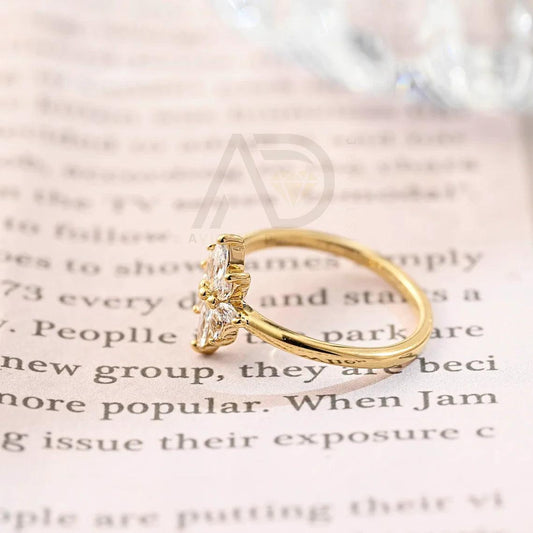
Three stones representing past, present, and future. It’s a meaning-rich design that also happens to look fantastic. The 2026 trend worth watching here is mixed-shape pairings, like an oval center stone flanked by pear-shaped side stones. This creates visual movement and avoids the uniform look of three identical cuts.
What makes it work:
- Built-in symbolic meaning makes it a natural anniversary or milestone gift
- The flanking stones add perceived width and presence
- Mixed shapes create a unique look that’s harder to replicate
- A strong choice for buyers stepping up from a simpler engagement ring
Tradeoffs to know:
- Three stones means three points of potential maintenance
- Mixed shapes require careful proportional matching (poor proportions look awkward fast)
- Takes up more finger real estate, which doesn’t suit all hand sizes
For the classic version of this design, a cushion-cut three-stone ring with pear accents nails the trending mixed-shape approach. If you want something you can personalize further, a customizable three-stone cushion-cut ring lets you select your metal and tweak the design.
6. Vintage-Inspired and Art Deco Rings
Best for: Lovers of old-world romance who want a ring that feels hand-crafted and one-of-a-kind.
The vintage trend continues to dominate moissanite ring jewelry in 2026. These designs pull from specific historical eras, combining milgrain edges, intricate filigree work, and antique cuts like Old European and Old Mine cuts. The result is a ring that looks like it could have been handed down through three generations but was actually made last month.
What makes it work:
- Milgrain and filigree details create visual texture that catches light differently than smooth metal
- Antique cuts (Old Mine, Old European) produce a softer, chunkier sparkle pattern that feels warm rather than icy
- Split-shank designs add architectural interest
- These rings photograph with enormous personality
Tradeoffs to know:
- Intricate metalwork traps dirt and requires more detailed cleaning
- Filigree elements are delicate and can snag on fabrics
- Antique cuts have fewer facets than modern brilliant cuts, so they sparkle differently (not less, just differently)
- Not everyone appreciates the old-world aesthetic; it’s polarizing
If antique cuts intrigue you, an old mine cut cushion moissanite ring delivers that hand-crafted, historical feel. For something more ornate, the vintage cushion-cut split-shank ring with halo and Art Deco paving is about as dramatic as this category gets.
7. East-West Setting Rings
Best for: Fashion-forward buyers who want a modern twist on familiar shapes.
Thanks partly to celebrities like Zendaya, setting elongated stones horizontally across the finger has become one of the most talked-about moissanite ring trends. An oval, emerald-cut, or marquise stone oriented east-west instead of the traditional north-south changes the entire visual dynamic of the ring. It’s unexpected. It reads as intentional and stylish.
What makes it work:
- Instantly modernizes any elongated stone shape
- Marquise moissanite is experiencing a major comeback specifically in east-west settings
- The horizontal orientation makes the finger appear wider and the stone more prominent
- Works beautifully as both an engagement ring and a standalone fashion piece
Tradeoffs to know:
- Not a traditional look, which means some people (parents, in-laws) may not “get it”
- Horizontal orientation can catch on things if the stone has pointed ends (marquise especially)
- Fewer ready-made options compared to vertical settings, so you may need to go custom or shop selectively
For a creative take that blends the east-west concept with other trends, an elongated cushion ring with compass setting and hidden halo shows how these ideas combine. The compass prongs rotate the stone 45 degrees, creating a diamond-shaped orientation that splits the difference between traditional and horizontal.
Our marquise cut ring guide covers the cut in more depth if you’re considering it for an east-west design.
8. Black Moissanite Rings
Best for: Buyers who want to make an unapologetic statement and break from convention.
This is the category that’s growing fastest in moissanite ring jewelry right now. One retailer reported black moissanite engagement ring searches up 340% since last winter. The appeal is obvious: black stones convey power, strength, and a kind of dramatic elegance that colorless stones simply can’t.
What makes it work:
- Striking visual contrast, especially in white gold or platinum-colored settings
- Symbolizes passion, unbreakable commitment, and individuality
- Stands out in every social media photo
- More affordable than black diamonds while maintaining the same visual impact
Tradeoffs to know:
- Black stones don’t show fire and brilliance the way colorless moissanite does (that’s the point, but know what you’re choosing)
- Limits pairing options for wedding bands since the stone is so visually dominant
- Not a traditional engagement ring look, which matters to some buyers
- Fewer metal/setting combinations look good with black (stick to white metals or rose gold for contrast)
The Asscher black moissanite engagement ring pairs the step-cut geometry of an Asscher with the drama of a black center stone, and it’s one of the most distinctive pieces in this category.
While colorless moissanite still dominates, 2026 is clearly the year of expressing individuality through color. Beyond black, stones in champagne, mint green, and sky blue are gaining traction among buyers who want something personal.
9. Cushion-Cut Moissanite Rings
Best for: Vintage-adjacent style seekers who want maximum fire in a romantic shape.
The cushion cut (sometimes called a “pillow cut”) features rounded corners and larger facets that produce incredible flashes of fire. It’s the cut that arguably showcases moissanite’s optical properties best, because those large facets throw rainbow light in a way that’s immediately noticeable and, frankly, gorgeous.
What makes it work:
- Rounded corners mean fewer sharp edges to catch on things
- Large facets create bold, dramatic light dispersion
- Versatile enough for solitaire, halo, and vintage settings
- Elongated cushion variants offer a more modern, slimming finger profile
Tradeoffs to know:
- Large facets also make inclusions or color tinting more visible (though moissanite is generally very clean)
- Cushion cuts can “face up” smaller than other cuts of the same carat weight
- The romantic, softer shape doesn’t appeal to buyers who prefer crisp geometric lines
For a cushion cut that combines multiple trending elements, the dazzling cushion moissanite with pavé and hidden halo bridges several styles into one ring.
10. Princess-Cut Moissanite Rings
Best for: Clean-line lovers who want a contemporary geometric look with serious sparkle.
The princess cut is the square counterpart to the round brilliant. It’s the second most popular cut for engagement rings overall, and for good reason: it combines sharp modern lines with excellent light performance. The pointed corners give it an architectural quality that round and cushion cuts lack.
What makes it work:
- Square shape appears larger face-up than round cuts of equivalent carat weight
- Contemporary and clean, pairs beautifully with minimalist band designs
- Works exceptionally well in channel settings where the squared edges sit flush
- Generally more affordable per carat than round brilliant cuts
Tradeoffs to know:
- Pointed corners are more vulnerable to chipping, so protective settings (like bezel or V-prong) are worth considering
- The square shape can look smaller on wider fingers
- Less “classic” than round, which may matter if traditional aesthetics are important
The princess cut shows up across many of the other style categories too. You’ll find it in halos, hidden halos, solitaires, and pavé designs, making it one of the most versatile cuts in moissanite ring jewelry.
11. Stackable and Eternity Bands
Best for: Collectors and milestone markers who want to build a curated set over time.
Stacking rings has moved from a niche jewelry habit to one of the defining trends of the decade. Moissanite, with its combination of affordability and brilliance, has become the natural stone of choice for building a serious stack. Buy one band for your engagement, add another for your wedding, a third for your first anniversary, and keep going.
What makes it work:
- Each band can represent a different milestone or memory
- Mixing metals (rose gold with yellow gold, or white gold with rose) has emerged as a dominant design preference
- Eternity bands with moissanite stones all the way around create a continuous sparkle effect
- Individual bands stay affordable, making this a collectible habit rather than a one-time financial commitment
Tradeoffs to know:
- Stacking multiple bands causes friction between rings, which wears down metal faster
- Full eternity bands can’t be resized (the stones wrap all the way around)
- Too many bands look cluttered on shorter fingers; three is usually the practical maximum
- Metal mixing only works if you commit to it; a single mismatched band looks accidental, not intentional
If you’re curious about how different ring styles pair together in a bridal set context, our guide on wedding bands and bridal sets covers compatibility and pairing strategy.
12. Custom-Designed Moissanite Rings
Best for: Couples who want something nobody else has, down to the last detail.
Custom moissanite rings are gaining real momentum in 2026 as buyers increasingly want designs that reflect their specific taste rather than picking from existing catalogs. The process has gotten much more accessible too. Many jewelers now accept reference images and work with you remotely to recreate or adapt a design.
What makes it work:
- Complete control over stone shape, size, metal type, and setting style
- Combine elements from different styles (say, an east-west marquise with a vintage-style filigree band)
- Engravings add a personal dimension no off-the-shelf ring can match
- Often more affordable than you’d expect, especially with moissanite as the center stone
Tradeoffs to know:
- The process takes longer than buying a ready-made ring (plan for several weeks)
- Communicating your vision accurately requires clear reference images
- Custom rings are harder to return or exchange since they’re made to your specifications
- The design process requires patience and back-and-forth communication
At Avittam, custom orders start at $150 with a 70/30 payment structure (70% upfront, balance before shipping). The process works through WhatsApp and email coordination, and you can send reference images to recreate or adapt any design you’ve seen.
Choosing the Right Metal for Your Moissanite Ring
This is one of the most overlooked decisions in ring buying, and it has a bigger impact on your ring’s look, feel, durability, and price than most people realize. Here’s an honest breakdown.
925 Sterling Silver is the most budget-friendly option, and it’s where many buyers start, especially for promise rings or everyday fashion pieces. Silver tarnishes over time and is softer than gold alloys, so it scratches more easily. But for a ring you’re wearing casually or testing out a style before committing to gold, it’s a smart entry point.
10K Gold (41.7% gold purity) gives you real gold at the most accessible price. The gold tone is more subtle than higher karats, and the higher alloy content actually makes it quite durable. If you want solid gold but the budget is tight, 10K is practical and honest.
14K Gold (58.5% gold purity) is the sweet spot, and it’s what most jewelers recommend for everyday rings. It strikes the best balance between color richness, durability, and price. Gold alloys at 14K and 18K resist daily wear, maintain their shape, and handle impact better than silver. For yellow and rose gold in particular, 14K gives you beautiful color without the softness of higher karat gold.
18K Gold (75% gold purity) delivers the richest, warmest gold color and the lowest sensitization potential for people with metal allergies. It’s the most luxurious option, but the higher gold content means it’s slightly softer than 14K. For daily wear, that means it’ll develop a patina faster, which some people love and others don’t.
Every moissanite ring at Avittam is available across these metal tiers, so you can see exactly how price changes as you move from silver to 18K gold on any design.
How to Keep Your Moissanite Ring Sparkling
Most moissanite ring jewelry articles skip this part entirely, but it matters. The cloudiness you occasionally see on moissanite comes from external buildup, not internal flaws. Soap residue, lotion, hairspray, cooking oil, and plain old dust stick to the surface and dull its sparkle over time.
The daily habit that prevents 60% of the problem: Apply hand cream, sunscreen, and perfume before putting on your ring, not after. This single change reduces surface contamination dramatically.
Weekly routine (30 seconds): Use a dry microfiber cloth to buff the top of the stone and the exterior of the band. This removes fingerprint oils before they oxidize.
Monthly deep clean: Soak the ring in warm water with a few drops of mild dish soap for 15 to 20 minutes, then gently brush with a soft toothbrush. Rinse under running water, pat dry.
When to take it off: Remove your ring before swimming in chlorinated water, before using household cleaners containing bleach or ammonia, before applying hair dye, and before heavy gardening or manual labor. One Hacker News user shared that they’d taken their wife’s moissanite rings to jewelry stores three times for cleaning or small stone replacement, and “every time I have to tell the jeweler that it is moissanite.” That’s how good these stones look when properly maintained.
What Makes Moissanite Different from Diamond (Quick Facts)
Readers shopping for moissanite ring jewelry expect this comparison, so here it is, briefly and honestly.
Moissanite is silicon carbide. Diamond is pure carbon. They are fundamentally different gemstones that happen to look similar at first glance. Moissanite has a refractive index of 2.65 compared to diamond’s 2.42, which means it actually produces more fire and light dispersion. That extra sparkle is the “rainbow flash” that distinguishes moissanite, while diamonds produce more white-spectrum light.
At 9.25 on the Mohs hardness scale (diamond is 10), moissanite is extremely scratch-resistant and suitable for daily wear. It retails at 60-75% lower price points than equivalent quality diamonds.
The honest downsides: moissanite has lower resale value than diamond. In larger stones (above 2 carats), some may display a faint yellow or green tint under certain lighting. And that rainbow fire, while beautiful, is noticeable to experienced diamond buyers who know the difference. All moissanite is lab-created, meaning no mining, no environmental disruption, and no conflict sourcing concerns.
For a more detailed comparison, our moissanite vs. diamond guide covers the full picture.
Users on finance and tech forums (Team Blind, AnandTech) often frame moissanite as a straightforward smart-money decision. The common refrain in those communities is blunt: “diamonds are a scam.” Whether or not you agree, the practical argument is hard to dismiss when you can get a visually indistinguishable stone for a fraction of the cost.
Frequently Asked Questions
How much does a moissanite ring cost?
A high-quality moissanite ring typically ranges from $150 to $2,500, depending on stone size, cut complexity, and metal choice. Sterling silver designs start at the low end, while 18K gold with larger center stones approaches the higher end. The metal you choose affects the price more than most people expect. At Avittam, prices range from $150 to $1,500 for moissanite rings across all metal tiers.
Can people tell the difference between moissanite and diamond?
In normal social situations, almost never. Moissanite’s slightly different light dispersion (more rainbow flash vs. diamond’s white flash) is only noticeable to trained eyes, and even then only under specific lighting. One user on Hacker News reported that professional jewelers couldn’t tell the difference without being told.
Is moissanite durable enough for an engagement ring?
Yes. At 9.25 on the Mohs hardness scale, moissanite is second only to diamond in scratch resistance. It’s harder than sapphire, ruby, and every other popular gemstone. It handles daily wear without issue.
What is the best metal for a moissanite ring?
14K gold offers the best balance of durability, color, and price for daily wear. 925 silver works well for budget-conscious buyers or occasional-wear pieces. 18K gold is ideal for those with metal sensitivities or who want the richest gold color. There’s no universally “best” choice; it depends on your budget and how you plan to wear the ring.
Does moissanite lose its sparkle over time?
No. Moissanite’s optical properties are permanent. Any cloudiness is caused by external buildup (oils, soap residue, lotions), not degradation of the stone itself. Regular cleaning restores full brilliance every time.
What are the most popular moissanite ring styles in 2026?
Hidden halos, vintage-inspired Art Deco designs, east-west settings, and black moissanite are all trending strongly. Stackable bands and mixed-shape three-stone rings are also seeing significant growth. The overall direction is toward personalization and individuality rather than following a single dominant trend.
Is 52% of buyers really preferring moissanite for bridal jewelry?
According to GLEEI.com research, 52% of surveyed buyers indicated they prefer moissanite specifically for bridal jewelry, and a broader 66% of US jewelry buyers are open to lab-created gemstones in general. This tracks with the industry growth numbers and the rapid expansion of moissanite-focused retailers.
Can I customize a moissanite ring?
Absolutely. Custom moissanite rings are increasingly common. Many jewelers accept reference images, and the process works remotely through digital communication. At Avittam, custom orders start at $150 with coordination through WhatsApp and email, and you can recreate designs from any reference image.
→ Ready to find your style? Explore the full collection with options across every metal tier and free worldwide shipping.