
TL;DR
An engagement ring is given at the proposal to symbolize a promise of marriage, while a wedding ring is exchanged during the ceremony itself. Engagement rings typically feature a prominent center stone and ornate settings, while wedding bands are simpler and built for everyday wear. Most couples still use both, though modern alternatives exist for every budget and lifestyle. A wedding band often costs just 10% of what you’d spend on the engagement ring.
The number of people who confuse their wedding ring and engagement ring, or assume they’re the same thing, is surprisingly high. Walk into any jewelry store and you’ll hear some version of the question: “Wait, I need two rings?” The answer is usually yes, but the reasons behind that answer, and the exceptions to it, are worth understanding before you spend a dime.
These are two different rings with two different jobs. One marks the question, the other marks the answer. Getting clear on their purpose, cost, style, and how they work together will save you from buying the wrong thing or overspending where you don’t need to.
Browse moissanite pavé engagement rings to see how modern designs balance brilliance with budget.
What Is an Engagement Ring?
An engagement ring is given during a proposal. It represents the promise of marriage, not the marriage itself. Think of it as the opening chapter.
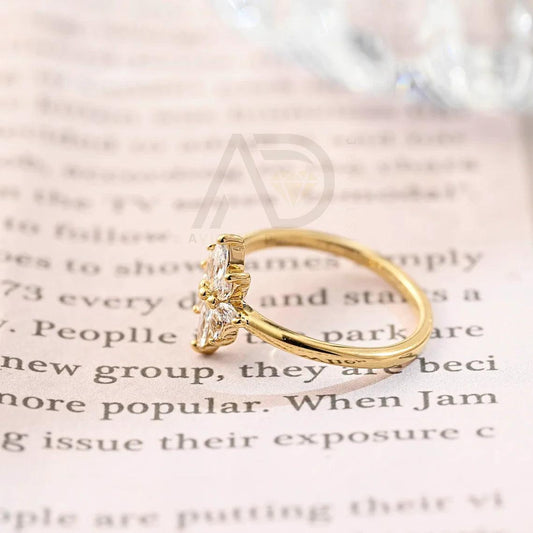
Design-wise, engagement rings are meant to be showstoppers. They feature a prominent center stone, whether that’s a diamond, moissanite, sapphire, or another gemstone, set in an elaborate mounting. Solitaires, halos, hidden halos, pavé bands, three-stone settings, split shanks: these are all engagement ring territory. The goal is to highlight the center stone’s brilliance, and the setting exists to amplify that.
The tradition of diamond engagement rings traces back to 1477, when Archduke Maximilian of Austria gave Mary of Burgundy a diamond ring to mark their betrothal. Before that, engagement rings existed but weren’t necessarily diamond. The diamond-as-default is really only a few centuries old, and moissanite and lab-grown stones are now genuine alternatives that deliver comparable sparkle at a fraction of the cost.
Traditionally, only the person who was proposed to wears an engagement ring. That’s changing in Nordic countries and increasingly in the U.S. and U.K., but the convention still holds for most couples.
What Is a Wedding Ring?
A wedding ring (also called a wedding band) is exchanged during the ceremony itself. While the engagement ring says “I will,” the wedding ring says “I do.” It marks the official union.
The design philosophy here is different. Wedding bands lean toward simplicity and practicality because they’re worn every day, often for decades. Common styles include plain metal bands, eternity bands with stones all the way around, thin pavé bands, milgrain-edged bands, and engraved bands. They’re built to withstand daily wear, which means less protruding metalwork and fewer opportunities for a prong to catch on something.
Both partners typically wear wedding bands. That said, men’s wedding bands are a relatively modern invention. They only became mainstream during World War II, when soldiers wore bands as reminders of their wives back home. The custom stuck.
The history of wedding rings themselves goes much further back, roughly 5,000 years to ancient Egypt, where the unbroken circle symbolized eternity. The Romans later placed rings on the fourth finger of the left hand, believing a vein (the “vena amoris,” or vein of love) ran directly from that finger to the heart. Modern anatomy has debunked that, but the tradition remains charming and persistent.
For a deeper look at what distinguishes bands specifically, our guide on wedding band vs. wedding ring breaks it down further.
Key Differences at a Glance
| Feature | Engagement Ring | Wedding Ring |
|---|---|---|
| When given | At the proposal | During the wedding ceremony |
| Symbolism | Promise of marriage | Marriage fulfilled |
| Design | Ornate, center stone, elaborate setting | Simple, built for daily wear |
| Typical cost | ~$5,200 average | ~$1,200 (women’s) / ~$600 (men’s) |
| Who wears it | Traditionally the person proposed to | Both partners |
| Center stone | Yes, usually prominent | Optional, often none |
The cost gap is the detail that surprises most people. A wedding band’s price is often just a fraction of the engagement ring’s, sometimes as low as 10% of the total cost. A couple spending $5,000 on an engagement ring might spend $500 to $600 on the matching band. That’s useful to know when you’re budgeting for everything at once.
If you’re drawn to ornate engagement ring designs, a vintage halo moissanite ring shows how much design complexity is possible without a diamond-level price tag.
How to Wear Both Rings Together
The traditional stacking order is straightforward: the wedding band goes on first (closest to your heart), and the engagement ring sits on top. This isn’t a rule anyone enforces, but it’s the convention most jewelers will mention.
During the wedding ceremony itself, many brides move their engagement ring to the right hand temporarily. That way, the wedding band slides onto the left ring finger during the vow exchange, and afterward, the engagement ring goes back on top. Some people find this fussy and skip the switch entirely. Others keep the rings on separate hands permanently.
Jeweler Jillian Sassone, quoted by The Knot, put it well: “Some clients move their jewelry from hand to hand, and some even wear them on a chain around their neck if they work with their hands often.” There’s no wrong answer.
A few other approaches worth knowing:
Soldering the rings together. A jeweler can permanently fuse the engagement ring and wedding band into one piece. This eliminates spinning and shifting but means you can’t wear them separately.
Enhancer or jacket rings. These are wedding bands designed to wrap around the engagement ring, creating a single unified look. They avoid the stacking gap problem entirely because the engagement ring slots inside the wedding ring.
The stacking gap problem. This is real and underappreciated. When couples buy their engagement ring and wedding band from different sources, the profiles often don’t align. A contoured shank on the engagement ring leaves a visible gap against a straight-profile band. If you’re planning to stack, a straight-shank engagement ring is the most forgiving for later pairing. Or buy both from the same jeweler who can ensure a flush fit.
For guidance on which hand and finger to use across different cultures, check out our article on what hand the wedding ring goes on.
Do You Actually Need Both?
Strictly speaking, no. But most people get both anyway. Studies show that over 90% of couples who propose and marry do so with all ring traditions intact. The idea that modern couples are ditching rings is more narrative than reality. They’re choosing differently, not choosing less.
That said, there are perfectly good reasons to use a single ring. Some couples repurpose the engagement ring by adding an engraving after the ceremony. Others prefer a minimalist approach, especially people who work with their hands, and a single sturdy band serves both purposes. Budget is another honest factor. If you’d rather put money toward the honeymoon or a house down payment, one ring does the job.
In Japan, many women replace their engagement ring with the wedding ring for daily wear, reserving the engagement ring for special occasions. Plenty of Western couples have quietly adopted this same approach.
Bridal Set vs. Buying Separately
A bridal set is an engagement ring and matching wedding band designed and sold together. A wedding set (sometimes called a trio set) includes both of those plus the groom’s band.
The case for buying a set: Cost savings of roughly 5 to 15% compared to purchasing each ring individually. Because the two rings are designed as partners, they sit flush against each other without spinning or shifting. No stacking gap. No guesswork.
The case for buying separately: Creative freedom. You might want a very specific engagement ring now and a contrasting band later. Buying separately also lets you defer the wedding band expense. Many couples are engaged for a year or more, and that’s money you can allocate elsewhere in the short term.
Practitioners on Reddit frequently mention that buying the engagement ring first, then bringing it to a jeweler to custom-match a band, gives the best result for people who want a curated but not matchy-matchy look. The risk is that some engagement ring profiles (especially curved or cathedral settings) make finding a compatible band harder than expected.
If you’re considering a customizable three-stone ring, planning ahead for the band pairing is especially important since three-stone settings tend to have wider heads that narrow bands can’t always sit flush against.
Cost Comparison: Engagement Rings vs. Wedding Bands
According to The Knot’s 2024 Jewelry and Engagement Study, the average engagement ring in the U.S. costs about $5,200. That number has actually been declining, down from $6,000 in 2021 and $5,800 in 2022. Women’s wedding bands average around $1,200, and men’s plain metal bands sit near $600.
On the natural diamond side, the picture looks different. The Natural Diamond Council reported that the average engagement ring price rose 9% in 2025 to $7,364 for natural stones. The gap between natural and lab-grown is now substantial: lab-grown diamonds cost about 50% less than natural counterparts of comparable quality ($5,188 vs. $10,760 on average).
Moissanite pushes costs lower still, with comparable visual brilliance. Budget-conscious shoppers on YouTube and Reddit consistently report that choosing moissanite for the center stone freed up budget for a nicer metal, a better band, or savings for other priorities. The stigma around non-diamond center stones continues to erode, particularly among Gen Z and younger Millennials.
And that “three months’ salary” rule for engagement rings? Pure marketing. It was a mid-20th century advertising campaign, never a genuine cultural tradition. Spend what makes sense for your finances.
For a thorough breakdown of how moissanite stacks up against diamonds on price and sparkle, see our moissanite vs. diamond comparison.
Ring Traditions Around the World
Most articles about the wedding ring and engagement ring stop at the Western tradition, which is a missed opportunity. Ring customs vary wildly, and knowing about them can inform your own choices.
Western tradition. Left hand, fourth finger. Based on the Roman belief in the vena amoris. Still the default in the U.S., U.K., France, and most of the Americas.
Eastern Europe. In Poland, Russia, Greece, and parts of Austria and Germany, both engagement and wedding rings are worn on the right hand instead of the left.
Nordic countries. In Sweden, Norway, Iceland, Finland, and Denmark, both partners exchange and wear engagement rings, typically simple gold bands. This is one of the more egalitarian ring traditions out there.
India. Engagement rings are traditionally worn on the right hand. In Hindu cultures, brides often wear toe rings called “Bichiya” rather than finger rings to represent marriage. Modern Indian brides increasingly combine both traditions.
Argentina. Both partners wear a silver engagement ring during the engagement. At the wedding, they swap the silver for gold bands. Diamond engagement rings aren’t common.
Ireland. The Claddagh ring is worn differently depending on relationship status: heart pointing outward means you’re single or looking, heart pointing inward means you’re taken or married.
These traditions prove there’s no single “right” way to handle rings. If wearing your wedding ring on your right hand or skipping the engagement ring entirely feels right, you’re in good historical company.
Modern Trends Worth Knowing
A few shifts are reshaping how couples think about their engagement ring and wedding ring:
Yellow gold is back. Yellow gold engagement rings now appear in 36% of all engagement rings, up from just 9% in 2017. For years, white gold and platinum dominated. That era appears to be ending, with yellow and rose gold gaining ground rapidly.
Round still dominates, but ovals are surging. Round brilliant cuts account for 62% of all engagement ring sales, with oval at 14% and growing. Cushion, princess, and emerald cuts hold steady behind them.
Personalization over convention. Millennials and Gen Z consumers favor unique rings, often incorporating colored gemstones, unconventional cuts, or bespoke design elements. The era of “everyone gets the same solitaire” is fading.
Moissanite and lab-grown acceptance. These alternatives have moved from fringe to mainstream. Couples who would have felt self-conscious about a non-natural diamond five years ago now openly share their choices online. The savings are too significant to ignore for many households.
Explore moissanite bridal set options that pair engagement rings and wedding bands designed to sit flush together.
FAQ
Can one ring serve as both an engagement ring and wedding ring?
Absolutely. There’s no law requiring two rings. Some couples use a single ring for both purposes, adding an engraving or upgrading the setting after the ceremony. This works especially well for people who prefer a minimalist look or have jobs where bulky jewelry is impractical.
Which ring goes on first when stacking?
The wedding band goes on first, closest to your heart, with the engagement ring on top. This is convention, not a requirement. Some people reverse the order, and some wear them on different hands entirely.
Do men wear engagement rings?
In Nordic countries, it’s standard for both partners to wear engagement rings. In the U.S. and U.K., male engagement rings are growing in popularity but still uncommon. There’s no reason a man can’t wear one. It’s simply a matter of preference.
Can you mix metals between the engagement ring and wedding band?
You can, and many people do. Mixing yellow gold with white gold or rose gold creates visual contrast that looks intentional when done well. The practical concern is that softer metals (like yellow gold) may wear faster against harder ones, but this takes years to become noticeable.
Should the engagement ring and wedding band match perfectly?
Not necessarily. Matched sets look cohesive and sit flush, but intentionally mismatched pairs can look striking. The most important thing is that the two rings physically fit together without a gap or wobble. If they sit flat against each other, the aesthetic is up to you.
What is an eternity ring, and when does it come in?
An eternity ring (or anniversary ring) features stones all the way around the band. It’s typically given on a milestone anniversary, not at the wedding. Some couples use an eternity band as their wedding ring, which works perfectly well but blurs the traditional lines a bit.
How much should I spend on a wedding band compared to the engagement ring?
Wedding bands typically cost a fraction of the engagement ring. Industry data puts the average at about $1,200 for women’s bands and $600 for men’s, compared to $5,200 for the average engagement ring. That roughly 10% to 25% ratio holds across most price points.
Is moissanite a good choice for an engagement ring?
Moissanite scores 9.25 on the Mohs hardness scale (diamond is 10), has more fire and brilliance than diamond in many lighting conditions, and costs significantly less. For couples who prioritize sparkle and durability over the diamond label, it’s one of the strongest options available. Read more in our guide on moissanite vs. diamond.
Explore the full collection of engagement rings at Avittam Diamond Jewels, available in 925 sterling silver and solid 10K, 14K, or 18K gold with free worldwide shipping.